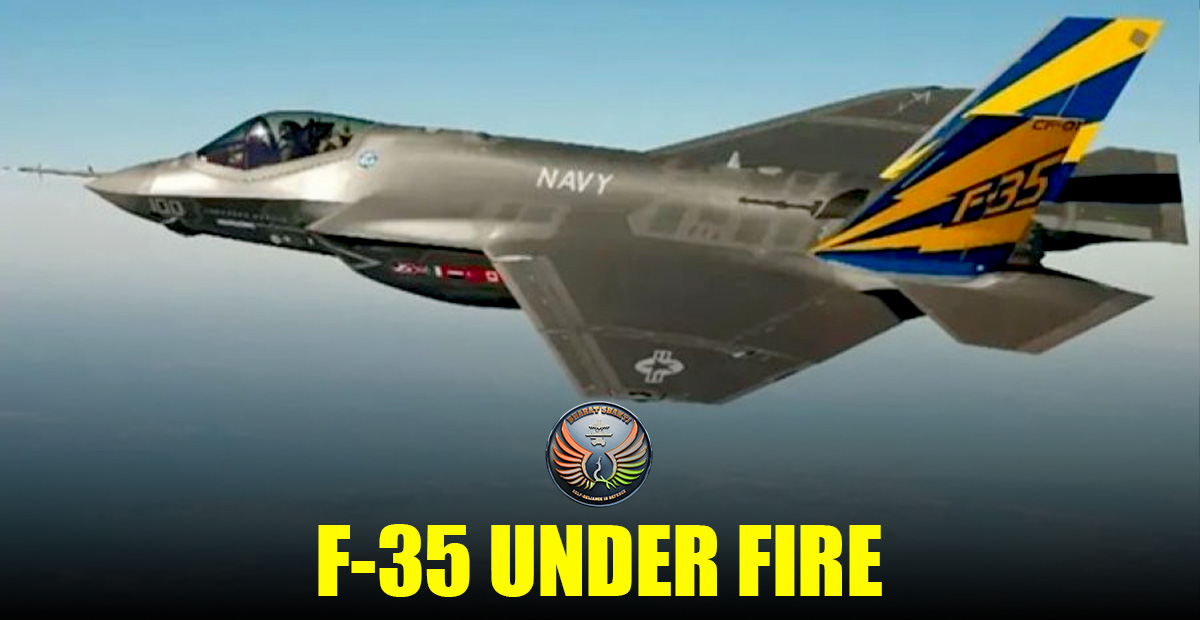
As the United States intensifies its pitch to sell the F-35 stealth fighter to India, the aircraft’s reliability has once again come under scrutiny. On Wednesday, a U.S. Navy F-35C crashed near Naval Air Station Lemoore in California, marking yet another mishap in a growing list of accidents involving the world’s most expensive fighter jet.
The pilot managed to eject safely, and the U.S. Navy has launched an investigation into the incident. The F-35 was assigned to Strike Fighter Squadron VF-125, also known as the “Rough Raiders”, a training unit responsible for preparing pilots to operate this fifth-generation aircraft.
This latest crash has raised renewed concerns among global observers, including within India’s strategic community, about the aircraft’s safety, operational readiness, and cost-effectiveness.
F-35: Crashing, Grounded, and Caught on Radar
This incident follows a series of F-35-related embarrassments. In June, an F-35B operated by the British Royal Navy remained grounded at Trivandrum International Airport in Kerala for over a month due to a technical failure. The $110 million stealth jet — considered one of the most advanced in the world — had been forced to land unexpectedly during operations in the Arabian Sea.
Initially attributed to a fuel issue, the grounding was later confirmed to be due to a critical systems fault, leading to prolonged downtime in a non-NATO country. The situation gained global attention not only for the operational failure but also for a more significant reason: Indian defence systems reportedly detected the stealth aircraft.
India’s Integrated Air Command and Control System (IACCS) tracked the F-35 flying over the Arabian Sea, raising questions over the aircraft’s radar evasion capabilities, the very feature Lockheed Martin and U.S. officials repeatedly claim makes the jet unique.
The incident embarrassed both the U.S. and British militaries, particularly as the F-35 is marketed globally for its unmatched stealth and interconnectivity in multi-domain operations.
A Pattern of Failures
The California crash is not an isolated incident. Since 2018, there have been at least 15 major accidents involving various versions of the F-35 across the U.S. military and allied forces. In January 2024, another F-35A crashed at a U.S. Air Force base in Alaska, leading to further questions about reliability, maintenance costs, and the pressure it puts on ground crews.
Even tech entrepreneur Elon Musk has publicly criticised the jet, calling it “junk” and pointing to its over-engineered systems and poor agility in modern air combat scenarios. Musk has suggested that the U.S. should focus on next-generation, unmanned or AI-assisted fighters, further fuelling the debate on whether the F-35 represents cutting-edge innovation or an expensive dead end.
Implications for India
The U.S. has been actively lobbying India to consider the F-35A, especially as the Indian Air Force (IAF) faces a fighter squadron deficit and delays in the AMCA program. However, New Delhi has been firm in its stance, there are no formal talks, and India remains focused on indigenous development and co-production, not off-the-shelf imports.
Moreover, recent geopolitical strains — including U.S. trade tariffs on Indian goods — have further complicated any large-scale defence acquisitions from Washington.
Global Buyers on Alert
The F-35 program includes over 20 partner nations, including Britain, Israel, Italy, Japan, and Australia. While its stealth, networking, and electronic warfare systems are frequently praised, operational downtime and maintenance bottlenecks have raised concerns among several of these buyers.
According to open-source tracking and media reports, mission-capable rates for the F-35 across various fleets have often fallen below 60%, far from the reliability expected of a frontline fighter.
A Shiny Jet with Dented Credibility
The F-35 may be the most expensive fighter in the world, but its track record of crashes, technical failures, and over-promised stealth continues to dent its credibility, especially in countries like India that seek autonomous capabilities, not just elite status.
With another crash now on record, India’s cautious stance appears vindicated. For a nation that values strategic autonomy and operational readiness, the F-35’s high cost and inconsistent performance make it a hard sell, no matter how shiny the brochure.
Team BharatShakti