






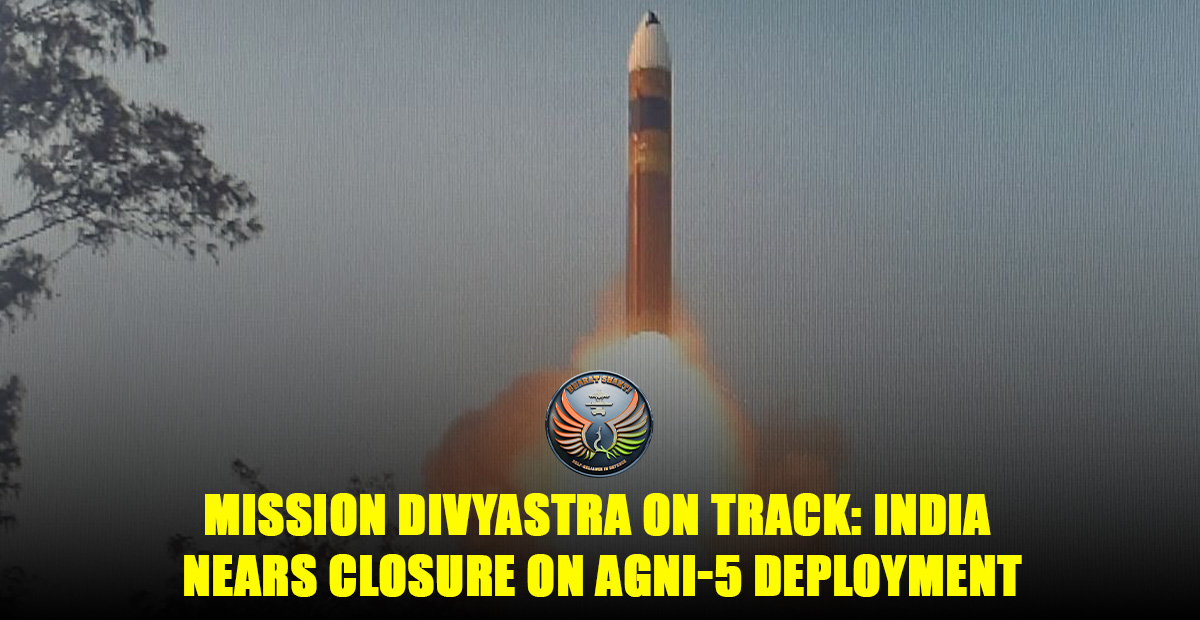
India’s quest for a credible, survivable, and technologically advanced nuclear deterrent took a decisive step forward with the successful test of the Agni-5 ballistic missile equipped with Multiple Independently Targetable Re-entry Vehicle (MIRV) technology, which reinforced the operational readiness of its long-range strategic deterrent. Conducted under the Strategic Forces Command (SFC) on August 20, 2025, the trial validated precision targeting and full-spectrum operational parameters, marking a historic milestone for India’s strategic arsenal.
Building on Mission Divyastra
The test follows the landmark March 11, 2024 launch under “Mission Divyastra”, when Agni-5 first demonstrated MIRV capability. This enhancement allows a single missile to deploy multiple nuclear warheads against separate targets, complicating adversary missile defences and strengthening India’s second-strike credibility.
According to defence sources, the latest test represents the most advanced iteration of Agni-5 to date, showcasing reliable MIRV deployment and precision guidance, which is near deployment. It moves India closer to fielding an operational long-range deterrent capable of striking multiple, dispersed targets simultaneously.
The Apex of the Agni Family
Since its maiden test in 2012, the Agni-5 has matured into the crown jewel of India’s missile programme, bridging the gap between regional deterrence and true intercontinental capability.
- Range: 5,000+ km, covering almost all potential adversary targets.
- Propulsion: Three-stage solid-fuel system, enabling high efficiency and quick launch readiness.
- Launch System: Canisterised for mobility and rapid deployment.
- Payload: 1.5-tonne capacity, with MIRV integration for multiple warheads.
- Guidance: Hybrid system blending a ring laser gyroscope-based INS, micro-INS, and support from NavIC and GPS.
- Survivability: Lightweight composites, advanced re-entry heat shielding, and upgraded avionics enhance resilience against missile defences.
In contrast to earlier Agni series missiles, Agni-I and II are tailored for regional deterrence, Agni-III covers parts of China, and Agni-IV bridges mid-range capability – Agni-5 represents a qualitative leap, marrying ICBM-class reach with survivability, accuracy, and flexibility.
Strategic Impact
The successful test reinforces India’s credible minimum deterrence posture, core to its nuclear doctrine anchored in No First Use (NFU). By combining long-range, canister mobility, and MIRV flexibility, Agni-5 strengthens India’s second-strike capability – the assurance of retaliation even after a first strike.
Defence analysts suggest that the test signals steady, doctrine-consistent capability growth, not an escalatory move. Nevertheless, it compels adversaries to diversify their defences, acknowledging India’s technological maturity and restraint.
Regional Reactions: Agni Series vs Pakistan’s Ghauri Arsenal
The test comes amid heightened geopolitical tensions and in the aftermath of Operation Sindoor earlier this year.
In Islamabad, the Strategic Vision Institute (SVI) warned that a MIRV-capable Agni-5 poses a “serious challenge to regional stability,” urging Pakistan’s leadership to rally international attention. With Pakistan’s Ghauri missile series limited to 1,350–2,300 km range and reliant on single-stage, liquid-fuel designs without MIRV capability, the technological gap between the two rivals is widening.
Strengthening the Triad
Agni-5’s MIRV capability plugs a critical gap in India’s nuclear triad, complementing:
- Sea-based deterrence: submarine-launched ballistic missiles (SLBMs).
- Air delivery systems: fighter-bombers equipped with gravity bombs.
- Tactical assets: short-range systems like Pralay and Prithvi-II.
It ensures survivability across all legs of the deterrent, reinforcing India’s ability to retaliate decisively.
The Road Ahead
India’s missile programme is unlikely to pause here. Future watchpoints include:
- Agni-VI development, expected to extend range to 8,000–10,000 km with up to 10–12 MIRVs.
- Integration of penetration aids to outsmart layered missile defences.
- Advanced targeting systems designed for hardened or underground installations.
Taken together, these steps reflect India’s resolve to sustain a robust, flexible, and technologically superior deterrent – not for aggression, but to anchor stability through strength.
Huma Siddiqui