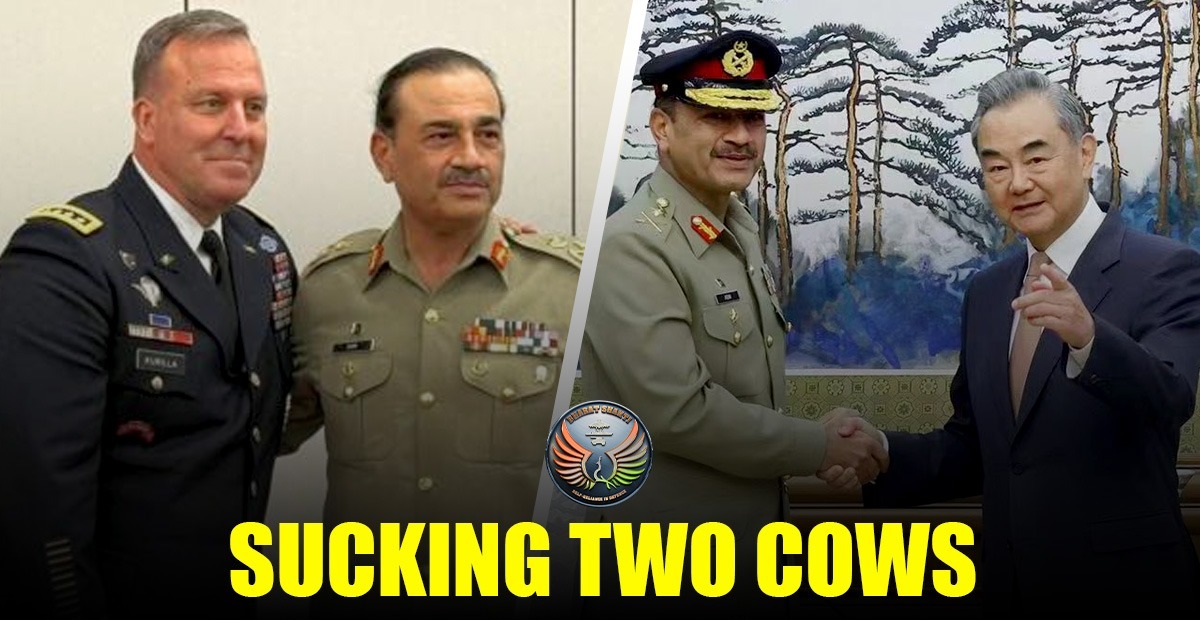
Islamabad exemplifies 21st-century non-alignment. It is maintaining a “phenomenal partnership” with America while fostering an “all-weather strategic cooperative partnership” with China. Like the Cold War-era non-aligned nations, winch the Polish economist Michał Kalecki described as “clever calves that suck two cows,” Pakistan is skilfully leveraging its geopolitical significance to secure military aid, economic investments, and diplomatic support from both Washington and Beijing.
This duality was unmistakable during Operation Sindoor, when Pakistan’s Air Force deployed Chinese jets and missiles while its diplomats negotiated a fresh IMF loan. Soon after, Field Marshal Asim Munir, Pakistan’s Army Chief, was hosted by President Donald Trump. Now, Munir made another visit to Washington. During his second visit, Munir attended the retirement ceremony of outgoing U.S. Central Command (CENTCOM) Commander General Michael E. Kurilla and the Change of Command Ceremony, welcoming Admiral Brad Cooper as the new Commander in Tampa, Florida. These engagements underscore Pakistan’s ongoing strategic partnership with the Pentagon. Islamabad and Washington have also concluded a bilateral trade agreement, which includes plans for joint development of Pakistan’s untapped oil reserves, a deal publicly confirmed by President Trump.
India’s influential American lobby has been caught off guard by the sudden Trump-Munir camaraderie. Given flourishing Indo-US ties, America’s Afghanistan withdrawal, and its Indo-Pacific pivot, most analysts assumed Pakistan had lost its strategic relevance to Washington. It is despite the first Trump administration’s decision to resume Pakistan’s participation in the U.S. International Military Education and Training (IMET) program in 2019, valued as part of a broader $2 billion security aid package suspended in 2018. America is nurturing Pakistani female military personnel’s participation in IMET courses. Fifty-five women attended IMET courses from 2020 to 2023, which is more than double the 22 women who participated from 2013 to 2019.
Yet New Delhi’s misreading of the US-Pakistan nexus stems from deeper analytical flaws. At its core, India’s narrative of Pakistan’s origins remains fixated on Jinnah’s leadership and religious nationalism, while largely ignoring the Cold War geopolitics that midwifed the nation’s creation.
Since 1947, Washington has consistently invested in Pakistan as a strategic bulwark against Soviet expansion – continuing the British imperial tradition of using the subcontinent as a Eurasian buffer. Its alignment was formalised through Pakistan’s 1955 membership in the Central Treaty Organisation (CENTO), the U.S.-backed military pact designed to contain Soviet influence across the Middle East.
From independence onward, Pakistan’s elites traded military independence for Anglo-American patronage. It created a rentier army that continues to serve Western interests – a reality often missed in analyses that exaggerate the autonomy of the ISI and Pakistan Army while underestimating Pakistan’s strategic role in global geopolitics.
The Western narrative framing terrorism as an exclusively Islamic phenomenon has blinded many Indians to jihad’s historical role as a geopolitical weapon. In World War I, Germany weaponised the Ottoman caliphate’s jihad call to destabilise the British Empire. In November 1914, the Ottoman Caliph declared jihad against the Allies, backed by German funding, arms, and propaganda. Berlin aimed to incite Muslim revolts across British India, French North Africa, and Russian Asia – including enemy troops – through translated fatwas and a network of 75 Ottoman propaganda hubs. Key targets were India and Egypt, where uprisings could cripple Allied forces. Expeditions from Kabul to India sought to spark local jihad.
During the Cold War, the U.S. recycled this playbook – through the ISI in Afghanistan – deploying jihadist proxies against Soviet forces. Even after 9/11, Pakistan extracted billions in U.S. military aid as a ‘frontline ally’ while sheltering Taliban leadership. The lesson remains unlearned – both Pakistan’s army and its jihadist infrastructure remain chess pieces in great power rivalries.
Although no conclusive evidence confirms China’s direct involvement with Pakistan’s jihadist networks, historical trends warrant reasonable suspicion. Similarly, Washington is likely to leverage Pakistan for its strategic objectives in Xinjiang or Iran. America has launched a campaign against Beijing for detaining almost a million Uyghurs and other Muslims in its crackdown in Xinjiang.
China’s continued investments in Pakistan – despite the apparent risks -reveal the broader struggle for Eurasian dominance. Beijing appears to be probing the boundaries of U.S. influence in a long-standing American client state that still hosts critical U.S. military installations. Through massive economic entanglements like CPEC, China seeks to gradually erode the ISI’s entrenched Western affiliations while gaining strategic access to the Indian Ocean. Trump’s recent courting of Munir may be a reassertion of American influence over Pakistan, sending a strong signal to Beijing and India.
In a strategic paradox, both Washington and Beijing leverage Pakistan to constrain India – the U.S. to maintain New Delhi’s military reliance on Western arms, China to divert Indian resources away from Indo-Pacific dominance. It places India in a strategic bind, caught between a near hegemon (China) and a distant empire (the U.S.). New Delhi’s ultimate challenge lies in manoeuvring through this triangular rivalry without becoming collateral in great power competition.
If China can pragmatically engage U.S.-aligned states, India too should explore calibrated outreach to Pakistan. Beijing sustains CPEC despite terrorist killings of its nationals, prioritising strategic connectivity over grievances. India could similarly leverage Pakistan’s geography to revive ancient Eurasian trade routes, unlocking Central Asian access while advancing regional stability. Perpetual hostility only perpetuates the subcontinent’s strategic stagnation.
Dr Atul Bhardwaj

Author is Visiting Research Fellow at School of Policy and Global Affairs, City St George’s, University of London