


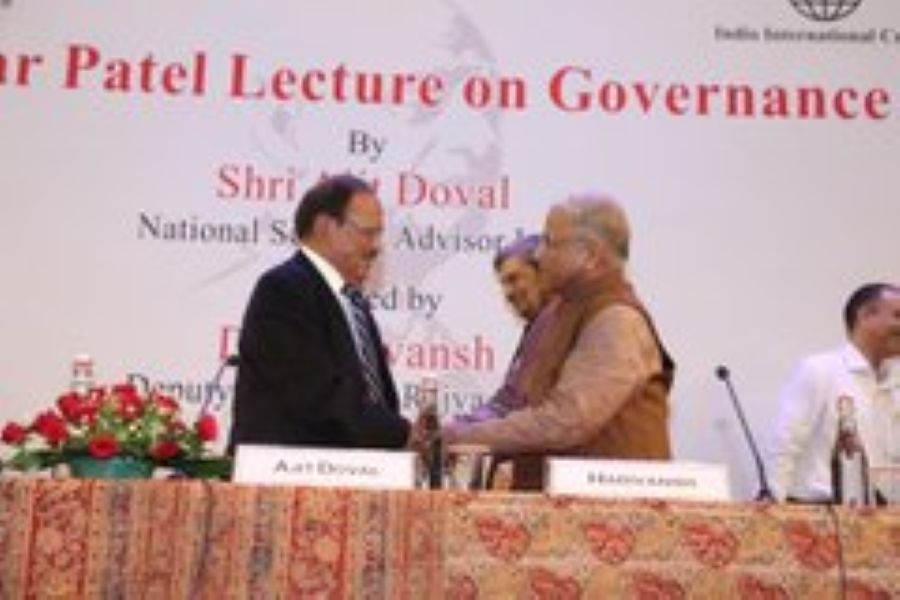
“No amount of power can hold a nation together if its people lose faith in governance. It is governance that makes a nation strong, secure, and prosperous.” National Security Advisor Ajit Doval delivered this warning at the Sardar Patel Memorial Lecture in New Delhi on October 31, where he argued that governance, more than military strength or resources, is the first line of national security.
He began by stressing that governance is the thread that connects security, prosperity and stability. “Governance,” he said, “is not just about laws and rules; it is about creating a system that ensures accountability, efficiency, and justice.” He argued that no state can remain secure or strong if its system of governance is weak.
In his speech, titled “Regime Changes, Shift In Global Order, Governance & Security,” he cited examples ranging from the Roman Empire to Tsarist Russia and the Mughals to illustrate that when governance weakened, internal rot set in and collapse followed. He described his point with figures from modern history, noting that after World War II, 37 countries had collapsed or fragmented. In 28 of those cases, “it was primarily the failure of governance.”
The lesson, he said, was simple yet profound: governance failure inevitably leads to instability.
For Doval, good governance means the ability to deliver justice, manage resources, and maintain internal security. “No amount of power can hold a nation together if its people lose faith in governance,” he cautioned. “It is governance that makes a nation strong, secure, and prosperous.”
He cited several key challenges: institutional decay, internal weaknesses, and economic mismanagement. A breakdown in institutions, he warned, could open the door to “non-institutional changes of regime” — but his larger point was that when governance deteriorates, nations begin to drift.
Turning to democracy, Doval acknowledged its many strengths but noted that it has also given rise to its own complications. “Democracy has created its own problems,” he said. “It has led to partisan politics where there are dividends in division.” He explained that politics often becomes a contest of fragmentation rather than consensus-building, and that this tendency “weakens governance, weakens the state, and weakens society.”
Doval defined the essence of modern governance as “the ability to deliver to the last man,” adding that good governance is not only about rules but about results. He called for a focus on integrity and competence within public institutions, warning that corruption or inefficiency can destroy people’s faith in the state.
He also underlined the role of technology as both an opportunity and a risk. “We have to exploit technology that ensures greater transparency, accountability and delivery of service to the common man,” he said, but added that the same technology brings new dangers. “We have to protect society from threats like cyber threats and many other threats that technology poses.”
Women’s empowerment, he said, must be treated as a central pillar of governance. “Empowerment of women is necessary for good governance in the modern new world,” Doval said. “It is not only important to have good laws, good structures and good systems, but more importantly, to implement them effectively.”
Referring to Sardar Patel, whose birth anniversary the lecture commemorated, Doval said Patel demonstrated the finest model of leadership and governance when he unified over 500 princely states after independence. “The most important thing,” he said, “is clarity of vision. The noise and threats do not sway you. You have to prepare yourself, you have to equip yourself.”
Doval described the present moment as one of “orbital shift,” not only in India’s governance structures but in its societal and global positioning. This transformation, he said, demands a renewed focus on institutional strength and visionary governance. “In the task of nation-building,” he concluded, “the most important are the people who build and nurture these institutions, because these institutions provide governance, and governance creates nations and powerful states.”
Ramananda Sengupta

In a career spanning three decades and counting, I’ve been the foreign editor of The Telegraph, Outlook Magazine and the New Indian Express. I helped set up rediff.com’s editorial operations in San Jose and New York, helmed sify.com, and was the founder editor of India.com. My work has featured in national and international publications like the Al Jazeera Centre for Studies, Global Times and Ashahi Shimbun. My one constant over all these years, however, has been the attempt to understand rising India’s place in the world.
I can rustle up a mean salad, my oil-less pepper chicken is to die for, and it just takes some beer and rhythm and blues to rock my soul.