






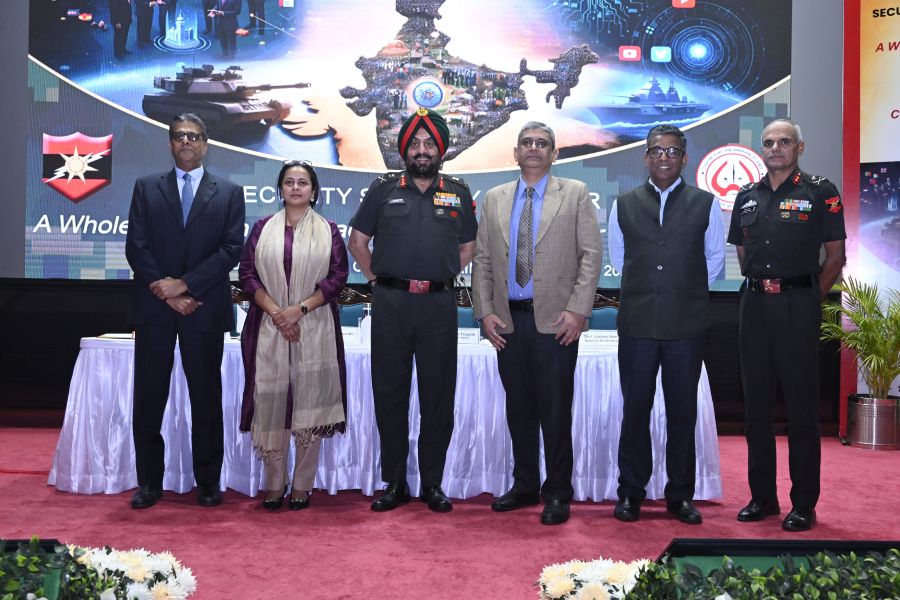
Against the backdrop of a rapidly evolving global security environment, the Indian Army’s Sapta Shakti Command, in collaboration with the Centre for Land Warfare Studies (CLAWS), hosted a first-of-its-kind Security Synergy Seminar on the theme “A Whole-of-Nation Approach (WoNA) to Counter Future Conflicts” at the Jaipur Military Station on 10–11 November.
Inspired by Prime Minister Narendra Modi’s guiding framework of JAI – Jointness, Atmanirbharta, and Innovation, the two-day seminar brought together an unusually broad spectrum of stakeholders, including senior military commanders, diplomats, bureaucrats, industry leaders, innovators, academics, media professionals, and over 150 university students. The event aimed to build consensus on how India can enhance its national resilience by integrating all instruments of national power—diplomatic, Informational, Military, and economic (DIME).
‘Security Must Become a Habit’: Lt Gen Manjinder Singh
Delivering the inaugural address, Lt Gen Manjinder Singh, Army Commander, Sapta Shakti Command, highlighted how contemporary conflicts, from the Russia–Ukraine war to the Israel–Hamas crisis, have demonstrated the blurring of conventional and non-conventional domains.
Future wars, he warned, would target not just armed forces but also economic systems, civil infrastructure, cyber, information networks and even citizens. As warfare becomes increasingly multi-domain and technology-driven, he stressed that true national resilience lies in the collective synergy of governance, industry and society at large.
“Security of the nation should become a habit and the soul of the nation,” he said, calling for seamless integration among all actors responsible for safeguarding India’s interests.
Four Sessions, One Objective: Building the WoNA Framework
Across four thematic sessions, the seminar examined the strategic imperatives of a Whole-of-Nation approach. It assessed how India can operationalise such a framework at both the national and state levels.
Day One focused on defining the WoNA concept, analysing emerging multi-domain threats, and identifying gaps in India’s existing security architecture.
Day Two focused on Information Warfare, highlighting the rapid weaponisation of information, the targeting of cognitive domains, and the need for national-level structures for information, cyber, and influence operations.
The concluding session used Rajasthan as a model case study, exploring how military–civil fusion can be institutionalised from the state level down to districts and tehsils.
Key Takeaways: Institutionalised Synergy, Cognitive Defence, Indigenous Capability
Participants converged on several critical priorities:
- Closing gaps in inter-agency coordination through institutionalised mechanisms.
- Strengthening national-level cognitive defence architectures.
- Building indigenous technological capabilities to reduce vulnerabilities in the information domain.
- Harnessing emerging technologies for influence operations.
- Cultivating a resilient national mindset capable of countering misinformation and hostile narratives.
On the Rajasthan model, stakeholders agreed on the need for further deliberations to identify key verticals where civil–military collaboration can be deepened. A state-level WoNA model is expected to be developed for potential replication across other states.
Towards Atmanirbhar and Viksit Bharat 2047
Beyond security, the seminar highlighted how national preparedness is deeply intertwined with India’s developmental goals under Atmanirbhar Bharat and the vision of Viksit Bharat 2047. The forum effectively acted as a launchpad for shaping an integrated national security framework that aligns military modernisation with societal, industrial and technological progress.
By bringing together diverse voices under one roof, the Sapta Shakti Security Synergy Seminar provided a pragmatic blueprint for strengthening India’s resilience and self-reliance in an era of unpredictable and hybrid threats, reaffirming that a Whole-of-Nation and Whole-of-Government approach is not just desirable but essential.
Team BharatShakti