


Pakistan is trying to turn a brief air war with India into a long-term business opportunity. Its military and political elite now speak less about battlefield outcomes and more about markets, buyers, and leverage.
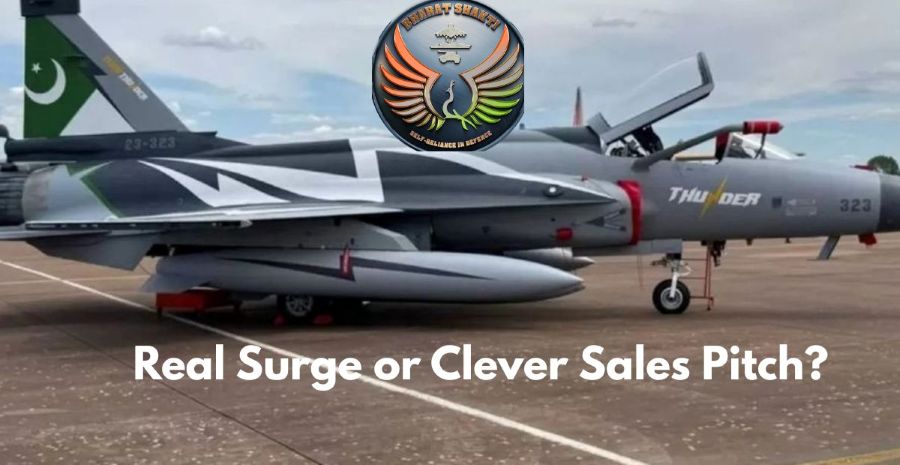
At the centre of this push is the JF-17 Thunder fighter jet. Pakistani officials describe it as “combat-tested”. They market it as cheap, flexible, and politically convenient. The message is clear. You can buy Western jets, or you can buy ours without lectures.
From the Gulf to Africa and Southeast Asia, Pakistan is pitching the JF-17 as a lower-cost alternative to US and European platforms. The pitch is not just about price. It is about politics. Many states dislike the conditions attached to Western arms sales. Islamabad is selling itself as the no-strings-attached option.
The sales drive surged after Operation Sindoor in May 2025. The clash remains disputed. Losses are contested. But for Pakistan, facts mattered less than narrative.
Islamabad seized the moment. It recast the JF-17 from a “budget jet” to a frontline fighter. The Block III version is jointly developed with China’s Chengdu Aircraft Corporation and assembled in Pakistan. Officials now describe it as capable of high-intensity combat.
Reuters noted that Pakistan is “aggressively marketing” the aircraft across the Middle East and Africa, even as hard contract details remain scarce. Most leads still come from unnamed officials rather than signed deals.
Pakistan’s Defence Production Minister Raza Hayat Hiraj told the BBC that talks were “underway” with several countries. He refused to name them, calling the negotiations “protected secrets”.
Combat vs credibility
The India clash provided Pakistan something money cannot buy – a story.
Islamabad claims its jets downed at least one Indian Rafale. New Delhi has stayed silent. The claim remains unproven. But in the arms market, perception often sells better than proof.
Before this, the JF-17 struggled to shake its image as a poor man’s fighter. Now, Pakistani officials say it proved itself under fire.
Pakistan has already sold the jet to Azerbaijan, Myanmar, and Nigeria. Indonesia has held talks. Bangladesh is reassessing defence ties after Sheikh Hasina’s ouster in 2024. Iraq has shown “keen interest” after a high-level visit by Pakistan’s Air Chief, according to state-run PTV.
Africa is where the strategy is most visible. Reuters reported that advanced talks with Sudan are underway on a $1.5bn defence package. It includes JF-17 Block III fighters, K-8 attack aircraft, and over 200 drones. The deal would strengthen Sudan’s army in its brutal civil war.
Libya has also emerged as a potential partner, signalling a shift from simple sales to deeper defence ties.
The Saudi pivot
The biggest prize is Saudi Arabia.
Islamabad and Riyadh recently signed a Strategic Mutual Defence Agreement. It followed an Israeli strike on Doha in September. The pact treats an attack on one as an attack on both.
Reuters reported discussions on converting $2bn in Saudi loans into an order for JF-17 jets. Pakistan’s foreign ministry says it is “unaware” of any formal deal. But senior-level meetings suggest otherwise.
Pakistan’s air chief has already visited Riyadh to meet the commander of the Royal Saudi Air Force.
Saudi Arabia already operates F-15s and the US-made THAAD missile defence system. Washington has even approved potential F-35 sales. So why the JF-17?
Defence analyst Ayesha Siddiqa was blunt. “Saudi Arabia already has top-of-the-line aircraft,” she said. “It does not really need the JF-17.” She added that the move is “about supporting Pakistan and building a strategic hedge.”
That hedge reflects Saudi unease with the United States. Washington’s muted response to the 2019 Houthi attacks, the drawdown of missile defences, and reduced support in Yemen have shaken Riyadh’s confidence, CSIS noted in an October report.
Bloomberg reported that Turkey is in “advanced” talks to join this emerging defence framework, hinting at a wider regional realignment.
China’s shadow
Behind every JF-17 deal stands China.
Nearly half of the aircraft’s critical components come from Chinese suppliers. Beijing must approve every export. Pakistan cannot sell alone.
Minister Hiraj admitted this openly to BBC Urdu. “Some components are made in China,” he said. “So China will be part of any third-party agreement.”
Analysts say this makes Pakistan a “buffer seller” for Beijing. Many countries want Chinese tech but fear Western backlash. Buying via Pakistan softens the optics.
Capacity questions
The moot question: Is Pakistan’s export capacity real and credible?
Myanmar bought 16 jets in 2015; however, by 2023, the majority of those aircraft were reportedly grounded due to persistent issues with engines, avionics, radar, and airframe fatigue. Relations between Myanmar and Pakistan reportedly soured, forcing China to step in to manage technical fallout. Unverified reports in 2025 even suggested that one JF-17 may have been shot down, further damaging the aircraft’s credibility.
Nigeria inducted its first in 2021. Azerbaijan signed a $1.6bn deal in 2024 for 16 jets, later expanded to 40. Its first Block III batch entered service in late 2025.
Yet doubts linger.
One analyst put it simply. “France makes only 24 or 25 Rafales a year.” The question follows. “How will Pakistan mass-produce JF-17s if orders flood in?”
For now, Pakistan’s boom is more promise than production. The India clash gave it a story. China gives it technology. But capacity, not rhetoric, will decide whether this becomes a real arms surge or just a clever sales pitch.
Ravi Shankar

Dr Ravi Shankar has over two decades of experience in communications, print journalism, electronic media, documentary film making and new media.
He makes regular appearances on national television news channels as a commentator and analyst on current and political affairs. Apart from being an acknowledged Journalist, he has been a passionate newsroom manager bringing a wide range of journalistic experience from past associations with India’s leading media conglomerates (Times of India group and India Today group) and had led global news-gathering operations at world’s biggest multimedia news agency- ANI-Reuters. He has covered Parliament extensively over the past several years. Widely traveled, he has covered several summits as part of media delegation accompanying the Indian President, Vice President, Prime Minister, External Affairs Minister and Finance Minister across Asia, Africa and Europe.