As Bangladesh goes to the polls today, the question of whether Pakistan is poised for a strategic return to Dhaka has taken on sharper urgency, driven not only by recent policy shifts under the interim government but also by intelligence-linked reporting on the forces behind the political upheaval that ended Sheikh Hasina’s rule.
In a detailed report a day after Prime Minister Sheikh Hasina’s ouster in August 2024, India Today, citing Bangladeshi and Indian intelligence sources, said officials in Dhaka have claimed to possess evidence of meetings between Tarique Rahman, the Acting Chief of the Bangladesh Nationalist Party, and officials of Pakistan’s Inter-Services Intelligence (ISI) in Saudi Arabia.
The report further stated that intelligence assessments suggest a “blueprint for regime change” in Bangladesh was drafted in London in collaboration with the ISI, amid the protests over the quota system that eventually led to the fall of the Hasina government.
According to these assessments, Pakistan’s military and intelligence establishment sought to destabilise Hasina and facilitate the return of the BNP, long regarded as pro-Pakistan.
India Today also reported claims that Chinese involvement, routed through ISI-linked channels, contributed to the escalation of unrest, alongside coordinated social media activity, including hundreds of anti-Hasina posts originating from Pakistani-linked accounts.
While these allegations remain contested and untested in open judicial processes, their circulation in a mainstream Indian publication has significantly shaped how New Delhi’s security establishment interprets Bangladesh’s political transition.
They form the backdrop against which subsequent developments—particularly Dhaka’s rapid diplomatic and economic outreach to Pakistan—are now being assessed.
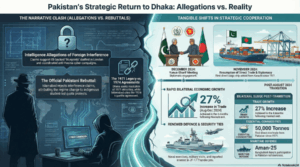
Against this backdrop, the interim administration led by Muhammad Yunus has enacted a policy shift that materially alters Bangladesh’s regional posture. In a compressed time frame, Dhaka has restored senior-level political engagement with Islamabad, revived direct maritime trade routes, and diluted institutional barriers that had long constrained Pakistan’s access to Bangladesh’s economic and logistical ecosystem. These moves have changed facts on the ground, ensuring that any incoming government inherits not a neutral foreign policy baseline, but a recalibrated strategic environment.
What amplifies the significance of this shift is the electoral context itself. Both principal political forces contesting today’s vote—the BNP and Jamaat-e-Islami Bangladesh—carry historical reputations for pro-Pakistan positioning and pronounced scepticism towards India’s regional role. Past BNP governments pursued closer engagement with Islamabad, while Jamaat’s ideological lineage and organisational networks have consistently favoured Pakistan and opposed Indian influence.
Unlike the Awami League, which institutionalised strategic alignment with New Delhi and treated Pakistan as a contained interlocutor, these forces have traditionally viewed engagement with Islamabad as ideologically legitimate and strategically advantageous.
Under Sheikh Hasina, Bangladesh’s foreign and security posture functioned as a firewall. Military-to-military contact with Pakistan was effectively frozen, intelligence cooperation tightly circumscribed, and economic engagement deliberately limited to prevent security spillovers. The unresolved legacy of the 1971 Liberation War operated not only as historical memory but as a structural barrier against Pakistani re-entry into Bangladesh’s political and institutional space.
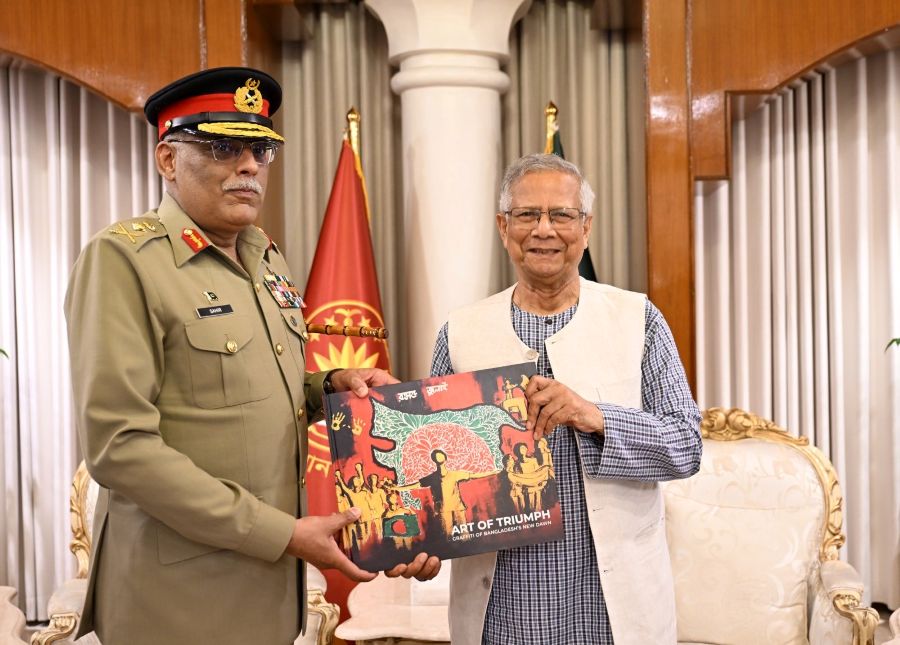
That firewall has now weakened. While the Yunus administration continues to reference unresolved 1971 issues, it has reframed engagement with Pakistan as functional rather than exceptional. This recalibration was signalled early through Yunus’s outreach to Pakistan’s prime minister Shehbaz Sharif, followed by diplomatic normalisation that moved quickly from symbolism to operational outcomes.
The most sensitive shift has occurred at sea. The revival of a direct maritime route between Karachi and Chittagong Port, dormant for more than five decades, carries implications well beyond trade.
Pakistani cargo vessels are once again entering Bangladeshi waters directly, bypassing third-country trans-shipment hubs that previously provided buffers and oversight. The easing of inspection and clearance procedures for Pakistani shipments has heightened attention in New Delhi, particularly given Chittagong’s proximity to India’s northeastern states and its strategic location in the Bay of Bengal.
Security engagement, while publicly understated, has also crossed psychological thresholds. No defence agreements have been announced, but official language now stresses institutional contact and confidence-building rather than strategic distance. Under Hasina, even limited military-to-military interaction with Pakistan was politically unacceptable due to intelligence concerns. Under the interim government—and with BNP-Jamaat forces electorally competitive—such engagement becomes conceivable, and potentially durable.
For India, the concern is cumulative rather than episodic. An interim leadership sceptical of Indian influence, electoral contenders historically aligned with Pakistan, reopened maritime access points, and intelligence-linked allegations of prior external involvement together create conditions under which Pakistani influence could regain strategic footholds lost over the past decade. The India Today report has reinforced the perception in New Delhi that the current convergence is not merely coincidental, but structurally consequential.
What is unfolding, therefore, is not a formal alliance shift but a reopening of strategic space at a moment of political flux. Dhaka no longer treats Pakistan as a contained or exceptional actor, but as a normalised interlocutor with expanding access—commercial, diplomatic and potentially institutional.
As Bangladesh votes today, the central question is whether this recalibration will be arrested by the electoral outcome or entrenched by it. Either way, the Pakistan factor has returned to the centre of Bangladesh’s politics—and India is watching closely.
Ramananda Sengupta

In a career spanning three decades and counting, I’ve been the foreign editor of The Telegraph, Outlook Magazine and the New Indian Express. I helped set up rediff.com’s editorial operations in San Jose and New York, helmed sify.com, and was the founder editor of India.com. My work has featured in national and international publications like the Al Jazeera Centre for Studies, Global Times and Ashahi Shimbun. My one constant over all these years, however, has been the attempt to understand rising India’s place in the world.
I can rustle up a mean salad, my oil-less pepper chicken is to die for, and it just takes some beer and rhythm and blues to rock my soul.