


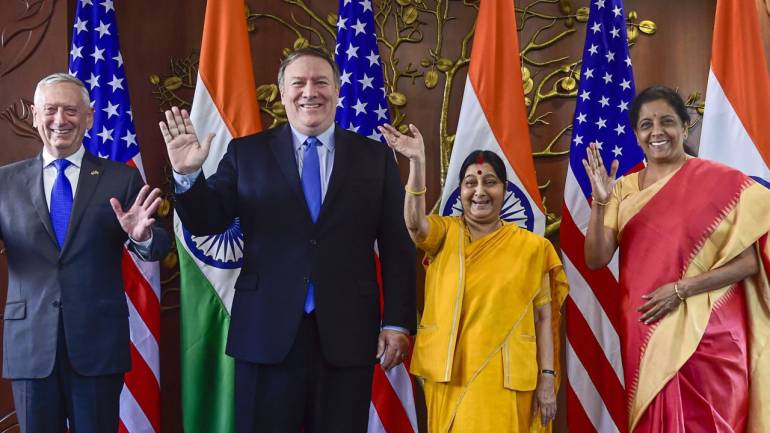
India and the United States on Thursday signed the Communication and Information on Security Memorandum of Agreement (COMCASA) that is meant to facilitate transfer of communications security equipment from the U.S. to India and ensure ‘interoperability’ between Indian, U.S. and other partners in the region, further cementing the defence partnership, already the driving force in their ties. U.S. Secretary of Defence James Mattis and Indian Defence Minister Nirmala Sitharaman put their signatures on the second foundational agreement between the two countries. In September 2016, India had signed the Logistics Exchange Memorandum of Agreement or LEMOA, meant to facilitate logistics support to each other’s forces.
COMCASA allows the use of high-end secured communication equipment to be installed on military platforms like C-130 and P8I planes already sold to India and fully exploit their potential. Currently, the Indian Air Force and the Indian Navy—that use C-130 and P8Is respectively—are dependent on less secure, commercially available communication systems on these American platforms. COMCASA also becomes mandatory if India decides to buy the armed version of the Sea Guardian drones from the U.S. since the high-end drones are critically dependent on highly secure data and communication system links.
The ministers reaffirmed the strategic importance of India’s designation as a Major Defence Partner (MDP) of the United States and committed to expand the scope of India’s MDP status and take mutually agreed upon steps to strengthen defence ties further and promote better defence and security coordination and cooperation. They noted the rapid growth in bilateral defence trade and the qualitative improvement in levels of technology and equipment offered by the United States to India in recent years. They welcomed the inclusion of India by the United States among the top tier of countries entitled to license-free exports, re-exports, and transfers under License Exception Strategic Trade Authorization (STA-1) and also committed to explore other means to support further expansion in two-way trade in defence items and defence manufacturing supply chain linkages.
Over the past two decades, India has steadily increased the military-to-military engagement with the U.S. and currently, the Indian armed forces do the largest number of joint exercises with their American counterparts. In keeping with the trend, both the countries have now agreed to a more complex trilateral exercise and to further increase personnel exchanges between the two militaries and defence organisations. To further consolidate their maritime cooperation in the western Indian Ocean, both sides decided to start exchanges between the U.S. Naval Forces Central Command (NAVCENT) and the Indian Navy. Both sides acknowledged the role of technology in the India-U.S. defence partnership, the ministers reaffirmed their commitment to continue to encourage and prioritise co-production and co-development projects through the Defense Technology and Trade Initiative (DTTI), and to pursue other avenues of defence innovation cooperation. In this regard, they welcomed the conclusion of a Memorandum of Intent between the U.S. Defense Innovation Unit (DIU) and the Indian Defence Innovation Organization – Innovation for Defence Excellence (DIO-iDEX).
So even as some major irritants (in the American eyes) like sale of Russian military platforms to India and India’s relationship with Iran remain, the inaugural 2+2 dialogue—twice postponed in the past—can be deemed successful.

Author, thought leader and one of South Asia's leading strategic analysts, Nitin A. Gokhale has forty years of rich and varied experience behind him as a conflict reporter, Editor, author and now a media entrepreneur who owns and curates two important digital platforms, BharatShakti.in and StratNewsGlobal.com focusing on national security, strategic affairs and foreign policy matters.
At the beginning of his long and distinguished career, Gokhale has lived and reported from India’s North-east for 23 years, writing and analysing various insurgencies in the region, been on the ground at Kargil in the summer of 1999 during the India-Pakistan war, and also brought live reports from Sri Lanka’s Eelam War IV between 2006-2009.
Author of over a dozen books on wars, insurgencies and conflicts, Gokhale relocated to Delhi in 2006, was Security and Strategic Affairs Editor at NDTV, a leading Indian broadcaster for nine years, before launching in 2015 his own digital properties.
An alumni of the Asia-Pacific Centre for Security Studies in Hawaii, Gokhale now writes, lectures and analyses security and strategic matters in Indo-Pacific and travels regularly to US, Europe, South and South-East Asia to speak at various international seminars and conferences.
Gokhale also teaches at India’s Defence Services Staff College (DSSC), the three war colleges, India's National Defence College, College of Defence Management and the intelligence schools of both the R&AW and Intelligence Bureau.
He tweets at @nitingokhale