


Editor’s Note
The debates at Ran Samwad 2025 showcased differing perspectives among the Service Chiefs regarding the pace and nature of theatre command reforms. While some observers viewed the contrasting remarks as dissonance, the exchanges highlight the complexity of adapting global models to India’s unique security environment. The author contends that discussions reflect a healthy deliberative process rather than discord, underscoring that the Services remain united in their commitment to jointness and multi-domain warfighting.
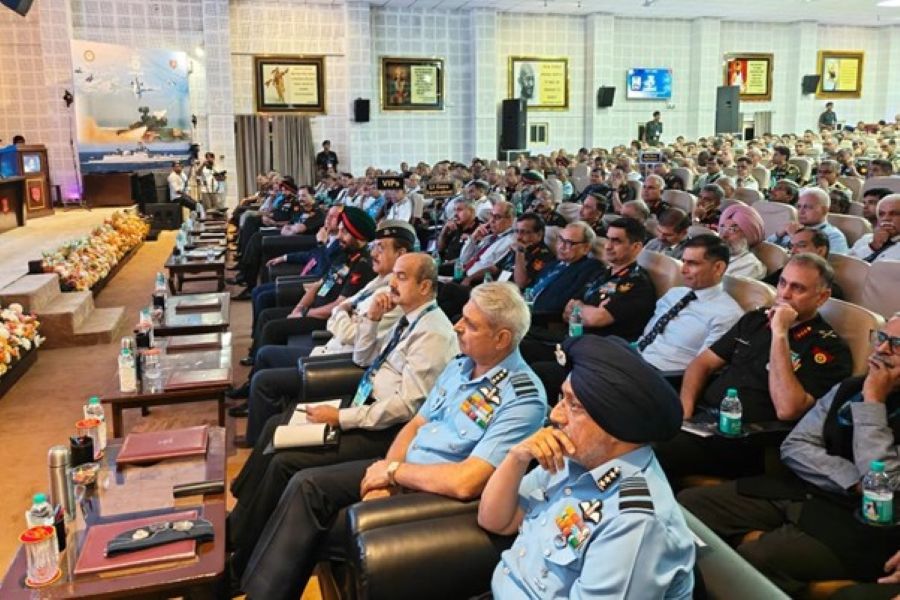
Ran Samwad – Discussion on war’, warfare and warfighting was organised under the aegis of HQ IDS at the Army War College, Mhow, on 26 and 27 August, earlier this week. The seminar brought together professionals from across a wide spectrum, including officers from the armed forces and CAPF, veterans from the three services, academia, the defence industry, and the media. The theme of the seminar was “Impact of Technology on Warfare”. The talks and discussions on the subject were engaging and generated many ideas that the armed forces would ponder over in the days to come. The ideation would surely provide a robust roadmap for the planners and warfighters.
While the Defence Minister and CDS spoke at length about diverse issues on technology and warfighting including lessons from recent conflicts and the way forward, what made news across the nation were remarks by the Air Chief Marshal AP Singh, Chief of Air Staff (CAS) during the fireside chat on Tuesday and Admiral Dinesh Tripathi, Chief of Naval Staff (CNS) during his talk the next day. Both referred to theaterisation or future warfighting structures in the Indian armed forces. At first glance, the two Service Chiefs appear to be speaking in different voices, but it is essential to understand the context behind their statements.
Every Service has its own DNA, which has developed over many decades of warfighting experiences and lessons from history, since services truly embody rich history and modern technology. It is inappropriate to expect that every Service would think and act in a standardised fashion, since the raison d’être of each Service is to fight and win wars for which they appropriately structure and formulate their warfighting doctrine, strategy and tactics. It would be tragic to expect every Service to think alike in a modern, technologically oriented warfare milieu.
First, let’s analyse the fireside chat involving the CAS. The discussion primarily focused on technology, including its effects on recent conflicts, such as Op Sindoor, the role of UAVs in future warfare, the future of manned combat aircraft, and the primacy of air power in both present and future wars. The discussion on structures, including theaterisation for future conflicts in the Indian context, was a minuscule component which garnered disproportionate attention. In response to the question on theatre commands, the CAS highlighted a few aspects. First, he expressed the view that any new structure should not add layers to decision-making; instead, the fresh structures must address the infirmities observed in the present system and structures, and they must be designed for future threats, not meant to fight the last war. Unless that is achieved, we should not disrupt or dismantle the present structures, he emphasised.
He went on to add that the national leadership, including the National Security Advisor (NSA), would be deeply involved in the progress of any conflict, especially in the Indian context, and hence it would be difficult for the theatre commanders to come to Delhi repeatedly for consultations. He thereafter recommended that we must first establish a joint planning and coordination organisation at the headquarters (HQ) level under the Chairman of the Chiefs of Staff Committee. He also categorically emphasised that this should be the first step, and thereafter, a review could be conducted before taking the next step; we must not imitate the USA or China. It highlights his opinion on the joint structures needed in the Indian context, derived from the experience of Op Sindoor. While Op Sindoor was not a full-fledged war, air power was fully employed, and every available resource was dynamically tasked for maximum effect.
During his talk on the impact of technology in the maritime domain and specifically in reference to the Indian Navy, the CNS said that the Indian Navy is “committed to synergising its command control, communications and combat capability with the Indian Army and IAF. Full stop. Period.” He also emphasised the importance of integration starting at the human level. He went on to say that the Indian Navy was undertaking significant efforts towards jointness and integration between the three Services with theatre commands as the long-term goal.
The CDS, during his concluding remarks, made a mention of the dissonance between the stakeholders on the issue of theatres. He, however, appeared confident that he could resolve it in the best interest of the nation. CDS has invested a significant amount of intellectual capital in its efforts to achieve convergence in pursuit of theatre commands. However, the fact that no major announcement has been made in almost five years suggests differences of opinion among stakeholders and perhaps also the complexities involved in the process.
A deeper analysis of the remarks made by the CDS, CAS, and CNS indicates that, while there is a difference of opinion among stakeholders on the path to forming theatres, all Services are committed to jointness and integration. While every modern military is investing in jointness and integration, not every country has established theatre commands. Therefore, the ‘one size fits all’ approach is not applicable in the context of theatre commands. It implies that the creation of theatre commands is not necessarily a prerequisite to the joint application of force.
Distinctive changes in the character of war influenced by technology, recent conflicts including Operation Sindoor, Multi Domain Operations (MDO) evolving into Joint all Domain Operations (JADO), the uniqueness of threats faced in the Indian context and the success achieved by the Indian armed forces so far are perhaps the reasons for the CAS to recommend a relook at the process.
The increasing importance of networked AI, which enables high-intensity operations strongly reliant on space and cyber to tackle threats from drones, missiles, cruise missiles, long-range air strikes, artillery, and hypersonic weapons, demands centralised planning and decentralised execution, with a man-in-the-loop philosophy. There will also be an interplay between the two originally suggested theatres (West and North).
Some other factors in the Indian context that must be considered are: collusion between our adversaries, unresolved borders and sub-conventional/ hybrid warfare practised against India. The conflict in our context could start as sub-conventional operations, leading to conventional war, which can be either short and intense or protracted. It will bring national leadership actively into the progress of the war, which was evident during Op Sindoor, another point highlighted by the CAS. It would be a relevant element in the ongoing discussions on theatre commands.
Many observers have viewed these remarks at Ran Samwad as dissonant and controversial. In the author’s opinion, these remarks should be viewed as a constructive approach to moving forward on a far-reaching decision to establish theatre commands, especially in the wake of Operation Sindoor and the evolving nature of warfare. The success achieved through the integration of Air Defence and joint planning to destroy the terror infrastructure during Op Sindoor further strengthens the argument for reviewing the method, manner, and outcomes leading to the formation of theatre commands. A building block approach may therefore be more acceptable to all stakeholders as the three Services continue building their capabilities and capacities. It may be an indicator of healthy discussions at the highest level in the armed forces and a participatory approach to structural changes for multi-domain warfighting.
Air Marshal RGK Kapoor (Retd) (The author retired as Commander-in-Chief Central Air Command)

Air Marshal RGK Kapoor PVSM, AVSM, VM (Retd) has over 5000 hours of flying experience on various fighter aircraft of the Indian Air Force. He has handled myriad tasks like operations, training, personnel, intelligence, cyber and media and public relations. He has commanded a fighter squadron, a UN mission in Congo and a fighter base. He was the Air and Defence Attaché at embassy of India in USA.
He has been the Deputy Commander-in-Chief of Strategic Forces Command and was Air Officer Commanding-in-Chief of Central Air Command prior to superannuating from the IAF. He was the IAF spokesperson during the Balakot strike and handled Intelligence at Air HQ during Eastern Ladakh standoff. He has been writing articles on air power, military aviation and Geo-strategy. He also participates in podcasts on military issues. In his spare time, he mentors’ people who are keen to delve into defence industry.