


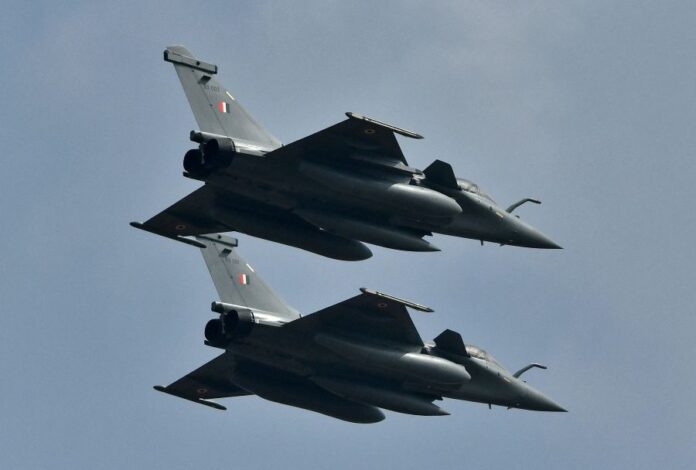
At his annual press conference in New Delhi, Air Chief Marshal Amar Preet Singh offered his clearest signals yet on the Indian Air Force’s fighter roadmap. While leaning openly towards the French-built Rafale as the most practical choice for the IAF’s next big fighter acquisition, he also kept the door ajar for Russia’s Su-57 stealth fighter — if Moscow can pair cutting-edge technology with credible Make-in-India commitments.
His remarks landed at a politically charged moment. Russian President Vladimir Putin is scheduled to visit India in December, followed by French President Emmanuel Macron in early 2026. Both trips are expected to carry heavy defence agendas — and the future of India’s fighter fleet will likely be high on the table.
Rafale: Familiar Advantage, Faster Integration
“Rafale is one of the options that is available with us because we had already done our own homework in terms of the earlier MMRCA contract, in that we have found Rafale to be the best aircraft suited for us amongst those candidates. Any aircraft of that class is what is required immediately. Now, whether it is Rafale or something else, it really doesn’t matter, but yes, Rafale is easy to absorb. So whichever design house is ready to come up with the proposal to make in India, to give us technology, give us more freedom, I think that design house should be chosen,” observed Air Chief.
For Singh, Rafale represents a natural next step. With two squadrons already operational at Ambala and Hashimara, and infrastructure ranging from simulators to hangars firmly in place, expanding the fleet offers speed and certainty.
“The platform is already integrated into our operational ecosystem. Infrastructure, maintenance, simulators — everything is in place,” a senior IAF officer explained on the sidelines.
Dassault Aviation, meanwhile, has pitched assembly of the proposed 114 jets in India, dovetailing neatly with the government’s Make-in-India priorities. A Safran facility for engine overhauls is already functional, while plans for deeper localisation of spares and subsystems are underway. Strategically and logistically, the Rafale promises low risk and quick delivery.
Su-57: Promise and Peril
Yet Singh stopped short of ruling out newer platforms. The Russian Su-57, he noted, is a possibility that “could fly in this decade under Indian colours” if the terms are attractive enough.
The fifth-generation stealth fighter offers a leap in stealth, situational awareness, and electronic warfare; however, its service entry in Russia has been slow, and its export record remains limited. Indian planners remain wary after past experiences with Russian delays and maintenance logjams.
Even so, Putin’s December visit could inject momentum. If Moscow couples Su-57 discussions with technology transfers, industrial participation, and joint development, it might regain lost ground in a segment where India has no operational equivalent.
Strategic Timing
The urgency underpinning Singh’s remarks was unmistakable. India’s fighter strength hovers well below sanctioned levels, even as tensions with both Pakistan and China keep the demand for credible airpower high.
“We should have inducted more fighters yesterday,” Singh said pointedly, highlighting both the gap and the growing impatience with the pace of acquisition.
France, as a proven partner, is poised to consolidate its advantage. A direct government-to-government deal could shortcut the long-stalled MRFA competition. Russia, by contrast, will argue that only a fifth-generation stealth fighter, such as the Su-57, can provide India with a genuine technological leap.
BharatShakti’s Early Call
For months, BharatShakti has reported that Rafale was pulling ahead in the race. The IAF Chief’s latest comments seem to validate that trajectory — though official rhetoric still maintains space for competition.
Also Read: Rafale Surge: IAF Eyes 40 More Jets as Navy Deal Nears Signing
What is now clear is that the next six months may be decisive. The Rafale represents continuity, reliability and faster integration. The Su-57 embodies ambition, risk and a chance to leap ahead technologically. Much will depend on the offers tabled during the upcoming high-level visits — and whether New Delhi has the political will to move quickly.
Also Read: Exclusive Confirmed: Rafale Frontline in IAF’s Fighter Crisis
The stakes are high. The choice India makes could shape its airpower balance well into the 2040s.
Huma Siddiqui