India has issued a sharp rebuke to Pakistan over its handling of mass protests in Pakistan-occupied Jammu and Kashmir (PoJK), calling the Pakistani forces’ actions against civilians “horrific” and a reflection of the country’s “oppressive approach” towards the illegally occupied region.
Responding to media queries during the weekly press briefing on Friday, Ministry of External Affairs (MEA) spokesperson Randhir Jaiswal said New Delhi had taken note of the violent crackdown on demonstrators in PoJK, where at least 10 civilians were killed and dozens injured in recent days.
“We have seen reports on protests in several areas of Pakistan-occupied Jammu & Kashmir, including brutalities by Pakistani forces on innocent civilians,” Jaiswal said.
“We believe that it is a natural consequence of Pakistan’s oppressive approach and its systemic plundering of resources from these territories, which remain under its forcible and illegal occupation. Pakistan must be held accountable for its horrific human rights violations,” he added.
Unrest Deepens in PoJK on Sixth Day of Agitation
The protests, now entering their sixth day, have swept across several towns in PoJK, with the capital Muzaffarabad becoming the epicentre of the growing civil unrest. The demonstrations, led by the Jammu Kashmir Joint Awami Action Committee (JKJAAC), were initially sparked by demands for economic relief and basic services, but have since escalated into a wider political movement.
According to local reports, including from Pakistani outlet Dawn, the unrest was triggered by rising electricity tariffs, inflation, and grievances over resource exploitation by Islamabad. Protesters are rallying behind a 38-point charter of demands, which includes calls for subsidised wheat flour, free education and healthcare, abolition of elite privileges, and political reforms.
Shops, markets, and public transport in Muzaffarabad have remained shut for days. Internet services have reportedly been suspended in an effort to contain the protest movement.
Violence and Allegations of State Brutality
Tensions escalated sharply when Pakistani forces allegedly opened fire on unarmed protestors. According to Shaukat Nawaz Mir, a prominent leader of the JKJAAC, the violence began when “facilitators” armed with “institutional weapons” fired directly on peaceful demonstrators at Neelum Bridge.
“All the citizens of Muzaffarabad were peacefully recording their protest when some facilitators, with institutional backing, arrived and opened direct fire in the presence of police and administration,” Mir said during a public address.
“We have evidence of this. One youth was martyred, and more than 20 were injured by direct fire. We will not forgive this murder under any circumstances.”
Reportedly, another JKJAAC leader, Faisal Jamil Kashmiri, stated that years of unfulfilled promises and economic hardship have pushed the public to the brink.
Mass Funerals Fuel Public Outrage
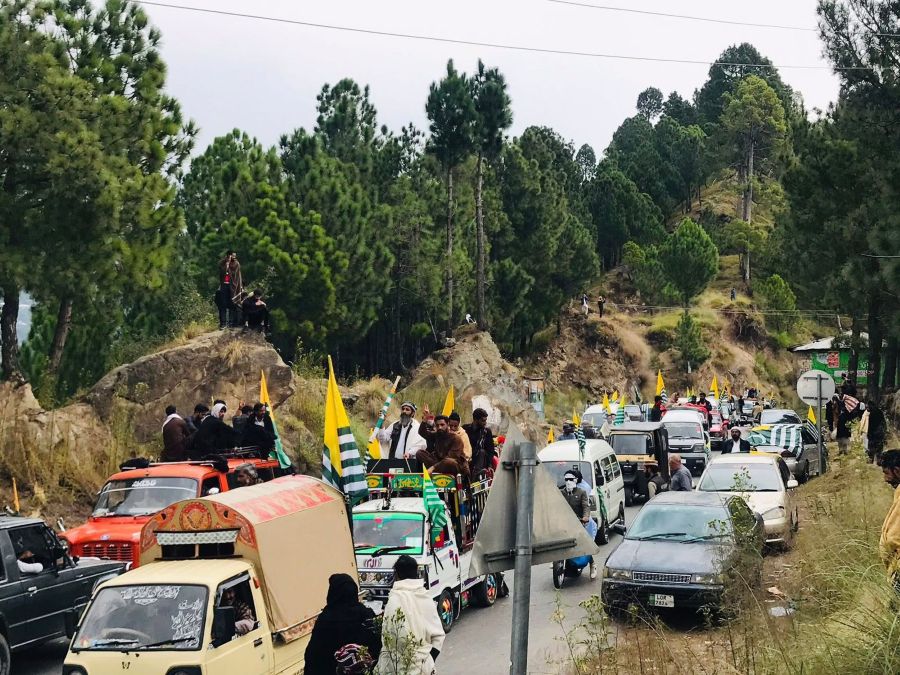
On Friday, thousands turned out for the funerals of those killed in Muzaffarabad. Video footage shared online showed crowds chanting slogans and demanding justice. The mass turnout further intensified pressure on Pakistani authorities, who now face the most serious civilian uprising in PoJK in recent memory.
PTI leader Syeda Zahra commented on social media, saying, “The tsunami of Kashmir will hit Muzaffar today.” She also referenced a report documenting widespread violence by state forces and increasing public resentment toward Islamabad.
Pakistan Scrambles to Respond
In response to the deteriorating situation, the Pakistani government dispatched a high-level delegation to PoJK, led by senior federal ministers including Ahsan Iqbal, Rana Sanaullah, and Qamar Zaman Kaira. Former PoJK president Sardar Masood Khan also joined the negotiations.
Talks began late Thursday in Muzaffarabad and continued into Friday, according to Dawn. Representing the protestors were JKJAAC leaders Shaukat Nawaz Mir, Raja Amjad Ali Khan, and Anjum Zaman Awan.
In a statement made during a funeral procession, Mir stressed that before discussing political demands, there must be accountability for the killings.
Crackdown and Defiance
Despite internet shutdowns, heavy troop deployment, and blockades, protest caravans have continued to reach Muzaffarabad and other towns. Reports of fresh clashes emerged on Friday, with more injuries being reported.
Security forces have attempted to secure bridges and restrict movement, but the protests show no signs of abating. According to civil society representatives, the population remains determined to continue the struggle until key demands are met.
India’s Stance and Regional Implications
India has consistently maintained that the entire Union Territory of Jammu and Kashmir, including areas under Pakistani occupation, is an integral part of India. The latest developments in PoJK have only reinforced New Delhi’s long-standing position.
“Pakistan’s governance of these territories is neither legal nor sustainable,” sources in the defence and security establishment told this publication. “What we are seeing is the inevitable breakdown of a system built on repression and neglect.”
As protests in PoJK enter their second week, international attention is mounting. Human rights organisations and diplomatic observers are beginning to raise concerns about the use of force and the growing humanitarian crisis in the region.
Team BharatShakti