


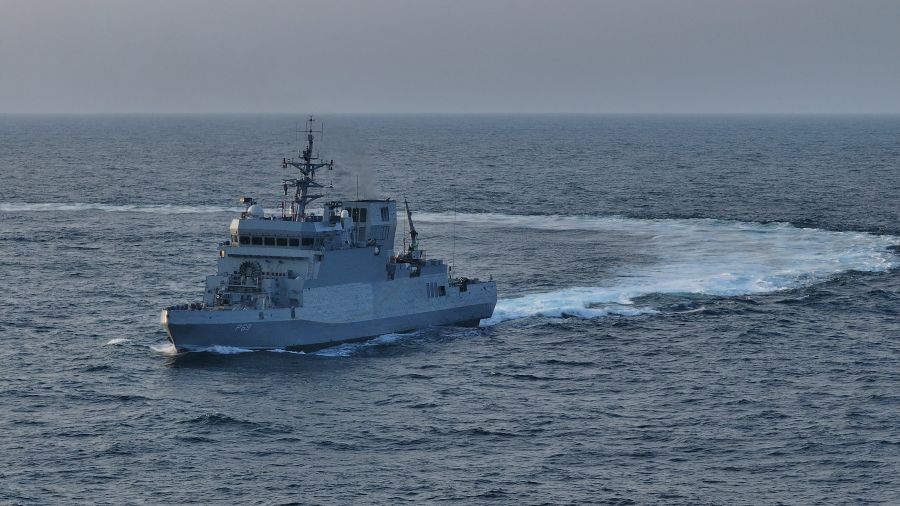
The Indian Navy on Monday commissioned INS Androth, the second Anti-Submarine Warfare Shallow Water Craft (ASW-SWC), at the Naval Dockyard in Visakhapatnam. The ceremony was presided over by Vice Admiral Rajesh Pendharkar, Flag Officer Commanding-in-Chief, Eastern Naval Command.
Built by Garden Reach Shipbuilders and Engineers (GRSE), INS Androth showcases over 80% indigenous content and is equipped for anti-submarine operations in shallow littoral zones, a growing area of concern given recent submarine acquisitions by Pakistan.
The commissioning marks yet another milestone in the Navy’s ambitious indigenisation programme, with the vessel joining INS Arnala, the first in the ASW-SWC series, which was inducted earlier this year.
India’s Indigenous Naval Build-Up: 54 Warships Under Construction
INS Androth is part of a much larger naval modernisation plan. At present, 54 vessels are under construction across Indian shipyards — the highest number in India’s shipbuilding history. These range from cutting-edge stealth frigates and submarines to survey ships, missile boats, and support vessels.
By 2028, the Indian Navy is expected to have a fleet of over 150 warships, with the goal of reaching 200 by 2035 — all designed and built indigenously. It marks a sharp contrast with regional rivals like Pakistan, which continues to rely entirely on foreign designs, particularly those from China.
Among the key projects currently underway:
- Project 17A Stealth Frigates: 7 Nilgiri-class frigates are being constructed. Three — INS Nilgiri, INS Himgiri, and INS Udaygiri — have already joined the fleet in the past year.
- ASW Shallow Water Crafts: 16 vessels in total, split between GRSE Kolkata and Cochin Shipyard. Following Arnala and Androth, others like Ajay are already in sea trials.
- Survey Vessels: INS Sandhyak and Nirdeshak have been commissioned, while Ikshak has been delivered and will enter service shortly.
- Diving Support Vessels: Nistar and Nipun, the first of their kind built in India, will enhance submarine rescue operations. Additional diving support craft are also in production.
- Next-Gen Missile Vessels: 6 vessels are under construction in Kochi.
- Patrol and Training Ships: 11 new patrol vessels and three cadet training ships are under construction.
Every vessel under construction is being built using Indian steel, indigenous designs, and local technologies, involving hundreds of MSMEs and defence startups.
China’s Growing Naval Footprint – and Pakistan’s Dependence
While India pursues capability with self-reliance, China continues to outpace its neighbours in numbers, operating the world’s largest Navy and expanding its maritime presence in the Indian Ocean.
Beijing is not just growing its own fleet but actively arming Pakistan, having pledged 50 warships to its closest regional ally. One key initiative is the Hangor-class submarine programme, under which eight submarines, export variants of China’s Yuan-class (Type 039B), are being delivered to Pakistan. So far, three have been handed over.
However, these submarines suffer from performance limitations. Due to export restrictions, China has used less advanced diesel engines (CHD-620) instead of German MTUs, and their Air Independent Propulsion (AIP) systems remain unproven. In contrast, India’s Scorpene-class submarines, quieter, more agile, and equipped with modern sensors, offer significant tactical advantages.
Pakistan’s own Navy, which currently operates around two dozen warships, lacks domestic shipbuilding capability. Every vessel in its fleet, whether a frigate, missile boat, or submarine, is sourced from China or elsewhere.
Innovation, Sovereignty, and Scale
India’s approach is fundamentally different, focused on technology transfer, industrial growth, and strategic autonomy. Whether it’s sonar systems, weapon integration, or propulsion systems, Indian industry is now actively shaping every aspect of naval shipbuilding.
The Navy’s recent inductions — Arnala, Nistar, Udaygiri, Nilgiri, and now Androth — are emblematic of this shift. They not only enhance operational capability but also support national objectives under the Atmanirbhar Bharat (self-reliant India) vision.
Moreover, this indigenisation drive is having a multiplier effect, boosting the economy, generating employment, and nurturing high-end defence innovation within Indian borders.
While China may still lead in fleet size, India’s strategic bet on indigenisation, regional partnerships, and agile operations is shaping a new maritime equation in the Indo-Pacific.
Team BharatShakti