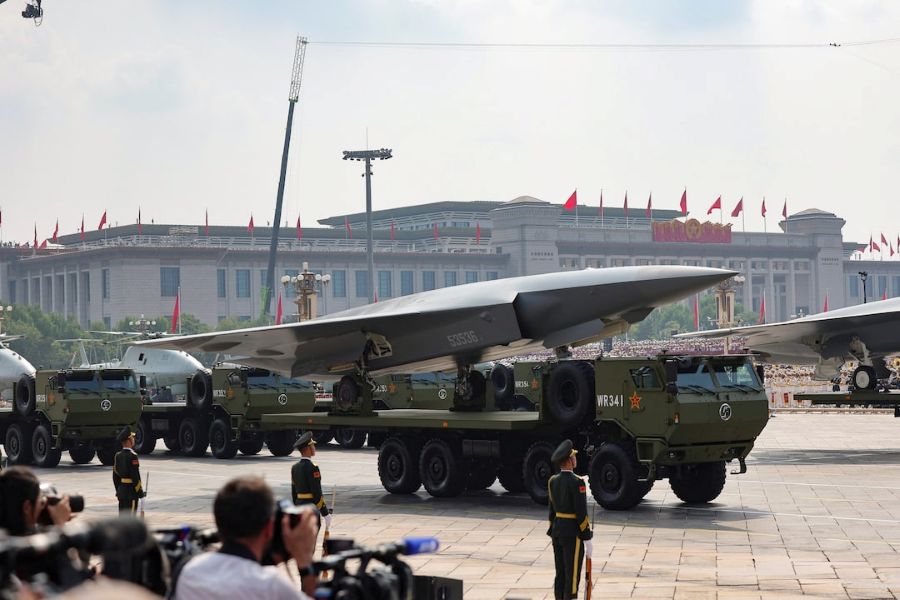
On September 3, 2025, Beijing rolled out its first major military parade in six years to mark the 80th anniversary of Japan’s defeat in World War II.
But this was less about marching columns than about demonstrating China’s defence-industrial muscle, its evolving doctrine, and the political role of its armed forces.
President Xi Jinping underlined the stakes, framing the moment as a choice between “peace or war” and casting the PLA as central to the Party’s vision of “national rejuvenation.” With Russian President Vladimir Putin and North Korea’s Supreme Leader Kim Jong Un standing alongside him, the parade doubled as geopolitical theatre—signalling China’s rise within a counter-Western bloc.
Beyond Platforms: China’s Industrial Muscle
The parade’s real story wasn’t a missile or a drone. It was the ecosystem behind them.
- Shipbuilding supremacy: In 2023, China delivered more than half the world’s new ship capacity. South Korea produced ~28%, Japan ~15%. That dual-use base means Beijing can build auxiliaries, replace losses, and sustain campaigns.
- Mobilisation edge: U.S. Navy/ONI estimates put China’s commercial shipbuilding tonnage at ~230 times America’s. Commercial on paper, mobilisation potential in practice.
- Fleet size: By 2024, the PLA Navy had more than 370 battle-force ships. Pentagon forecasts: 395 by 2025, 435 by 2030. Quality still matters more than raw numbers, but numbers buy presence, experimentation, and endurance.
The industrial engine goes well beyond shipyards.
- Missiles: The PLA Rocket Force holds one of the largest arsenals of ballistic and cruise missiles anywhere—enough for mass salvos against regional bases.
- Uncrewed systems: Drones and unmanned vessels weren’t props. They are now central to China’s force structure.
- AI pipeline: Between 2014 and 2023, China filed over 38,000 Generative-AI patent families—six times the U.S. Algorithms now power targeting, logistics, and command optimisation. The parade’s C2 demonstrations were a glimpse of that future.
Table 1. Industrial–Technological Ecosystem Indicators
| Indicator | China | Comparator/Context | Source |
| Global new ship capacity (2023) | >50% | ROK ~28%, Japan ~15% | UNCTAD RMT 2024 |
| Shipbuilding capacity vs U.S. | ~230× | – | CSIS/ONI estimate |
| PLAN battle-force ships | >370 (2024), 395 (2025), 435 (2030) | – | DoD CMPR 2024 |
| GenAI patents (2014–23) | >38,000 | U.S. ~6,300 | WIPO PLR 2024 |
This is not a collection of platforms. It is an industrial machine designed for sustained power projection.
From Data to Dominance: The PLA’s New Playbook
Parades show hardware. Reforms show intent. Since 2015, the PLA has been rewriting how it plans to fight.
- 2016: Seven military regions were replaced with five joint theatre commands.
- 2020: The Joint Operations Outline gave trial guidance on how those theatres should integrate.
- 2024: The Information Support Force was created. Cyber, space, and electronic warfare were consolidated into one arm, built on a single principle: control the network, control the war.
Logistics is being retooled, too. The Joint Logistic Support Force has tested UAV resupply above 4,500 metres—practice runs for sustaining troops in the kind of terrain that usually slows armies down.
Strike power remains central. The Rocket Force displayed hypersonics and intermediate-range systems aimed squarely at U.S. and allied bases across the first and second island chains. Stimson Centre modelling suggests mass salvos could shut runways, at least temporarily. The lesson: magazine depth and rapid repair will decide who stays in the fight.
Table 2. PLA Effectiveness Stress-Test Indicators (2024–25)
| Dimension | Evidence | Assessment |
| Jointness | 2020 Outline; theatre drills | Improving, uneven fusion |
| Information dominance | ISF creation, Xi’s directives | Prioritised, ongoing |
| Logistics | UAV resupply, JLSF | Scaling, endurance untested |
| EMS/EW | Expanded jamming units | Growing, resilience uncertain |
| Cyber/space | BeiDou & Gaofen reliance | Integrated, vulnerable |
| Munitions | PLARF inventories | Strong salvos, long-war unclear |
The thread is clear: the PLA is wiring itself for “intelligentised” war, where networks and algorithms matter as much as firepower.
Strategic Signalling: Choreography With a Message
The parade was as much about signal as spectacle.
- Diplomatic tableau: Putin and Kim’s presence framed Beijing as the hub of an alternative order.
- Regional deterrence: Hypersonics, drones, and strike missiles reinforced China’s A2/AD posture in the Western Pacific.
- Extended reach: Facilities at Djibouti and Cambodia’s Ream Naval Base are small but symbolic. They show intent: the PLA Navy wants to operate globally.
- Global backdrop: The show unfolded as global defence spending hit $2.7 trillion in 2024 (SIPRI)—the sharpest rise since the Cold War.
The message was clear: China is not only building military power, it is positioning itself as the political and military hub of a rival order.
Power as Politics
Xi Jinping’s remarks cut through the theatre. The PLA, he declared, is the vanguard of “national rejuvenation.”
- At home: The PLA stands for stability, inevitability, and unity under Party rule.
- Abroad: The parade warned rivals that China’s rise is durable and politically backed.
Modernisation here is not just about platforms or doctrine. It is about fusing military capacity with political legitimacy and strategic signal.
The Bottom Line
The 80th Victory Day Parade was spectacle, but not empty theatre. It showcased three things:
- Industrial strength—shipbuilding dominance, missile depth, AI pipeline.
- Doctrinal evolution—joint reforms, information dominance, logistics trials, missile posture.
- Strategic signalling—deterrence, partnerships, political legitimacy.
To dismiss it as pageantry is to miss the machine behind it. To read it as proof of Chinese supremacy is just as wrong. Capacity is rising, integration is improving, but resilience under combat friction remains untested.
For analysts, the watchpoints are clear: can the PLA sustain jointness under fire, hold its information edge under contest, and convert industrial depth into battlefield effect? Those are the metrics that will decide both the PLA’s future—and the region’s stability.
Brigadier Gagan Deep Singh Baath (Retd), PhD