






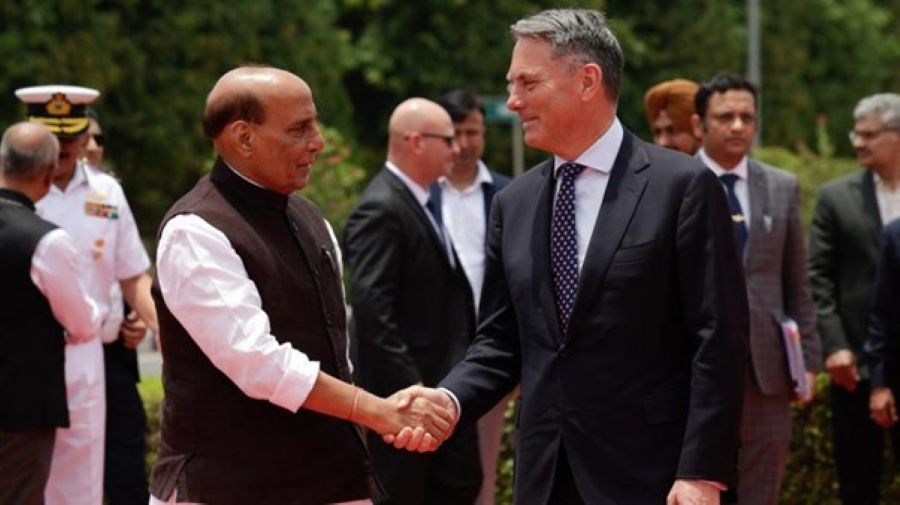
As geopolitical currents shift rapidly across the Indo-Pacific, India and Australia are preparing to scale up their defence and strategic cooperation to new heights. Indian Defence Minister Rajnath Singh is scheduled to visit Australia from October 8 to 10, in a move that underscores the growing significance of the India-Australia partnership within the region’s evolving security architecture.
The visit follows a series of high-level military and diplomatic exchanges that have taken place this year. It is expected to reinforce the momentum gained through joint exercises, technological collaboration, and defence industry linkages between the two nations. Singh’s visit will focus on strengthening interoperability, enhancing maritime domain awareness, expanding military training programs, and deepening bilateral cooperation across air, land, sea, and emerging technologies.
Indo-Pacific: A Shared Strategic Theatre
The Indo-Pacific has become a central arena for strategic competition and cooperation, and both India and Australia have emerged as key players advocating for a rules-based order. The forthcoming visit comes at a time of heightened concerns over regional stability, with both nations aligned in countering coercive and expansionist activities in the maritime domain.
The visit marks the latest chapter in a robust and expanding defence partnership that has seen exponential growth since the signing of the Comprehensive Strategic Partnership (CSP) and the Mutual Logistics Support Agreement (MLSA) in 2020. The agreements have since provided a strong framework for joint operations, logistics interoperability, and reciprocal access to military bases.
Focus on Indo-Pacific Security and Regional Preparedness
The visit is timely, given the shifting security architecture of the Indo-Pacific, where increasing maritime assertiveness and grey-zone tactics, particularly in the South China Sea and the eastern Indian Ocean, have emerged as pressing challenges.
Both India and Australia view their defence collaboration as essential to ensuring maritime domain awareness (MDA), protecting Sea Lines of Communication (SLOCs), and acting as first responders during humanitarian crises in the region.
The trip will also explore ways to extend joint military diplomacy to the South Pacific, building upon recent naval diplomacy efforts such as the visit of INS Kadmatt to Papua New Guinea, which coincided with Australian naval assets in a multinational fleet review.
“The India-Australia defence dynamic is no longer confined to bilateral exercises. We are now talking about joint roles as security enablers across the Indo-Pacific. The visit of Defence Minister Rajnath Singh is a clear indicator of this intent,” said Mahadevan Shankar, CEO of Arzuh International and Adjunct Fellow at the National Maritime Foundation of India.
Boosting Interoperability and Defence Exercises
Both nations have demonstrated growing interoperability through joint military exercises across all domains. From AUSINDEX and AUSTRAHIND to Pitch Black, MILAN, and the tri-service MALABAR under the QUAD framework, Indian and Australian forces have progressively integrated complex operational capabilities.
This year, India also made its debut in Exercise Talisman Sabre 2025, Australia’s largest warfighting exercise, alongside 18 other nations. These joint initiatives not only build combat readiness but also underline strategic alignment among like-minded democracies in the region.
Advancing Defence Industry Ties and Technology Sharing
One of the central themes of Singh’s visit will be to elevate government-to-government (G2G) and business-to-business (B2B) engagements. Indian and Australian defence firms are currently exploring joint ventures in shipbuilding, autonomous underwater vehicles, electronic warfare, AI-enabled surveillance systems, and cybersecurity.
A notable initiative in this space was the 2021 MoU between the Australian Industry & Defence Network (AIDN) and the Society of Indian Defence Manufacturers (SIDM), facilitated by Arzuh International. It laid the groundwork for collaboration between MSMEs and large defence integrators in both countries.
Bridging the Indo-Pacific with Strategic Logistics and Joint Platforms
India and Australia are also examining ways to operationalise the MLSA through dual-use facilities, potentially located in strategic outposts such as the Andaman & Nicobar Islands and Australia’s Cocos (Keeling) Islands. Such facilities could enhance forward logistics, repair, and refuelling capabilities, especially in contingency scenarios across the Indo-Pacific, including the Taiwan Strait.
This logistical cooperation, complemented by Defence Policy Talks (DPTs), the most recent of which took place in New Delhi in March 2025, is helping lay the foundation for resilient supply chains, shared maintenance infrastructure, and technology transfer agreements.
Strategic Dialogue and QUAD Cooperation
Australia and India remain deeply engaged through multilateral groupings such as the QUAD, alongside the United States and Japan. The tri-service Exercise MALABAR, in which the four QUAD nations participate, continues to reinforce a unified posture in the Indo-Pacific against coercive actions and strategic ambiguity.
Huma Siddiqui