


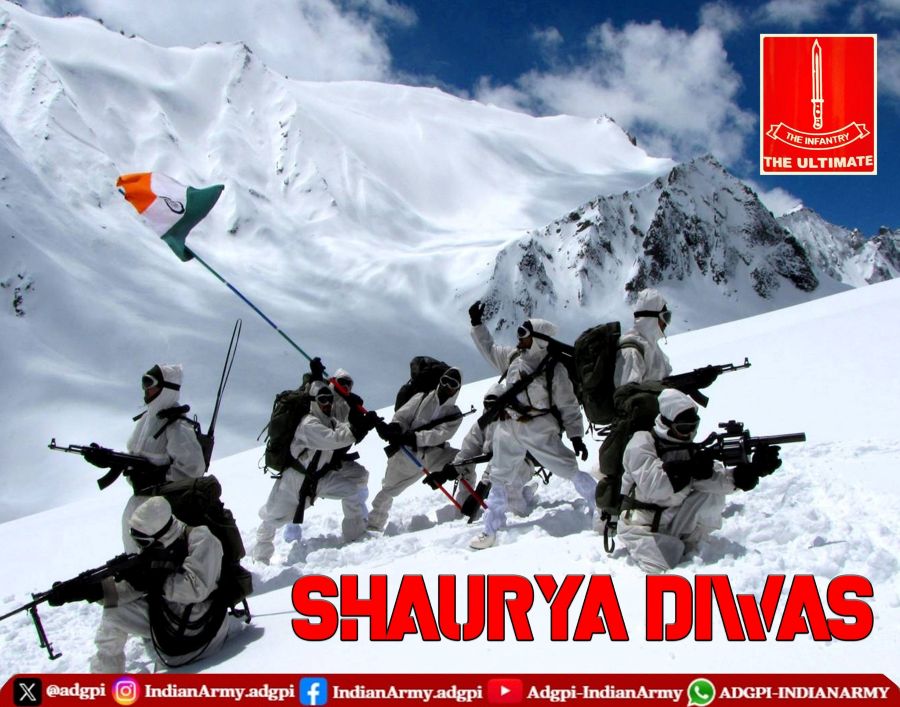
Can a nation truly be secure when its Armed Forces remain divided by narratives? The Indian Army celebrates 27 October as Infantry Day to commemorate the landing of No. 1 Sikh Regiment at Srinagar on this day in 1947, which led to Kashmir being saved from the marauders launched by Pakistan. The ensuing conflict, until the ceasefire that the United Nations brokered was not only one of the longest that the Indian Armed Forces were engaged in but also had the largest number of offensive missions by the Air Force in support of the Indian Army in any conflict that India has ever fought. The Indian Army and the erstwhile Royal Indian Air Force played a predominant and primary role in securing the state of Jammu and Kashmir excluding the regions of Gilgit Baltistan, Skardu and Muzaffarabad which remain occupied by Pakistan.
The troops of the 1 Sikh were moved to Srinagar by RIAF Dakotas of 12 Squadron soon after the Instrument of Accession was signed by Maharaja Hari Singh of Kashmir. Time was at a premium, and the IAF leadership took up the challenge, operating Dakotas that landed on an unprepared, rudimentary air strip with no landing aids. Exemplary leadership was displayed during this conflict by both Air Cmde Mehar Singh and Gen Thimayya, who subsequently flew the Dakota to land at Leh, the highest landing field in the world at the time. Neither of them knew whether it would work out, and they trusted each other with their own lives, flying without oxygen at altitudes above 20,000 feet.
There is no denying that the aerial attacks on enemy forces were instrumental in repelling them successfully. This war witnessed the largest number of offensive air operations, and complementary capabilities of the air and land forces were effectively employed to gain victory. The significance of this day needs no further explanation than the fact that it is celebrated as the Infantry Day or Shaurya Diwas by the Indian Army. It is a classic example of joint operations, yet it is seldom quoted as such.
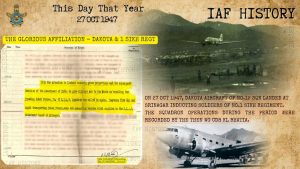
The official social media post by the ADGPI of the Indian Army on ‘X’ had the launch of the Infantry Day Magazine, Rifle and Bayonet, that featured a soldier holding a drone and another drone flying nearby on its cover page while the post by the IAF highlighted ‘The Glorious Affiliation – Dakota and 1 Sikh Regiment’ both posted on 27 October 2025. What is glaring is the fact that the post by the Indian Army makes no mention of the air lift at all. The bravery, valour, courage and sacrifice of the soldiers and airmen are not mutually exclusive, and they complement each other.
The Infantry would not have reached Srinagar in the desired time frame without air power, and air power without the Infantry would probably not have been able to save Srinagar. Both the Indian Army and the Air Force mutually supported each other and worked in tandem as the Indian Armed Forces in securing Srinagar and making further landings possible; otherwise, we would have been looking at a different map of India today.
Half a century later, the Kargil conflict of 1999 also witnessed the use of air power, when called upon to assist the Indian Army in evicting the intruders, turned the tide, leading to a speedy culmination of the conflict. Yet the narrative of the Indian Army operation was called ‘Op Vijay, ’ which was also the name assigned to the liberation of Goa in 1961, while that of the IAF was called ‘Op Safed Sagar.’
It reveals a lack of institutional memory and history across the ranks, as no one in the entire decision-making process pointed this out. This conflict also showcased numerous examples of exceptional courage and bravery by the junior leadership of the Indian Army, as well as IAF personnel, along with a conspicuous demonstration of jointness.
Why are we as armed forces loath to acknowledge and accept the contribution of the other service in any conflict, while all three work towards national interest in securing the nation? Parochial interest and the proclivity to gain ownership of the force that is invariably the first responder, due to its attributes of flexibility, reach, response, and firepower, could be one reason.
The glaring critical lacuna stems from the lack of professional and trained human resources to record operational military information, which is currently kept only as generic documentation by the services at the History Division of the Ministry of Defence.
Professional military scholars and historians need not only to document the same but also to derive lessons that contribute to the discourse on military history.
It is inexcusable, and the Indian Armed Forces must institutionalise a joint operational history and lessons learned framework as an inalienable part of every officer’s Professional Military Education. The courage and bravery of young air warriors and soldiers cannot be a substitute for a lack of knowledge of our own military history. National commemorations and military history must reflect the contributions of each service, along with the impact of synergy or its absence, to foster genuine jointness, not just in combat, but also in our collective memory.
The deliberate attempts to present one-sided narratives, along with post-truths, will only lead to endless debates on jointness, integration, and theatre commands. The larger concern is that these debates should not lead to outcomes that undermine national security itself.
AVM Anil Golani (Retd), DG, Centre for Aerospace Power and Strategic Studies (CAPS)

The officer was commissioned into the Fighter Stream of the IAF on 29 Dec 1982. Total Flying experience of more than 3000 hours which includes more than 1000 hrs of instructional flying. A Qualified Flying Instructor and an Instrument Rating Instructor and Examiner Fully Ops on the erstwhile Ajeet and Jaguar aircraft. Raised and commanded the first Harpy (Pechora III) squadron of the IAF. Commanded an Air Defence Direction Centre (47 SU) and an operational base (AF Stn Gorakhpur).
One of the few to have served in senior ranks in both the Joint Services Commands of the country. Andaman & Nicobar Command as the Air Force Component Commander and Strategic Forces Command as the Chief Staff Officer (Air Vector). The other joint services appointments include Air Officer Commanding Maritime Air Ops in Mumbai and Chief Instructor, Air Force, at Defence Services Staff College, Wellington.
Has done the Staff Course, Higher Air Command Course and a year’s course in International Security & Strategy at the Royal College of Defence Studies, London.