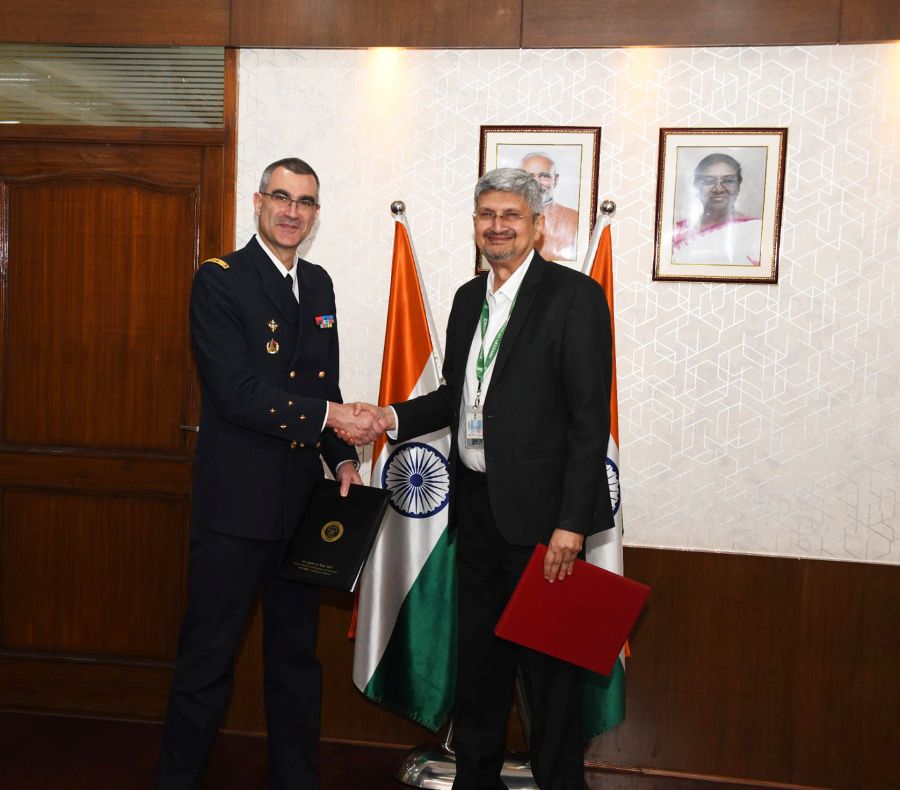
India and France opened a new chapter in their defence partnership on Thursday with the signing of a Technical Agreement between India’s DRDO and France’s Directorate General of Armaments (DGA). The pact, inked at DRDO headquarters in New Delhi by DRDO Chief Samir V. Kamat and DGA’s National Armaments Director Lt Gen Gael Diaz de Tuesta, establishes a dedicated framework for long-term cooperation in advanced defence science and technology.
The agreement creates structured channels for joint research projects, access to test facilities, specialist training, scientific exchanges, and collaborative workshops, enabling the two nations to work together on next-generation military technologies. It also allows mutual transfer of equipment, technical know-how, and sensitive technologies under mutually approved domains.
India and France identified a wide research agenda covering unmanned systems, aeronautics, new-age materials, cyber defence, artificial intelligence, navigation, propulsion, space systems, quantum technologies, advanced sensors, and underwater capabilities – a portfolio broad enough to shape future defence ecosystems in both countries.
The announcement comes ahead of French President Emmanuel Macron’s planned visit to India in February 2026, where he will attend the Global AI Summit, signalling rising convergence between the two nations in emerging technologies, including defence-focused AI applications.
A Partnership Already Reshaping India’s Defence and Aerospace Landscape
The new agreement builds upon a steadily rising wave of Indo-French military and industrial collaboration that has accelerated over the past two years.
Next-Generation AMCA Engine: India’s Most Ambitious Co-Development Yet
India recently partnered with Safran to jointly design a 120 kN fighter engine for the Advanced Medium Combat Aircraft (AMCA). Unlike earlier arrangements, this programme includes deep technology transfer, covering critical areas such as hot-section metallurgy and single-crystal blade technology, which have long been gaps in India’s propulsion capabilities.
For India, the project represents a decisive leap after years of challenges with indigenous engine development.
Indigenous Helicopter Engine for IMRH
In the rotary-wing segment, HAL and Safran are co-developing the Aravalli engine for the Indian Multi-Role Helicopter (IMRH) programme. It marks the first major effort to create a powerful helicopter engine with extensive Indian design inputs, enabled by French technical support and co-engineering.
India Emerges as a Strategic Manufacturing Base
Indo-French collaboration is also expanding on the industrial front. Godrej Aerospace recently secured a five-year contract from Safran Aircraft Engines to manufacture titanium ventilation assemblies for the LEAP engine family, the powerplant used in thousands of commercial aircraft worldwide.
Safran executives noted that this contract reflects India’s growing position as an essential node in global aerospace supply chains.
M88 Maintenance Facility in Hyderabad
Safran is also setting up its first overseas M88 engine maintenance centre in Hyderabad — a facility that will service the engines powering India’s Rafale fleet. When fully operational, it will overhaul more than 600 engine modules per year and is expected to employ close to 1,000 specialists eventually.
Safran’s senior leadership has described the centre as a strategic commitment to supporting India’s defence self-reliance and deepening its industrial base.
Rising Strategic Convergence
For India and France, the latest Technical Agreement is more than a procedural step; it formalises a maturing partnership built on co-development, shared innovation, and long-term technological trust.
With President Macron’s upcoming visit for the Global AI Summit, New Delhi and Paris are expected to widen cooperation not only in defence technologies but also in AI governance, dual-use algorithms, autonomous systems, and secure cyber-AI integration.
As both nations sharpen their focus on strategic autonomy and high-end capability development, their defence and technology partnership appears set to deepen further in the coming year.
Team BharatShakti