India’s military thinking is undergoing a measured but significant evolution: one driven not by headline-grabbing organisational changes, but by deeper questions of deterrence stability, decision-making authority and the growing impact of technology on warfare.
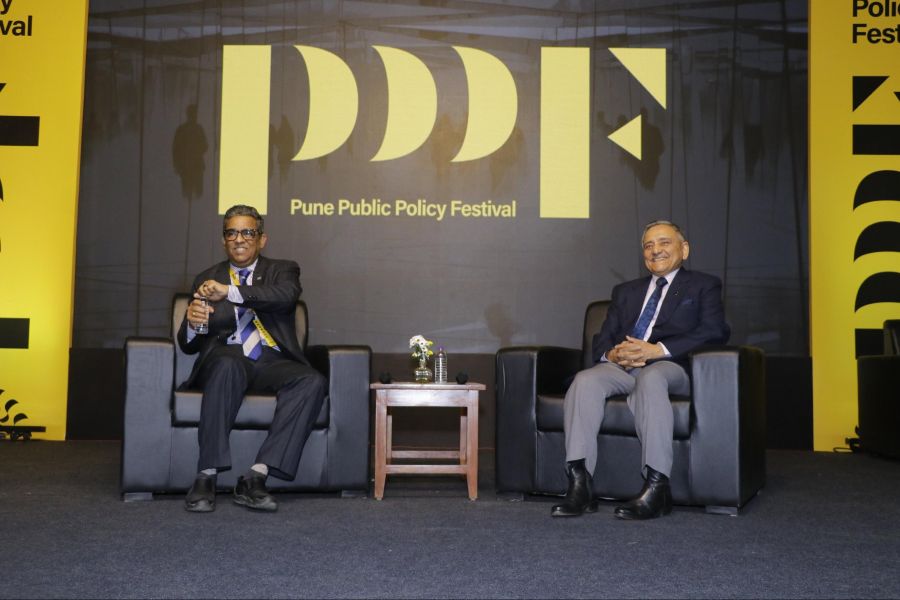
Talking about the distinction between strategic and conventional forces, command responsibility, manpower restructuring, and emerging domains of conflict, Chief of Defence Staff General Anil Chauhan outlined how India seeks to adapt to changing security realities while preserving escalation control.
At the core of India’s deterrence architecture lies a clear separation between strategic and conventional capabilities. According to the CDS, this distinction has been deliberately maintained to avoid compressing decision-making during crises.
“In our case, all our ballistic missiles are armed with strategic weapons. Conventional weapons are mounted on cruise missile vectors,” General Chauhan said.
He noted that systems which previously placed nuclear forces and conventional missiles under a single command have since moved to separate them, a shift he described as both sensible and consistent with global best practices.
“This creates another layer in the escalation matrix. It pushes the nuclear threshold higher. It has not come down; it has become more stable,” he said.
Among nuclear-armed states, separating strategic and conventional strike chains is increasingly seen as a way to reduce the risk of misinterpretation and inadvertent escalation, particularly in fast-moving crises where response timelines are compressed.
Collective authority at the apex
Gen Chauhan stressed that India’s strategic decision-making model is designed to prevent excessive concentration of authority, especially in matters with nuclear or national-level implications.
“Strategic decisions are taken by the Chiefs of Staff Committee in a collaborative manner. It is a collective decision. Execution, of course, is decentralised,” he said.
Clarifying his own mandate, the CDS pointed out that the post was deliberately structured to balance integration with service autonomy.
“The government sanction clearly states that the CDS will exercise no military command over the three Service Chiefs. That does not mean I do not have an operational role,” he said.
That operational role, he explained, flows from his position as Permanent Chairman of the Chiefs of Staff Committee, as well as from direct responsibility over newer domains of warfare.
“I have a direct operational role in domains like space, cyber, electromagnetic and cognitive warfare. These are directly under Headquarters IDS,” Gen Chauhan said.
Technology and the limits of geography
Reflecting on how warfare is changing, the CDS observed that technology is steadily eroding the traditional dominance of geography in military planning.
“For a long time, military strategy depended on geography and terrain. Now we are in an era where geography is becoming slightly less relevant, and technology is driving instability,” he said.
However, he cautioned against viewing this shift as the end of conventional, contact warfare. India’s unresolved borders ensure that territorial defence remains a central military task.
“In traditional domains like land, sea and air, war is always brutal, long and manpower-intensive,” he said, noting that holding territory continues to demand endurance, logistics and soldiers on the ground.
At the same time, operations in newer domains follow a different logic.
“New-domain warfare is smarter, faster, and results can be achieved simultaneously,” General Chauhan said, underlining that these capabilities complement rather than replace conventional force.
Rightsizing, not downsizing
As the character of warfare evolves, the CDS framed ongoing manpower adjustments as rightsizing rather than numerical reduction.
“Armed forces are always optimising and rightsizing. We take manpower from traditional domains and reskill them for new domains like space, cyber and cognitive warfare,” he said.
The focus, he explained, is on reallocating skills and building new capabilities, not hollowing out existing ones.
Rethinking modernisation
He also outlined a shift in how modernisation is being conceptualised. Instead of categorising equipment as obsolete, contemporary or futuristic, planners are increasingly mapping capabilities to different phases in the evolution of warfare.
“We are looking at manoeuvre warfare, net-centric warfare, and now data-centric, intelligent warfare,” he said.
To support this shift, the armed forces are relying more heavily on operational research and scientific analysis to determine requirements.
“Earlier, numbers were often based on estimation. Now we scientifically model requirements to arrive at optimum numbers,” he said.
This approach, he noted, improves efficiency, reduces unnecessary procurement and aligns capability development with realistic operational scenarios.
Beyond the guns-versus-butter debate
On defence spending, Gen Chauhan rejected the traditional framing of security expenditure as competing with development priorities.
“Money spent on defence is not just guns. It also contributes to butter,” he said.
Greater reliance on domestic procurement, he noted, ensures that defence spending circulates back into the economy through taxation, employment and industrial growth, while also strengthening resilience during crises.
Improvements in procurement procedures and domestic industrial capacity have further enabled more effective utilisation of allocated capital budgets.
A calibrated transition
Taken together, the CDS’s remarks point to a calibrated transition in India’s military thinking—one that prioritises escalation stability, collective decision-making and technological adaptation, while remaining anchored in the realities of territorial defence.
In an era marked by hybrid threats, information warfare and rapid technological change, India’s approach seeks not dramatic upheaval, but steady evolution in the changing grammar of war.
Huma Siddiqui