



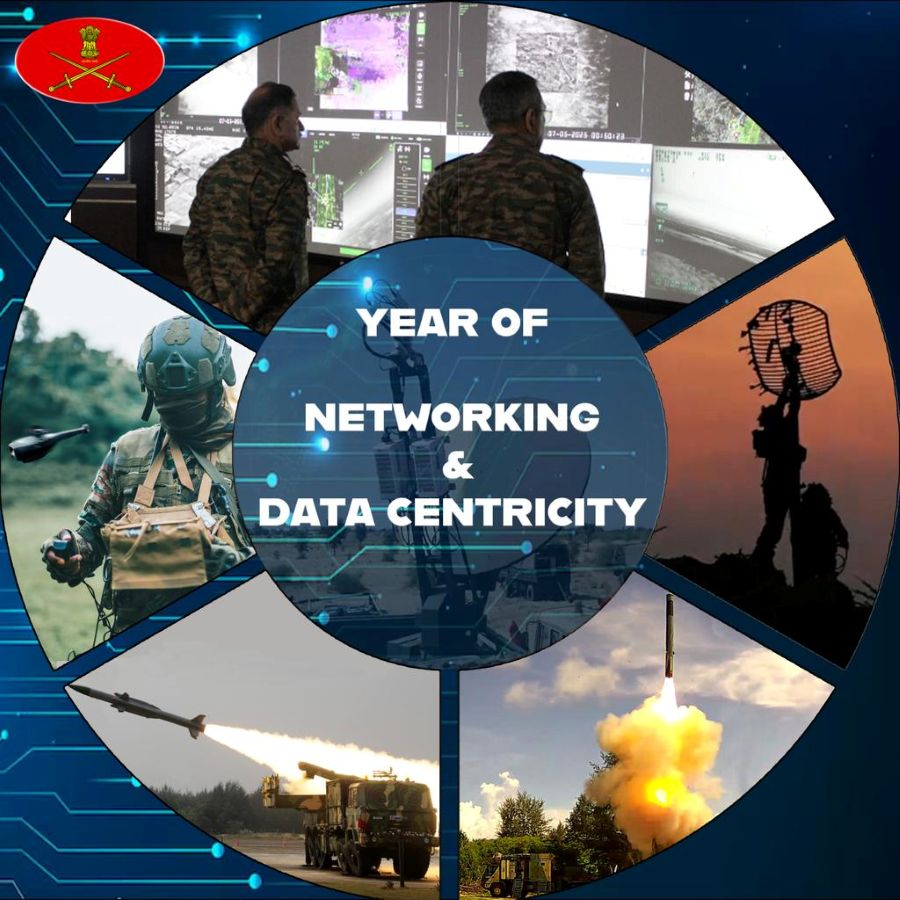
The declaration of 2026 as “The Year of Networking and Data-Centricity” by the top leadership of the Indian Army should be read not merely as an organisational modernisation initiative, but as a doctrinal signal. It reflects an institutional recognition that warfare is transitioning into a new historical phase—AI-Age warfare—which supersedes the long-dominant paradigm of information warfare.
This transition is not semantic. It represents a profound shift in how military power is generated, applied, and sustained. Information warfare sought to dominate the adversary’s awareness and decision-making by controlling information flows. AI-Age warfare seeks to accelerate, structure, and sharpen cognition itself, while preserving human judgment and accountability. Networking and data-centricity are, therefore, not support functions. They are the foundational conditions that enable AI-Age warfare possible.
Toffler, Information Age, and the Military Mind
The late futurist Alvin Toffler described the Information Age as a civilisational shift in which power moved away from brute force and mass production toward knowledge, information flows, and the ability to manage complexity. Militaries absorbed this insight earlier than most institutions. From the late twentieth century onward, information warfare became integral to military doctrine. Sensors, networks, communications, and command-and-control systems transformed the battlefield. Speed of information, situational awareness, and narrative control emerged as decisive force multipliers. The battlefield expanded into the electromagnetic and cognitive domains, and “seeing first” often meant “acting first.”
Yet the Information Age retained a critical assumption: that human cognition would remain the primary bottleneck. Information was gathered and transmitted faster, but analysis and decision-making remained largely human-centred. That assumption no longer holds.
The AI Age: A Cognitive Inflection
The AI Age represents a qualitative departure from the Information Age that is not merely technological. While the Information Age focused on the availability and dissemination of information, the AI Age focuses on interpretation, prioritisation, correlation, and prediction at scale. The distinction is crucial because while Information-Age warfare compresses time and space, AI-Age warfare compresses cognition.
In modern battlefields, data volumes far exceed human capacity to absorb and analyse them unaided. Sensors generate continuous streams of information across land, air, cyber, space, and the electromagnetic spectrum. The challenge is no longer collecting information, but making sense of it in time to matter. AI-Age warfare, therefore, centres on decision dominance—the consistent ability to generate better decisions faster than the adversary, under conditions of ambiguity, contestation, and stress.
Artificial intelligence is indispensable to this goal, but it is not an autonomous magic. It is only as effective as the networks that carry information and the data that feeds it. This is where the Indian Army’s emphasis on networking and data-centricity reveals the strategic depth of General Upendra Dwivedi’s understanding of the trend.
Networking: The Decision Fabric of AI-Age Warfare
In AI-Age warfare, networking must be understood not as connectivity alone, but as a decision fabric—the means by which intent, information, and insight flow across the force. Effective networking enables shared operational understanding across echelons, seamless integration across domains, decentralised execution aligned with the commander’s intent, and rapid re-orientation as situations evolve. It directly reinforces mission command, which remains central to the Army’s operational philosophy. Networks enable mission command at scale by ensuring that subordinate commanders operate with clarity rather than isolation.
Crucially, AI exploitation depends on this fabric. AI-enabled decision support is only useful if insights reach the right commander at the right moment. Fragmented or brittle networks turn AI into a theoretical asset rather than an operational one. The Army’s focus on networking, therefore, signals an understanding that networks are now as operationally decisive as manoeuvre corridors or logistics lines.
Data-Centricity: From Information Abundance to Cognitive Clarity
If networks form the nervous system of AI-Age forces, data is the cognitive substrate. Data-centricity represents a shift from treating data as an exhaust of operations to treating it as a strategic resource. It demands discipline in data generation, validation, governance, and use. Poor-quality data does not merely reduce efficiency; in AI-enabled environments, it can actively mislead.
For commanders, the value of data-centricity lies not in dashboards or analytics, but in decision confidence. Trusted data enables pattern recognition, trend analysis, and anticipation—allowing leaders to move from reactive to proactive decision-making. Importantly, data-centricity is also what makes joint and multi-domain integration feasible. Without common data standards and shared understanding, jointness remains procedural rather than operational. With it, integration becomes organic.
AI Exploitation: Augmenting Judgment, Not Replacing It
The Army’s sequencing—networks and data first, AI next—is strategically sound. AI in warfare should be understood as cognitive augmentation, not cognitive substitution. Its role is to reduce cognitive overload, highlight anomalies and opportunities, offer decision options, and accelerate planning cycles. Final judgment, accountability, and intent must remain human.
By emphasising foundational enablers, the Army avoids the trap of premature automation—a risk where AI systems are deployed without mature data foundations, leading to false precision and overconfidence. In the AI Age of warfare, restraint is a virtue. The most capable forces will be those that know where not to automate, as much as where to apply AI.
Joint and Multi-Domain Operations: The Natural Habitat of AI-Age Warfare
AI-Age warfare unfolds in an environment where land, air, maritime, cyber, space, and information domains are inseparable. Actions in one domain ripple instantly into others. Networking and data-centricity are what make this complexity manageable. They enable cross-domain awareness, coordinated effects, rapid re-tasking of assets and consequent re-grouping, and unity of effort across services and agencies.
AI exploitation magnifies these advantages by assisting in synchronisation and prioritisation. But again, AI’s value emerges only when data flows are coherent, and networks are resilient.
Risks and Frictions in the Transition to AI-Age Warfare
The vision is compelling, but execution will determine success. Transformations of this magnitude flounder not because of a lack of intent or technology, but because of misalignment between strategy, culture, and implementation.
Fragmented Networks Without Coherence: One of the most serious risks is fragmentation—the accumulation of systems that are technically connected but operationally incoherent. Such networks generate volume without clarity, overwhelming commanders rather than empowering them. Mitigation requires treating networking as a command-and-decision architecture challenge, not merely a technical integration exercise. Every connection must serve a defined operational purpose.
Data Proliferation Without Trust: As data volumes grow, so do vulnerabilities – poor quality, inconsistent standards, bias, and deliberate manipulation. Adversaries will seek to poison data streams to distort AI-assisted decision-making. If trust in data erodes, commanders will disengage entirely from data-driven tools. Robust governance, validation, and human-in-the-loop processes are, therefore, non-negotiable.
Cultural Resistance and Cognitive Inertia: Networking and data-centricity redistribute informational power. It can challenge legacy command cultures if not framed correctly. If transformation is perceived as technology-led rather than command-empowering, adoption will remain superficial. Doctrine, education, and leadership narrative must reinforce that these changes strengthen mission command, rather than dilute authority.
AI Overreach and Premature Automation: The temptation to over-automate is real. In warfare, however, errors are irreversible. AI systems must be introduced incrementally, transparently, and with clear boundaries. Human judgment must remain central, not as a fallback, but as the organising principle.
Adversarial Contestation of the Digital Battlespace: Adversaries will contest networks, data, and cognition through cyber attacks, electromagnetic interference, and information manipulation. Resilience must, therefore, be institutional, not merely technical. Training for degraded modes, redundancy, and cognitive adaptability is as important as technological hardening.
Strategic Design and Implementation
Sustainable transformation in the AI age demands a first-principles understanding of technology, a strategy rooted in operational reality, security and governance by design and clear ownership of outcomes. Technology must serve a purpose. Architecture must enable speed. Data must drive decisions. AI must enhance judgment.
What emerges from these risks is a central insight: implementing networking and data-centricity is not a technology project. It is a strategic design problem. Success depends on aligning strategic intent (decision dominance), operational philosophy (mission command), institutional architecture (networks and data), human judgment (trust and accountability), and adaptive execution (learning and feedback).
This logic aligns closely with contemporary strategic digital thinking articulated by organisations such as Eclat DigiStrat Advisors, founded by this author, whose positioning manifesto emphasises clarity before complexity, architecture before automation, and outcomes before tools. The alignment is philosophical rather than transactional, reflecting a shared understanding of how advantage is built in the AI Age.
Conclusion: Preparing for the Next Epoch of Warfare
The Year of Networking and Data-Centricity should be understood as the Indian Army’s most transformative initiative ever, a deliberate preparation for AI-Age warfare—the next stage in the evolution of information warfare. By strengthening networks and treating data as a strategic asset, the Army is laying the foundations for responsible AI exploitation, joint decision dominance, and resilient command under contestation. Humans will still fight wars in the AI Age. But they will be won by those institutions that design the best systems for thinking, deciding, and acting under uncertainty. In that sense, the Army’s initiative is not merely about technology. It is about how an institution prepares its mind for the future of war.
Maj Gen Ravi K Chaudhary, VSM(Retd)

The author is a former Additional Director General, Information Systems, at Army Headquarters, and Scientist ‘H’ at the National Technical Research Organisation (NTRO). A strategy and technology expert, he was also a full-time member of the Task Force on Defence Management.