



Editor’s Note
The article argues that China’s perception of India’s Tibet policy acts as a structural constraint on resolving the India–China boundary dispute, and that Himalayan confrontations are best understood not merely as territorial incidents but as manifestations of deeper Chinese sovereignty anxieties linked to Tibet. It seeks to offer readers a fresh analytical lens on the persistence of tensions despite decades of attempts to resolve them.
Recent diplomatic engagements and military-level talks between India and China have once again raised hopes that the long-frozen boundary dispute might finally move towards resolution. Statements about “stabilisation” and “disengagement” suggest a tentative thaw. Yet history urges caution. Every earlier phase of apparent calm has eventually given way to renewed confrontation, often more intense than before.
This recurring cycle points to a deeper problem. The India–China boundary dispute is not simply about competing maps or patrol routes. It is rooted in a fundamental divergence in how the two countries understand the dispute itself.
For India, the boundary question is essentially territorial. It concerns the alignment of the Line of Actual Control, the prevention of incidents, and, eventually, a mutually acceptable settlement. For China, however, the boundary is embedded in a wider political and security framework concerning Tibet. It is not just about the territorial dispute, but about how that dispute can be used as a strategic tool to advance its goals regarding Tibet. Therefore, at the heart of this divergent approach towards the boundary dispute between India and China sits Tibet.
Tibet occupies a unique place in Chinese strategic thinking. It is not merely an autonomous region on China’s western periphery. It is a political project whose legitimacy must be continuously reaffirmed. Since the unrest across Tibetan areas in 2008, Beijing has treated Tibet as a permanent national security priority. Surveillance networks have expanded. Political re-education campaigns have intensified. Monasteries have been placed under tighter state supervision. Control over religious institutions and the reincarnation process has been codified.
These measures reveal an underlying anxiety. Beijing does not see Tibet as a settled chapter of history. It sees it as an arena where internal cohesion and regime authority must be constantly defended.
This insecurity shapes how China approaches its Himalayan frontier. As long as this insecurity over Tibet persists, China is unlikely to accept a boundary settlement with India that will give away a strategic tool to pressurise India to assuage its perceived threat emanating from Tibetans staying in India.
India, however, approaches Tibet very differently. New Delhi officially recognises Tibet as part of the People’s Republic of China. This position has been consistent for decades. India hosts the Dalai Lama and the Tibetan refugee community on humanitarian grounds, reflecting historical circumstances rather than strategic design. India does not support Tibetan independence. It does not question Chinese sovereignty over Tibet.
From New Delhi’s perspective, Tibet is not a live political issue. However, from Beijing’s perspective, it is.
What India views as a humanitarian legacy, China often interprets as latent strategic leverage. The presence of Tibetan exile institutions on Indian soil, and their ability to engage international audiences, feeds Chinese suspicions that India could, under certain circumstances, become a facilitator of external pressure on Tibet.
Again, the issue is not Indian intent. It is a Chinese perception, or rather, a threat in being for them.
History suggests that Tibet-related anxieties have repeatedly intersected with the India-China conflict.
In the 1950s, China’s consolidation of control over Tibet and the construction of infrastructure linking Xinjiang to Lhasa altered the strategic landscape of the Himalayas. India’s concerns about these developments coincided with the rapid deterioration of bilateral relations. The 1962 war followed soon after the Tibetan uprising and the Dalai Lama’s flight into India. The first major India–China war thus emerged from a Tibet-centric security context, not merely from cartographic disagreement.
This pattern has echoed in later decades. The unrest across the Tibetan region in 2008 was followed by a marked hardening of Chinese internal security policies and a more assertive posture along the border. After the Dalai Lama relinquished his political role in 2011, Beijing no longer confronted a single charismatic figurehead but a civilian, institutionalised Tibetan political movement designed to endure beyond any individual. This shift fundamentally altered Chinese threat perception.
The Tibetan question was no longer viewed primarily as a personality-driven problem, but as a structural, society-wide challenge. In response, China accelerated efforts to penetrate and control Tibetan society at every level, tightening supervision of monasteries, criminalising everyday cultural expression, expanding grid-style surveillance into villages and towns, and codifying state authority over religious institutions and reincarnation processes.
As Tibet was redefined internally as a permanent national security frontier, its adjoining external frontiers acquired new strategic weight. The Himalayan border ceased to be treated merely as a disputed line and came to be seen as a protective political buffer for regime security. Within this framework, the Chinese perceived threat from what it viewed as India’s continued support for Tibetan refugees and institutions became a factor shaping external behaviour. Rather than directly articulating its anxiety over the Tibetan movement, Beijing found it strategically more effective to revive and sustain pressure along the Line of Actual Control.
Forward deployments, prolonged standoffs, and coercive patrol behaviour thus served as indirect instruments of signalling to the Government of India, exerting pressure without publicly linking confrontation to Tibet. In this sense, sustained Chinese activity along the boundary was not simply tactical friction, but an outward projection of inward insecurity.
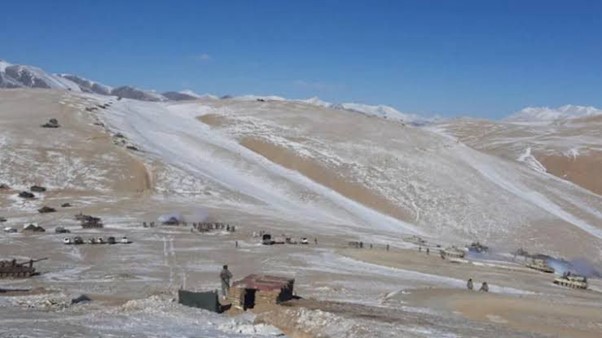
A series of major face-offs, beginning with the 2013 Depsang standoff in Ladakh, occurred following this phase of tightening. The most dramatic face-off came in 2020. Years of expanded surveillance, ideological campaigns, and border-county securitisation in Tibetan regions preceded the large-scale Chinese deployments across eastern Ladakh and the deadly clash in the Galwan Valley.
Correlation does not prove causation. But persistent correlation across decades suggests a structural relationship between Tibet-related developments and boundary tensions.
If Tibet drives Chinese strategic anxiety, then boundary confrontations serve purposes beyond territorial gain. They function as instruments.
Such confrontations signal resolve to India. They remind New Delhi of China’s escalation dominance. They test India’s willingness to defend third-party spaces. They also seek to reshape regional alignments.
The 2017 Doklam crisis illustrates this logic. While the immediate issue was Chinese road construction on a plateau claimed by Bhutan, the deeper objective was to open a direct strategic pathway to Thimphu. For decades, Bhutan’s China policy had operated within an India-centred security framework. Doklam marked China’s attempt to bilateralise its engagement with Bhutan and reduce India’s role as intermediary.
A similar logic can be seen in earlier Chinese pressure in the Sikkim sector. Efforts to test India’s position there in 1967 ultimately backfired when Sikkim was fully integrated into India, closing off the space China might have hoped to exploit. When pressure fails in one sector, Beijing shifts to another.
Seen in this light, boundary clashes are not accidents. They are messages.
They are part of a broader Chinese strategy aimed at shaping the political environment around Tibet and the Himalayan periphery.
This understanding has important implications for India.
If the boundary dispute is structurally linked to China’s Tibet anxiety, then a quick settlement is unlikely. Confidence-building measures can manage friction, but they cannot dissolve the underlying mistrust. India must therefore prepare for a prolonged phase of managed rivalry rather than imminent resolution.
It means continuing to strengthen deterrence and border infrastructure. It means maintaining diplomatic engagement without illusion. It also means handling Tibet-related issues with sensitivity, balancing humanitarian commitments with careful symbolism.
The most consequential line in the Himalayas is not the Line of Actual Control. It is the line in Beijing’s strategic thinking that links territorial dispute to its core anxiety in Tibet.
Until that perception changes, peace in the mountains will remain managed, not resolved.
Lakshman Kumar (Author is a research scholar who has extensively studied the 1962 Sino-Indian conflict and the Cold War dynamics)