






Editor’s Note
This is the first part of a two-part opinion series examining the changing utility of military force and lessons learnt from recent global conflicts. Drawing on Operation Sindoor, the Russia-Ukraine conflict and the US-Iran war, the author examines how drones, missiles and other technologies are changing the character of warfare. The author also explores why military victories are increasingly difficult to translate into durable political outcomes, and examines the roles of legitimacy, nationalism, interdependence, public scrutiny and revisionism in shaping modern conflicts.
What does the use of force in recent military engagements suggest about the prospects for crisis stability and escalation management in future conflicts?
What options are there for responding to coercion and escalation pressures?
What does strategic stability look like in the regional and global contexts?
The recent military conflicts offer rich pickings for deep analyses of war, warfighting and the utility of force. For some time now, I have mulled over the utility of force in postmodern wars, wars in the information age, and have concluded that the legitimacy of the use of force is as key to successful outcomes as legality. In this context, successful outcomes are not just a military win but also durable political change.
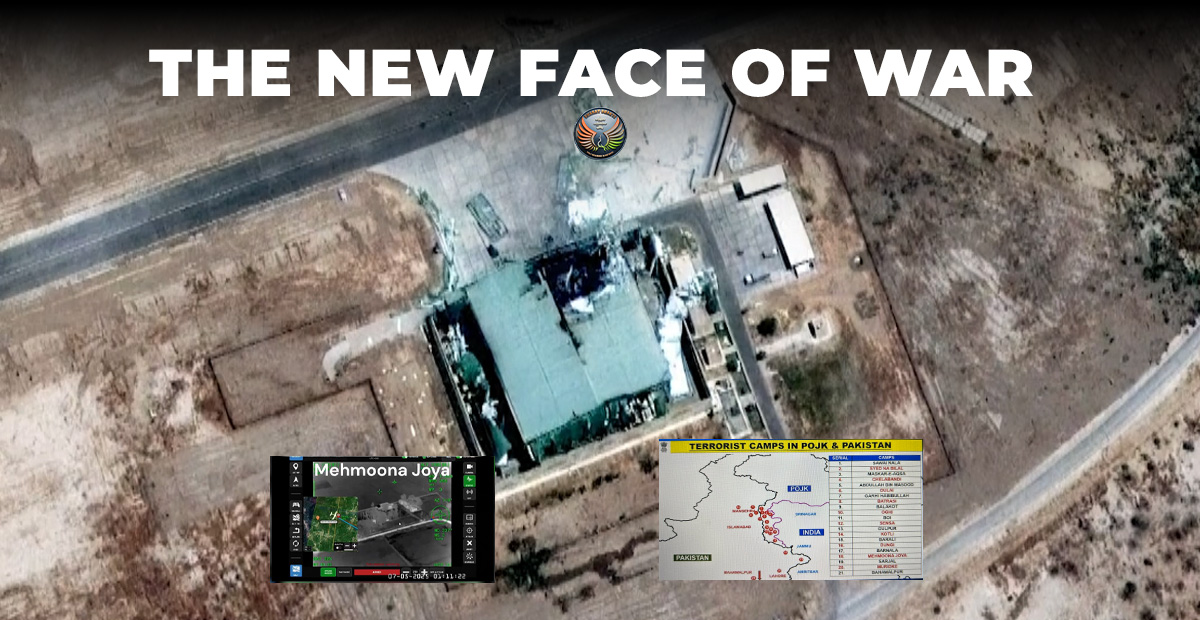
Of the recent military engagements, I have taken Operation Sindoor, the ongoing Russia-Ukraine and the US-Iran wars as the backdrop for my thoughts. On the face of it, there are similarities in all three conflicts. They differ in scale and duration but share the same logic. The attacking party is seeking behaviour change from the other protagonist and to address long-standing security concerns; it was not the first between the warring parties and will, in all likelihood, not be the last.
The significant takeaways or lessons from these conflicts that are contextual, and hence relevant to the subject at hand, can be summarised as follows:
- Ordnance delivery now appears to be better handled by low-cost drones and missiles, offering much greater cost-effectiveness and sufficient military value.
- The drone allows the weaker power to cause disproportionate damage and raise costs for the stronger force, thus dulling the ‘shock and awe’ doctrine. Mil-tech superiority need not necessarily translate into a subdued enemy.
- Warfighting will no longer be linear, and military and economic targets far from the locus of the fighting may well be the first targets in any conflict, thus complicating escalation management. Long-range drones and missiles armed with conventional warheads now enable horizontal escalation in any conflict by reducing the constraints and dilemmas inherent in such escalation earlier. Are we now in an era of unrestricted (or unrestrained) drone warfare?
- Deterrence dynamics have become even more complicated with cheap, low-cost drones impacting both deterrence by denial and by punishment. The drone will both weaken and strengthen deterrence, just like the non-state actor drone capability lends itself to asymmetric tactics and enables the use of force to be kept below a threshold.
With that as background, I propose that there have been very few examples of interstate use of military force post-World War 2 with successful political outcomes.
Most “wins” were military, but ended up politically messy. The rare cases that look like successes are the 1971 India-Pakistan War, the 1979 Tanzania-Uganda War and the 1982 Falklands Conflict. The 1999 Kargil Conflict and the recent Operation Sindoor can be included in this short list since their very limited politico-military aims were clearly achieved.
If Kargil is framed as a conflict aimed at changing Pakistan’s behaviour, then it would have fallen short; however, since it was clearly limited to the restoration of the LOC, it can be counted as an unqualified success.
The far more common pattern is a lack of durable political outcomes, with most resulting in frozen conflicts, stalemates, or, at best, temporary gains. It appears that interstate wars since 1945 have succeeded politically only when the aims were limited to restoring a status quo already recognised by the world, and when there was local legitimacy and the winner could leave quickly.
The recent ongoing conflicts, however, are different from those industrial-age wars, in that the character of war has changed with the advent of low-cost unmanned systems levelling the field. This situation will change again once suitable ‘equally low-cost’ countermeasures are developed, and the advantage may well swing back in favour of the big states. But for now, the weaker state can impose disproportionate costs on the stronger one.
Air defence becomes porous, allowing even a small state to contest the air, and persistent surveillance offered by drones and satellites means there are fewer surprises. As drones and unmanned long-range vectors change the character of war, they are also likely to reduce the probability of realising stable political outcomes.
Four Structural Reasons
Drones notwithstanding, I can see four structural reasons post 1945 that underpins this apparent lack of utility of force:
- Legitimacy of War
First: the strengthened international norm against wars of conquest, which means annexation is illegitimate. Numerous instances of use of force did not find an echo in the larger international community, for they seemed to go beyond the restrictions imposed by the UN Charter and have spurred debates not only on the legality of the use of force but also over its legitimacy.
This, coupled with the Law of Armed Conflict, which sought to limit the effects of armed war for humanitarian reasons by prescribing necessity, proportionality, and distinction as principles governing the use of force, has had a constraining effect. Any use of force that goes beyond the limits of these principles swiftly erodes legitimacy and support.
- Nationalism
Second: this has hardened post-1945 and not only as a consequence of the growing norm against conquest. As a result, populations resist any slights to sovereignty with fervour, thereby easing pressure on the state to capitulate.
While military tech can win battles, nationalism resists the political accommodation that is required to win the peace. Compromise becomes treason. Religion adds a transcendent layer. It is now not just territory; it is also identity and faith. You cannot trade that in a post-war treaty. Result: the cost of holding exceeds any gain. The drone age exacerbates this problem. So, even if you win militarily, the political win becomes much harder to obtain.
- Interdependency
Third: an interconnected world that has created a tangled web of interdependencies, and these can/have been weaponised to isolate and constrain the other side in ways that make any cost-benefit analysis untenable.
Thus, this dynamic works both ways – the strong and influential state has the means to constrain the weaker party by directly interfering with its dependencies. In contrast, the weaker state can generate risk to global supply chains by threatening to disrupt their smooth functioning.
- Public Scrutiny
Fourth: the transparency afforded by the information age brings every act of omission or commission of the military into public scrutiny. This impacts support and legitimacy of the use of force in ways that were unimaginable even a few years ago.
While access to information and transparency has the positive potential to deter war crimes and keep a check on excessive use of force, it also drives casualty aversion and allows propaganda to be spread. Thus, it can both build or undermine legitimacy.
Framing the purported loss of aircraft by India during Operation Sindoor as catastrophic, whereas similar US losses are the cost of war, is but a case in point.
Revisionism
In these circumstances, what are the prospects for crisis stability in future? My short answer is ‘bleak’, for this will depend on the lessons drawn from the ongoing conflicts, on how norms evolve and how deterrence is reimagined.
Revisionism, whether driven by religious or territorial motivations, may see in the drone (metaphor) the perfect instrument to play the long game. The international state system was built on the idea of absolute sovereignty and state responsibility. This norm has been gutted by allowing the idea of the ‘non-state’ actor to gain currency and accepting deniability as a reason to evade state responsibility.
This makes revisionism a win-win proposition. At best, the gamble will pay off; at worst, it will be a return to status quo, with the world applauding the revisionist state for backing down rather than punishing it for the misadventure in the first place. In the relief that de-escalation brings, the initial provocation is lost sight of. We saw this dynamic play out during Operation Sindoor.
Vice-Admiral RB Pandit (Retd)
(Note: Part II will appear on 24th August)

Vice Admiral RB Pandit was commissioned into the Indian Navy’s Executive Branch in July 1984. Over four decades, he commanded three ships, a missile squadron, the Western Fleet, and was Commander-in-Chief, Strategic Forces Command.