


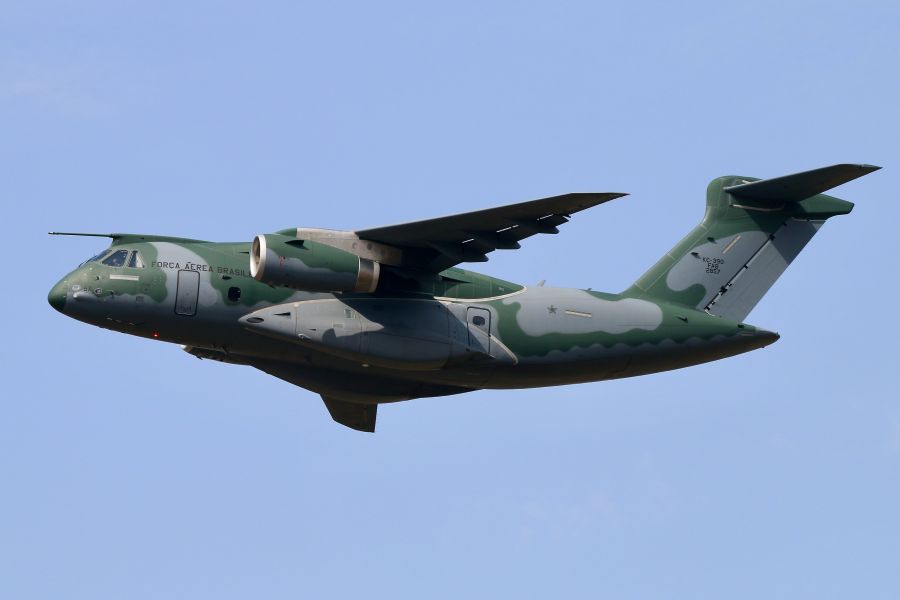
Brazilian aerospace major Embraer has agreed to acquire a 51% stake in Novavayu Aerospace Limited, a subsidiary of Mahindra Defence Systems, strengthening their partnership ahead of the Indian Air Force’s (IAF) Medium Transport Aircraft (MTA) competition. The agreement, signed on October 9, is expected to be completed by December 1, 2026.
The move comes as Embraer and Mahindra position the C-390 Millennium for India’s requirements, with Nagpur identified as the potential location for an aircraft assembly facility, subject to selection. The transaction will give Embraer majority ownership of Novavayu, which was incorporated in July as a wholly owned subsidiary of Mahindra Defence Systems.
The development adds momentum to an increasingly important contest. The Ministry of Defence issued the Request for Proposal (RFP) for 60 medium transport aircraft in August, opening the way for a programme aimed at replacing the IAF’s ageing An-32 fleet. The tender has also gone to Adani Defence & Aerospace and other Indian companies, including Tata Advanced Systems Limited (TASL), Mahindra Defence Systems and Hindustan Aeronautics Limited.
The two principal aircraft contenders are Brazil’s Embraer C-390 Millennium, partnered with Mahindra, and American manufacturer Lockheed Martin’s C-130J-30 Super Hercules, partnered with TASL. While other Indian companies have received the RFP, their participation should not be read as confirmation of a third aircraft offering in this contest.
The programme could determine the complexity of India’s private-sector participation in military aviation, the scale of technology transfer and the extent to which the country can maintain and upgrade its transport fleet independently.
Former Indian Air Force Officer Gp Capt Praveer Purohit (retd), explaining the implications, stated that the choice must be evaluated not only on aircraft performance but also on life-cycle costs, supply-chain resilience, industrial commitments and strategic autonomy.
The C-390 Millennium is a twin-engine jet-powered transport aircraft with a stated maximum payload of approximately 26 tonnes. Embraer’s C-390 Millennium uses two IAE V2500-E5 turbofan engines, each producing approximately 31,000–31,300 pounds of thrust.
The engines are produced by International Aero Engines (IAE), a multinational consortium that includes Pratt & Whitney, Japanese Aero Engine Corporation and MTU Aero Engines.
The engine’s international supply chain is an important consideration when assessing technology transfer, maintenance independence and long-term supply security for India.
The C-130J-30 is a four-engine turboprop with a long operational history and an established presence in the IAF.
The C-390’s higher maximum payload and jet-powered performance offer potential advantages in moving cargo quickly over long distances. The C-130J-30, meanwhile, brings proven operational experience, existing Indian infrastructure and familiarity among aircrew and maintenance personnel.
However, specifications mentioned in the public domain alone cannot decide which aircraft is better suited to India. Performance varies with temperature, altitude, runway conditions, payload and mission profile. The ability to operate from austere airfields, turnaround time, maintenance requirements and availability of spare parts will all be important considerations.
The IAF already operates the C-130J in tactical transport and special-operations roles. Additional aircraft of the same family could build on existing training, maintenance and support infrastructure, potentially reducing the cost and complexity of induction.
TASL also has an established industrial relationship with Lockheed Martin, including the manufacture of C-130J empennages in India. This gives the American manufacturer and its Indian partner an existing foundation on which to build further domestic production.
But an established fleet does not automatically settle the competition. Acquisition price, operating costs, future upgrades, production commitments and the depth of technology transfer will still require close scrutiny.
For Embraer, the MTA programme offers an opportunity to expand the C-390’s international footprint while establishing a stronger industrial presence in India. For Mahindra, the partnership could provide a road into more advanced military aircraft manufacturing.
A potential assembly line in Nagpur could attract Indian suppliers and create opportunities in aerostructures, components, maintenance and other aerospace activities. The extent of those benefits, however, will depend on the final industrial agreement and the programme award.
Introducing a new aircraft type also entails costs. India would need to develop the associated training, simulation, maintenance and logistics infrastructure, while building experience with a platform not currently operated by the IAF.
The C-390’s payload and speed advantages must therefore be weighed against the costs of establishing a new ecosystem. Equally, the C-130J’s existing support network must be assessed against the commercial terms and industrial commitments offered for additional aircraft.
The geopolitical dimension complicates the choice. India and the United States have developed substantial defence cooperation, but uncertainty in the wider bilateral relationship has sharpened questions about the reliability of overseas supplies and the conditions attached to technology access.
Brazil offers a different strategic and industrial partnership. Yet selecting a Brazilian aircraft would not automatically remove American influence over the supply chain.
The C-390 relies on internationally sourced systems, including components of American and British origin. The C-130J also depends on a multinational network of suppliers. US-origin components and controlled technologies can be subject to export licences that affect transfers, upgrades, spare parts and access to technical information.
The main issue, therefore, is not simply whether the aircraft comes from the United States or Brazil. It is whether India can secure dependable long-term support, integrate indigenous systems and maintain operational readiness during a supply disruption or diplomatic disagreement.
According to Purohit, India’s purchasing power should be used to negotiate enforceable commitments on spare-parts availability, maintenance rights, technology transfer and domestic industrial participation. An assembly line alone does not guarantee access to proprietary designs, software, engine technology or the ability to modify an aircraft independently.
These requirements must be addressed in the contract, with clear obligations, appropriate legal authorisations and remedies if agreed commitments are not met.
The MTA competition brings together two distinct propositions: an established aircraft and support ecosystem through Lockheed Martin–Tata, and a newer jet-powered platform with a proposed manufacturing partnership through Embraer–Mahindra.
The IAF’s operational requirements, trials, acquisition costs and life-cycle assessments must determine the outcome. Industrial participation and strategic autonomy should be integral to that evaluation, rather than treated as secondary benefits.
Huma Siddiqui