



Editor’s Note
The Easter Sunday attacks exposed a critical weakness in Sri Lanka’s security architecture – intelligence warnings are of little value unless they lead to timely, coordinated action. This article draws on the work of Sri Lankan security experts and the Pathfinder Foundation to examine how institutional reform, professional intelligence and clear lines of accountability can help prevent future failures.
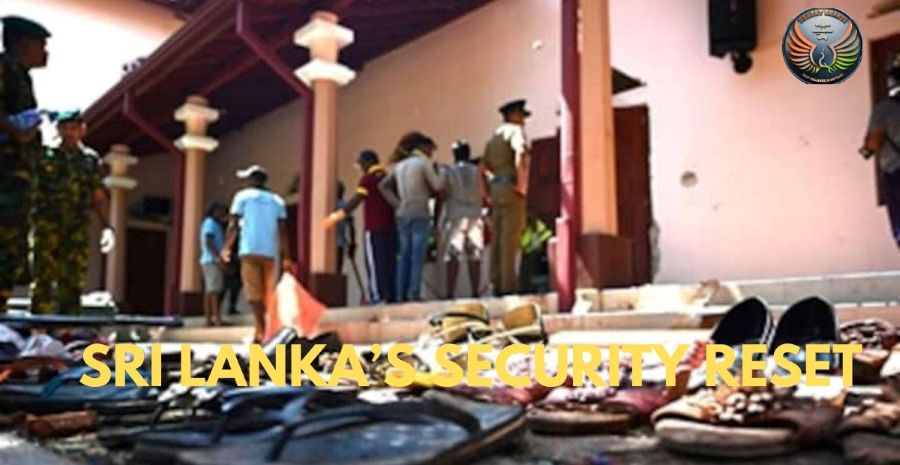
The verdict ( Sept 22, 2026) delivered by the Colombo Permanent High Court Trial-at-Bar in the Easter Sunday attacks case marks an important moment in Sri Lanka’s continuing search for justice and accountability. Beyond determining criminal responsibility, the proceedings have brought renewed attention to the institutional failures that allowed warnings of an impending terrorist attack to remain without an effective preventive response.
The significance of the judgment, therefore, goes beyond the courtroom. It should encourage Sri Lanka to examine how intelligence is collected, assessed, disseminated and converted into action. The objective should not be another cycle of political recrimination. It should be the creation of a security system capable of learning from failure and preventing its repetition.
In this respect, the recommendations of Sri Lankan security professionals, former public servants and independent policy institutions deserve particular attention. They provide a domestic foundation for strengthening the country’s national-security architecture without importing an externally prescribed model.
From intelligence to action
One of the central lessons of Easter Sunday is that the problem was not simply the absence of intelligence. Information relating to extremist activity and individuals subsequently associated with the attacks had been available to the security establishment. The Parliamentary Select Committee established after the attacks identified weaknesses in intelligence sharing, preparedness, coordination and the functioning of the national-security system.
The critical question, therefore, is what happens between the receipt of a warning and the taking of preventive action.
Prof. Rohan Gunaratna has consistently emphasised the importance of developing specialised national-security expertise and the capacity to identify and prevent extremist threats before they mature. His analysis is particularly relevant to Sri Lanka because the nature of terrorism has changed considerably from the traditional insurgency experience. Contemporary threats can emerge through transnational networks, online radicalisation, financial channels and relatively small cells operating below the conventional security threshold.
This requires more than additional manpower or equipment. It requires professional expertise, continuous assessment and institutional memory.
Sinduja Umandi W. Jayaratne, a Sri Lankan scholar-practitioner of intelligence and counter-terrorism, reaches a complementary conclusion. In her study, ‘Why Does Sri Lanka Need Intelligence Reform?‘ She argues that Sri Lanka needs to move from a predominantly reactive intelligence approach towards a more proactive strategic-intelligence framework. She identifies weaknesses in the existing system, including institutional and political factors, while also stressing the importance of modernisation, human rights and accountability.
Her analysis is particularly useful because it places the Easter experience within the broader evolution of Sri Lanka’s security environment. The lesson is not simply to improve counter-terrorism after an attack. It is to develop the ability to anticipate changing threats before they become operational crises.
Former IGP N. K. Illangakoon has highlighted another weakness: fragmentation among intelligence agencies and excessive dependence on individual senior officials. His advocacy of a strong and independent institutional mechanism established through legislation remains relevant. A national-security system cannot function effectively if its performance depends upon personalities, informal relationships or the particular leadership style of an individual office-holder.
Dinouk Colombage has likewise drawn attention to the need for better intelligence integration and a more effective National Security Council mechanism. The lesson is an important one: intelligence has little value unless it reaches the right authority, is properly assessed and results in a timely decision.
The Pathfinder contribution
Sri Lanka already has an important indigenous body of work on this question. The Pathfinder Foundation’s engagement with national-security policy predates the Easter attacks. Its National Security Strategy 2020 for Sri Lanka was prepared following consultations with former senior commanders of the armed forces, senior public officials, diplomats and academics.
That background gives the Pathfinder initiative particular relevance to the present discussion. It was not conceived simply as a reaction to Easter Sunday. The Foundation had begun examining Sri Lanka’s national-security requirements before the attacks, while the attacks subsequently reinforced the urgency of the issue.
The 2019 strategy argued for a coherent national-security policy and stronger institutional foundations for the National Security Council. Its central concern was the need to bring together the different instruments of national power within a clearly defined strategic framework.
The Pathfinder Foundation has now taken this thinking further. Its National Security Strategy for Sri Lanka 2026, launched in March 2026, argues for a comprehensive, state-led national-security framework encompassing internal security, cybersecurity, economic and energy security, human security and other emerging challenges. It employs the DIME framework—Diplomacy, Information, Military and Economy—to emphasise the coordinated use of national power.
For the present discussion, however, its institutional recommendations are particularly significant: a fully legislated National Security Council, a National Security Secretariat and a formally appointed National Security Adviser to provide continuity, coordination and policy implementation.
These proposals address precisely the institutional gap exposed by Easter Sunday: who brings together information from different agencies, who provides an integrated assessment, who ensures that the political leadership receives it, and who follows up to ensure that decisions are implemented?
Beyond legislation: building a national intelligence system
This is where Jayaratne’s more recent work adds an important dimension to the Pathfinder proposals. In her September 2026 paper, ‘Reforming Sri Lankan Intelligence: Beyond Legislation to a National Intelligence System‘, she cautions against assuming that a new law, by itself, will resolve the weaknesses of the intelligence system. Her argument is that meaningful reform has to address the structural, functional and strategic dimensions of intelligence. Sri Lanka already possesses considerable experience accumulated through decades of dealing with insurgency, terrorism and post-conflict security challenges. The objective, therefore, should not be to discard that experience or simply reproduce another country’s intelligence model, but to determine what should be retained, adapted and changed.
This is an important distinction.
Sri Lanka may require legislation to define responsibilities, establish oversight and provide institutional continuity. But legislation is only the foundation. An effective national intelligence system must also have professional analysts, appropriate technology, inter-agency information sharing, strategic assessment, clear dissemination channels and mechanisms that connect intelligence with policy and operational decision-making. In other words, the reform should be of the system, not merely of the statute.
From recommendations to operating procedures
Institutional reform must be accompanied by clear Standard Operating Procedures. A credible threat warning should enter a defined assessment mechanism within a specified period. Its reliability and urgency should be assessed by the relevant intelligence, police, military and civilian authorities. Where a warning identifies a person, location, event or method of attack, responsibility for follow-up should be explicitly assigned.
There should also be an auditable chain of responsibility. It should be possible to establish who received the information, who assessed it, who was informed, what action was ordered and whether that action was completed. Such procedures would not eliminate professional judgment. They would reduce the possibility that critical information becomes trapped in bureaucratic silos.
Accountability must form part of the system. Deliberate suppression of information, wilful failure to transmit a credible warning or disregard of established procedures should carry appropriate consequences. At the same time, officials acting honestly and professionally should not be penalised simply because an intelligence assessment later proves incorrect. A healthy security system must encourage responsible reporting rather than institutional caution and silence.
Building sovereign resilience
The real challenge now is implementation. Sri Lanka has accumulated recommendations from parliamentary inquiries, security professionals, commissions and policy institutions. What is missing is a mechanism that systematically translates those recommendations into institutional practice.
The Pathfinder Foundation’s work provides an important Sri Lankan framework for doing so. Its earlier strategy established the case for a coherent national-security policy and institutional coordination. Its 2026 strategy updates that argument in light of a more complex security environment and places the NSC, National Security Secretariat and National Security Adviser at the centre of the proposed architecture.
Jayaratne’s work complements this by reminding policymakers that institutional reform must go beyond formal structures. A national-security system has to be capable of producing strategic foresight, integrating information and providing decision-makers with timely and usable intelligence.
The government has also recognised the implementation problem. In 2026, the Cabinet approved an expert mechanism to examine and monitor implementation of recommendations arising from the Easter-related investigations. The next step should be to establish a permanent culture of review rather than another temporary exercise.
Sri Lanka does not require an unnecessarily elaborate security bureaucracy. It needs a professional, accountable and enduring national-security architecture in which institutions—not personalities—carry responsibility.
The country has the experience, professional expertise and policy recommendations necessary to undertake this reform. What is required now is the resolve to bring them together.
The lasting lesson of Easter Sunday should therefore be neither fear nor recrimination. It should be resilience. Sovereignty is strengthened when a state can receive a warning, assess it independently, make a timely decision, act upon it and subsequently account for that action within the law. That is the foundation of a secure democratic state. For Sri Lanka, the task now is to convert the painful lessons of Easter Sunday into an institutional capacity that can protect its citizens, preserve its democratic character and meet the security challenges of the future with greater confidence.
Pratap Heblikar