



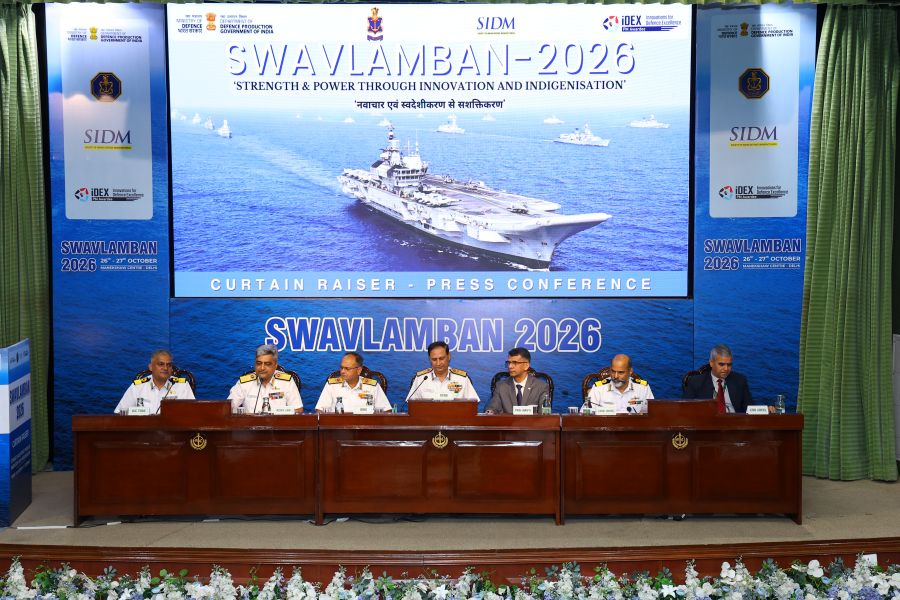
The Indian Navy’s push to indigenise defence technology has gathered momentum, with projects worth more than Rs 3,500 crore receiving Acceptance of Necessity (AoN) and contracts exceeding Rs 1,900 crore concluded under its innovation ecosystem, Vice Admiral Ajay Kochhar, Vice Chief of the Naval Staff, said on Monday.
The figures underline the expanding role of Indian industry, start-ups and micro, small and medium enterprises (MSMEs) in meeting the Navy’s operational requirements as it seeks to reduce dependence on foreign suppliers. More than 4,000 proposals have been received from Indian innovators under the Innovations for Defence Excellence (iDEX) framework, with around 150 MSMEs and start-ups participating.
Addressing a press conference ahead of the fifth edition of Swavlamban, the Navy’s flagship Naval Innovation and Indigenisation Organisation (NIIO) seminar in, Vice Admiral Kochhar said the focus was on connecting India’s technological talent with operational requirements and translating indigenous innovation into deployable capabilities.
The Navy currently has 42 platforms on order, while projects worth Rs 2.14 lakh crore have received AoN, he said, highlighting the scale of its modernisation and procurement pipeline. The AoN figures represent project approvals and should not be confused with contracts actually signed or expenditure incurred.
Scheduled for October 26-27 at the Manekshaw Centre in New Delhi, Swavlamban 2026 will bring together the Navy, domestic industry, start-ups, MSMEs, academia, investors and the wider defence ecosystem to develop solutions for emerging maritime security challenges.
The seminar has grown significantly since its inaugural edition, which attracted around 800 participants. Nearly 3,000 attended last year, and more than 100 stalls are expected at this year’s event.
The Navy’s indigenous technology priorities increasingly extend to advanced systems, including quantum positioning systems, high-power microwave directed-energy weapons, extra-large autonomous underwater vehicles and indigenous ramjet engines for fixed-wing aerial platforms.
Vice Admiral Kochhar identified speed and spiral development as key priorities for the next phase of innovation. The objective is to shorten the path from concept and prototype to testing, production and operational deployment, while enabling technologies to be improved through successive stages of development.
The press conference also highlighted the Navy’s continuing operational commitments amid the West Asia crisis. Under Operation Urja Suraksha, the Navy has escorted merchant vessels carrying cargo valued at around Rs 16,000 crore through the West Asia and Arabian Sea region, helping safeguard India-bound energy shipments and other critical supplies amid disruptions around the Strait of Hormuz.
The Navy’s twin priorities, sustaining maritime security and accelerating domestic defence innovation, reflect the growing importance of indigenous industrial capacity to India’s operational preparedness and long-term strategic autonomy.
Team BharatShakti