



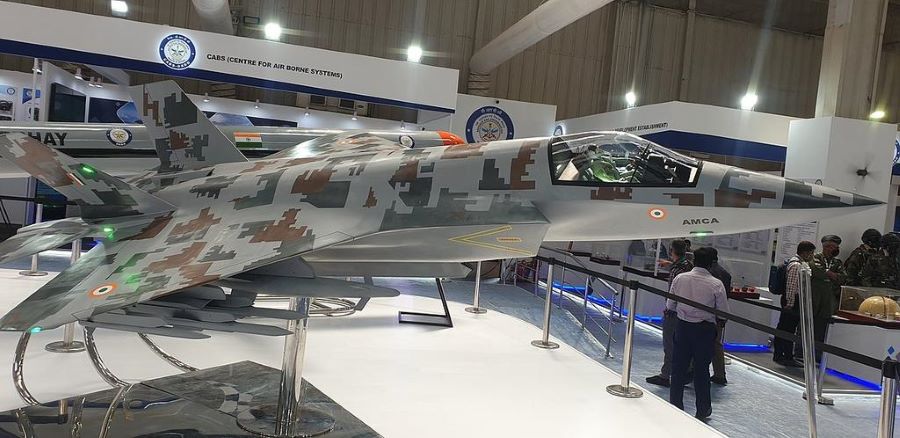
As China deepens defence ties with Pakistan, offering advanced platforms like the J-20 and J-35, India faces a stark choice: accelerate its homegrown Advanced Medium Combat Aircraft (AMCA) programme or risk falling into permanent disadvantage in the regional airpower balance.
The Ministry of Defence (MoD) has finally begun examining the Indian Air Force’s (IAF) proposal to acquire 114 “Made in India” Rafale fighter jets, a long-awaited step in the Multi-Role Fighter Aircraft (MRFA) programme. The deal, coupled with options for limited Su-57 imports from Russia, may plug immediate gaps. Yet this interim fix underscores the deeper reality: only AMCA can restore parity with China’s stealth fleet and Pakistan’s looming induction of fifth-generation fighters.
Interim Fix vs. Long-Term Sovereignty
The IAF’s fighter strength is set to shrink to 29 squadrons this month, far short of the sanctioned 42. To arrest the slide, planners are considering a hybrid approach: 3–5 squadrons of Rafales with Make-in-India clauses, a push to ramp up LCA Tejas Mk1A deliveries, and possibly a couple of Su-57 squadrons.
But such measures can only buy time. Former Air Chief Marshal R.K.S. Bhadauria, speaking on BharatShakti Dialogues, called AMCA “the most ambitious leap India has ever attempted in combat aviation,” urging that it be treated as a national mission involving government, DRDO, DPSUs, and private industry. “Importing fifth-generation fighters is not a sustainable option,” he warned.
Also Read: India Weighs Russian Su-57 Fighters as Fifth-Gen Option Ahead of Putin Visit
AMCA: The Decisive Leap
The AMCA is envisioned as a stealth-capable, multi-role, fifth-generation fighter with supercruise capability, advanced avionics, and networked warfare features. If delivered on schedule, it would not only give India generational parity with adversaries but also establish it as a serious aerospace power with the potential to export advanced combat jets.
For the IAF, which faces both declining numbers and widening technological gaps, the AMCA is more than a capability upgrade. It is the difference between strategic autonomy and permanent reliance on imports.
Lessons from the LCA: No Room for Drift
The cautionary tale is the Light Combat Aircraft (LCA) Tejas, which took nearly four decades from concept to squadron service. Chronic delays -caused by bureaucratic inertia, shifting requirements, and over-dependence on foreign inputs – left the IAF with dwindling numbers and outdated fleets.
AMCA cannot afford such drift. “We don’t just lack numbers; we lack generational parity,” warned Group Captain Praveer Purohit (Retd). “China already fields over 250 fifth-generation fighters, and Pakistan is preparing to induct them. AMCA is our only hope of restoring balance. Delivering on time is existential.”
Also Read Exclusive Confirmed: Rafale Frontline in IAF’s Fighter Crisis
Engine Dependence: A Strategic Vulnerability
A critical challenge lies in engines. GE’s recent delays in supplying F404 engines for the Tejas Mk1A disrupted HAL’s production schedule, highlighting the fragility of import dependence. Both Tejas Mk2 and AMCA Mk1 are tied to the GE F414 engine, but technology transfer is capped at about 58%, with ambitions to scale to 80%. Delivery schedules also remain uncertain.
This dependence raises fears of a repeat of the LCA experience. “This project must leapfrog us into the big league, not just militarily but industrially,” Purohit said. “But we must avoid the complacency of the LCA years. Time is running out.”
Safran Deal: Strategic Opening, Not a Solution
India is negotiating with French manufacturer Safran to co-develop an engine for AMCA Mk2 by 2037. This collaboration would provide joint intellectual property and potential export rights, representing a significant step beyond traditional Technology Transfer (ToT) agreements.
Yet experts caution against over-reliance on partnerships. “Engines, radars, and BVR weapons are strategic technologies no nation parts with easily,” noted Air Commodore T.K. Chatterjee (Retd). “Partnerships are important, but the long-term game must be 100% indigenous design. Anything less leaves us vulnerable.”
DPSUs Must Deliver – or Step Aside
The Aeronautical Development Agency (ADA) has already invited Indian private firms to participate in AMCA prototype development, flight testing, and certification. It marks a shift from state-dominated execution to a consortium model with private industry at the core.
But for the model to work, DPSUs like HAL and DRDO must evolve. HAL, already under fire for delivery delays in the Tejas Mk1A and trainer variants, faces questions about whether it can transform from a production house to an innovation-driven partner.
“The IAF must have a bigger say. DPSUs must be accountable, and private industry incentivised,” Purohit argued. “We can no longer afford an era where deadlines slip without consequences.”
The Strategic Imperative
For India, AMCA is not just about matching adversaries – it is about sovereignty. China’s stealth fleet is already operational, while Pakistan is likely to induct Chinese fifth-generation jets no sooner than later. The MRFA deal and interim imports may provide a cushion, but without AMCA, India risks sliding into permanent second-rank status in airpower.
As Chatterjee put it: “The AMCA is not just about stealth or speed. It’s about sovereignty. These are national assets – not for sale, not for dependency.”
2035: Two Possible Futures
- If AMCA Succeeds on Time: By 2035, the IAF fields at least 6–8 squadrons of AMCA Mk1 and prepares for the Mk2 with an indigenous engine. India achieves generational parity with China and Pakistan, strengthens deterrence, and establishes itself as an aerospace exporter with sovereign capabilities.
- If AMCA Slips into Delays: China operates over 400 stealth fighters, Pakistan fields 50–60 Chinese-built fifth-gen jets, and India remains dependent on imported stopgaps. The IAF faces a shrinking technological edge, and India’s aerospace industry misses its once-in-a-century chance to break free of dependence.
Key Takeaways
- China–Pakistan factor: Chinese fifth-gen exports to Pakistan make AMCA urgent.
- Interim cover: Rafales and Su-57s can plug gaps, but cannot replace indigenous stealth capability.
- Engine bottleneck: Dependence on GE highlights vulnerabilities.
- Safran partnership: Offers co-development and IP, but not full independence.
- Accountability imperative: DPSUs must reform; private industry must take the lead.
- Timelines sacrosanct: AMCA must avoid LCA-style delays—or India risks permanent disadvantage.
Huma Siddiqui


