



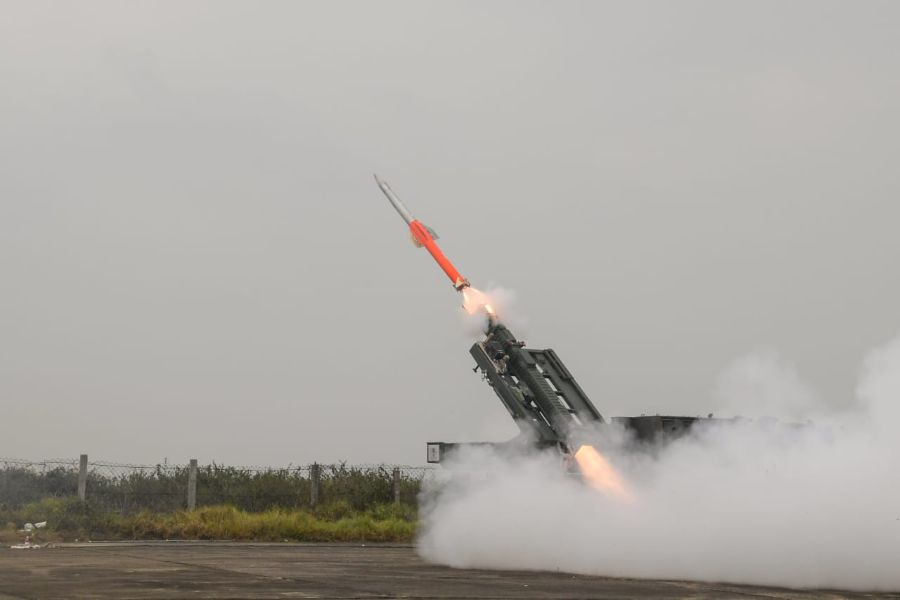
The Indian Army has kicked off the acquisition of the Anant Shastra Quick Reaction Surface-to-Air Missile (QRSAM) system, marking a major step in strengthening India’s short-range air defence. A Request for Proposal (RFP) has been issued to Bharat Electronics Limited (BEL) for the procurement of five to six regiments, according to defence officials.
Developed by the Defence Research and Development Organisation (DRDO) with BEL and Bharat Dynamics Limited (BDL), the Anant Shastra is designed to shield mobile formations from low-flying threats such as drones, helicopters, and attack aircraft. The system, sources said, will replace legacy OSA-AK platforms and provide rapid, mobile cover for mechanised units operating along India’s western and northern borders.
“Anant Shastra is built to dominate the 0–10 km air littoral zone, where modern aerial threats are most lethal,” a senior defence official told this newspaper. “Its speed and mobility will allow armoured and artillery units to manoeuvre with far greater security.”
Strategic Push Post-Operation Sindoor
The Defence Acquisition Council cleared the procurement soon after Operation Sindoor, which underscored the growing challenge of drone and precision-guided munitions employed by adversaries, including Chinese- and Turkish-origin systems. The induction is part of a layered air defence architecture that already fields Akash, MRSAM, Spyder, and S-400 systems.
Deployment along the Pakistan and China frontlines is expected to significantly strengthen India’s air defence grid, particularly against unmanned aerial threats and saturation strikes. Parallel efforts are underway to field new radars, jammers, and directed-energy systems to counter drone swarms.
Proven Capabilities
The missile system has undergone extensive trials, including day and night firings under varied terrain conditions. Key features include:
- Range: Engagement envelope of 30–40 km; altitude up to 10 km
- Mobility: Mounted on 8×8 high-mobility vehicles, adaptable across deserts, plains, and high-altitude terrain
- 360° Radar Coverage: Multi-function radars with target tracking and engagement capability
- Electronic Warfare Resilience: Designed to operate in contested electromagnetic environments
- Interoperability: Fully integrated with the Army’s Akashteer command and control system
The QRSAM employs high-speed solid-fuel propulsion and pre-fragmented warheads, enabling it to neutralise drones, loitering munitions, rockets, and short-range missiles.
Indigenous Momentum
The Anant Shastra programme highlights India’s push for self-reliance in defence manufacturing under the Atmanirbhar Bharat initiative. Together with upcoming assets like the Zorawar light tank, the system reflects a broader modernisation drive aimed at reducing dependence on foreign imports.
Once inducted, officials said, Anant Shastra will serve as a frontline shield for India’s battlefield formations —fast, mobile, and indigenous.
Team BharatShakti


