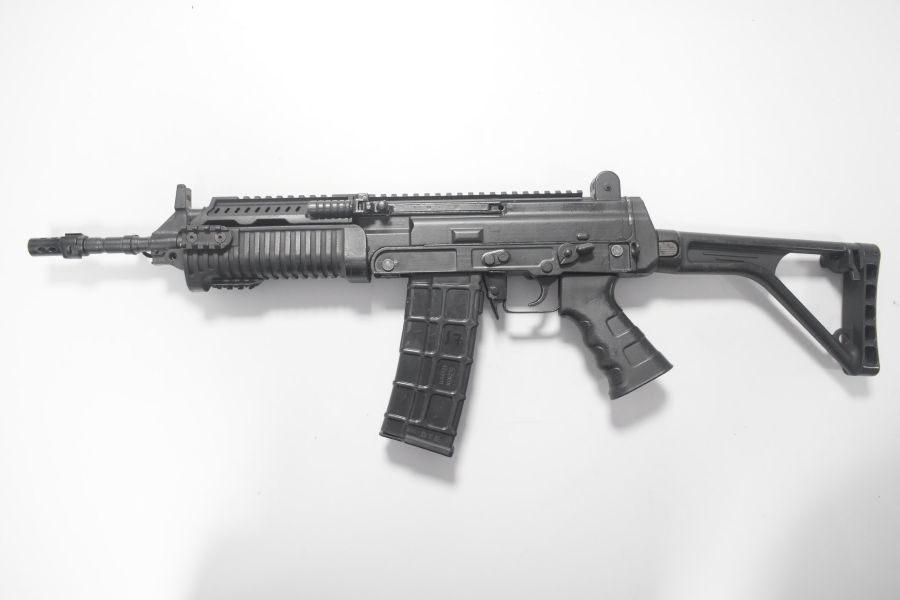
Marking a major milestone in one of the Army’s longest-pending modernisation efforts, the Ministry of Defence has signed contracts worth Rs 2,770 crore with two Indian companies – Bharat Forge and PLR Systems (Adani Group) – for the procurement of 4.25 lakh Close Quarter Battle (CQB) carbines last month. The induction of these modern weapons will replace the Army’s vintage 9mm sub-machine guns based on a 1940s British design, transforming the Infantry’s short-range firepower and operational effectiveness.
Announcing the development ahead of Infantry Day (October 27), Lieutenant General Ajay Kumar, Director General Infantry, said the contracts were finalised after extensive evaluation and would “meet a critical and long-overdue capability gap.”
“The current carbines are a very old weapon system based on the Sterling design. What we are going in for is a markedly improved weapon with superior metallurgy, accuracy and rate of fire,” Lt Gen Kumar said. “It will give our soldiers a decisive edge in close-quarter engagements.”
Contracts Finalised After Decades of Delay
The Rs 2,770 crore order, placed under the ‘Buy (Indian)’ category, will see Bharat Forge supply 60% of the total quantity and Adani’s PLR Systems the remaining 40%. The remaining share will be manufactured in India by Adani Defence under licence from Israel Weapon Industries (IWI), which supplies the Galil ACE CQB platform, locally marketed as the ‘Jeet’. Deliveries are expected to begin by September 2026 and to be completed within a year thereafter.
The procurement ends a nearly 25-year saga of repeated tenders, cancellations and fast-track procedures that never materialised. The Army’s CQB carbine requirement – first projected in the late 1990s – had remained unfulfilled for over two decades, forcing troops to rely on legacy 9mm 1A1/2A1 sub-machine guns, Indian adaptations of the British L2A3 Sterling, which entered service in the 1950s.
“Over the years, metallurgy and technology have changed dramatically. This new carbine embodies that evolution – it is Indian, modern, and built for the realities of contemporary combat,” the DG Infantry said.
Indigenous Design and High Firepower
The new carbine has been jointly developed by DRDO’s Armament Research and Development Establishment (ARDE), Pune, and Bharat Forge’s defence arm, Kalyani Strategic Systems Ltd (KSS). The weapon is chambered for the 5.56×45 mm NATO round, offering greater accuracy, reduced recoil, and superior lethality over legacy 9mm systems.
Officials said the carbine comfortably exceeds the indigenous content threshold mandated under the “Buy (Indian)” procurement route, as it is fully designed, developed, and manufactured in India. This makes it the most substantial domestically sourced small-arms order since the introduction of the INSAS rifle.
“This project demonstrates our progress toward true Atmanirbharta (self-reliance) in defence,” Lt Gen Kumar said. “The DRDO–Bharat Forge carbine represents not just an equipment upgrade but a capability transformation for the Infantry soldier.”
Competitive bidding and cost advantage
The tender attracted seven Indian firms, signalling the growing maturity of the domestic defence industry. Bidders included Bharat Forge, Adani Group’s PLR Systems, Jindal Defence, ICOMM, Bharat Electronics Ltd (BEL), and the Small Arms Factory, Kanpur. Bharat Forge’s winning bid of Rs 2,770 crore undercut competitors, including PLR Systems (Rs 3,148 crore) and Jindal Defence (Rs 3,379 crore).
The Ministry of Defence evaluated the bids on both cost and indigenous value parameters, with Bharat Forge and PLR emerging as the lowest and second-lowest bidders, respectively. The 60:40 production split ensures rapid scale-up and redundancy in the supply chain.
Part of a Wider Infantry Transformation
Lt Gen Kumar said the carbine contract is part of the Army’s ongoing comprehensive Infantry modernisation programme, following key lessons from Operation Sindoor. This joint military campaign underscored the need for greater tactical lethality, mobility, and technology integration.
“This procurement fits into our broader vision of an agile, lethal and networked Infantry,” he noted. “Alongside new weapons, we are fielding Bhairav light commando battalions and Ashni drone platoons to reshape our combat profile for modern battlefields.”
The DG highlighted that Infantry transformation is being driven by six pillars – lethality, mobility, communication, transparency, survivability and training. New 7.62mm assault rifles, anti-tank systems, and loitering munitions are also being inducted, while Software Defined Radios (SDR) and enhanced soldier protection kits are being introduced across battalions.
Looking ahead
With deliveries beginning in 2026, the new carbines will finally bridge a capability gap that has existed since the turn of the century. For the Army’s frontline Infantry units, especially those deployed in counter-insurgency and border operations, the new weapon represents both a tactical upgrade and a symbolic shift — from dependence on legacy imports to confidence in Indian design and production.
“This is not just a replacement,” Lt Gen Kumar concluded. “It is the beginning of a generational change in how our Infantry fights and prevails in close combat.”
Ravi Shankar

Dr Ravi Shankar has over two decades of experience in communications, print journalism, electronic media, documentary film making and new media.
He makes regular appearances on national television news channels as a commentator and analyst on current and political affairs. Apart from being an acknowledged Journalist, he has been a passionate newsroom manager bringing a wide range of journalistic experience from past associations with India’s leading media conglomerates (Times of India group and India Today group) and had led global news-gathering operations at world’s biggest multimedia news agency- ANI-Reuters. He has covered Parliament extensively over the past several years. Widely traveled, he has covered several summits as part of media delegation accompanying the Indian President, Vice President, Prime Minister, External Affairs Minister and Finance Minister across Asia, Africa and Europe.