


The Indian Army’s top brass will place drone warfare at the centre of its deliberations this week, drawing clear lessons from the ongoing US–Iran conflict and the Russia–Ukraine war, even as the Indian Navy prepares to roll out an updated national maritime security strategy at its parallel commanders’ conference.
The Army Commanders’ Conference (ACC) began in the capital on Monday and will run till April 16, overlapping with the Navy Commanders’ Conference (NCC) scheduled from April 14 to 16. Both meetings come against the backdrop of intensifying geopolitical churn stretching from West Asia to Eastern Europe, with direct implications for India’s security calculus.
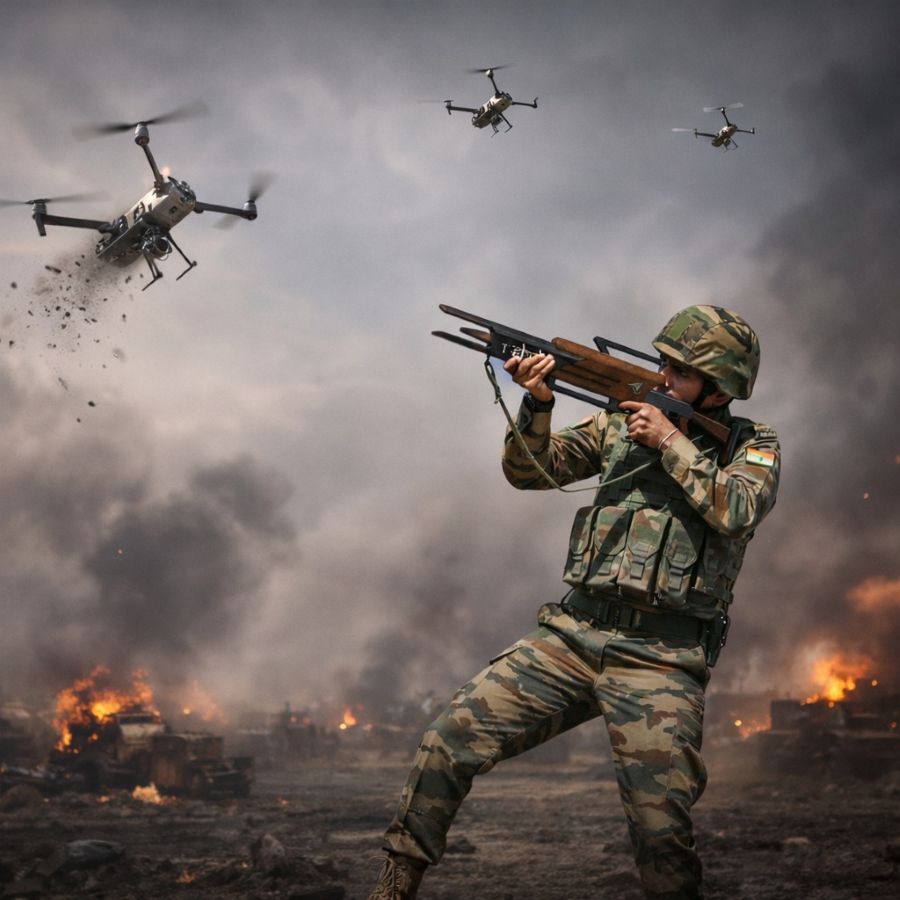
At the Army’s apex forum, senior commanders are expected to closely examine how unmanned systems have reshaped the battlefield. The widespread use of drones for surveillance, targeting, and precision strikes in recent conflicts has pushed the Army to accelerate its doctrine and capabilities for Unmanned Aerial Systems (UAS) and counter-UAS technologies.
Officials said discussions will focus on integrating drones into frontline formations, improving battlefield awareness, and hardening defences against enemy unmanned platforms, seen as critical to maintaining the combat edge in an increasingly networked, multi-domain environment. The deliberations are also likely to feed into ongoing efforts to rework training doctrines to prepare troops for technology-intensive, rapidly evolving conflict scenarios.
Alongside operational priorities, the Army will review human resource policies, including promotion structures for Junior Commissioned Officers and Other Ranks, and measures aimed at improving troop welfare and resilience. This area remains a constant alongside modernisation.
The conference will be addressed by senior government functionaries, including the Chief of Defence Staff (CDS) and the three Service Chiefs. Besides Cabinet Secretary T.V. Somanathan, Defence Secretary Rajesh Kumar Singh, and the Chairman of the National Security Advisory Board (NSAB), Alok Joshi.
Running almost in parallel, the Navy’s commanders’ meet is expected to be dominated by concerns over maritime security amid heightened naval activity in the Indian Ocean Region. Recent months have seen rapid deployments to safeguard sea lanes and energy flows, with multiple extra-regional forces operating in the region.
The first edition of the Indian Navy’s biannual Commanders’ Conference in 2026 is particularly important due to the rapid naval deployments aimed at protecting India’s energy security amid the ongoing conflict in West Asia and the presence of multi-national forces (MNFs) in the Indian Ocean region. The Conference will feature addresses from the Chief of Defence Staff and the Home Secretary, along with in-depth discussions involving senior naval leadership. There are also plans to review the implementation of the Artificial Intelligence roadmap for Pan Navy solutions and explore data-driven technologies for maritime operations.
However, the standout development from the naval conference is likely to be the unveiling of a revised Indian Maritime Security Strategy (IMSS). The document is expected to outline how the Navy intends to translate its doctrinal vision into operational reality, detailing force posture, deployment patterns and cross-domain integration.
Also Read: New Maritime Security Strategy Set for Rollout at Navy Commanders’ Meet
The strategy builds on the Indian Maritime Doctrine 2025, unveiled by Dinesh K. Tripathi last year, which emphasised operating in a “no war, no peace” environment marked by grey-zone threats and persistent competition. The new strategy is set to go a step further by spelling out execution, covering integration across cyber, space and information domains, alongside conventional maritime operations.
Navy planners are also expected to review the role of uncrewed systems, artificial intelligence and data-driven decision-making in enhancing operational readiness. Strengthening blue-water capabilities, logistics chains and inter-service coordination will also feature prominently in the discussions.
Together, the two conferences signal a clear shift in India’s military priorities, toward technology-led land warfare and a sharper, doctrine-backed maritime posture, amid an increasingly volatile global security environment.
Ravi Shankar

Dr Ravi Shankar has over two decades of experience in communications, print journalism, electronic media, documentary film making and new media.
He makes regular appearances on national television news channels as a commentator and analyst on current and political affairs. Apart from being an acknowledged Journalist, he has been a passionate newsroom manager bringing a wide range of journalistic experience from past associations with India’s leading media conglomerates (Times of India group and India Today group) and had led global news-gathering operations at world’s biggest multimedia news agency- ANI-Reuters. He has covered Parliament extensively over the past several years. Widely traveled, he has covered several summits as part of media delegation accompanying the Indian President, Vice President, Prime Minister, External Affairs Minister and Finance Minister across Asia, Africa and Europe.


