



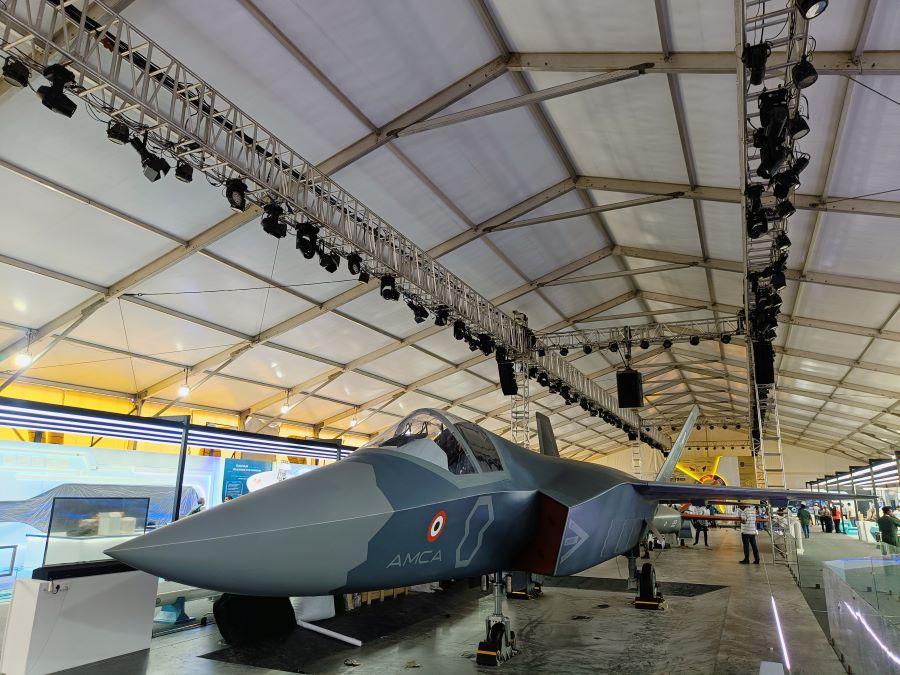
BrahMos Aerospace Thiruvananthapuram Ltd (BATL) has entered a strategic alliance with Axiscades Technologies Ltd and Goodluck India Ltd to jointly bid for the design and development of India’s ambitious fifth-generation fighter program, the Advanced Medium Combat Aircraft (AMCA).
The formal alliance, sealed on September 30, marks the final day for submissions responding to the Expression of Interest (EoI) issued by the Aeronautical Development Agency (ADA) of the Defence Research and Development Organisation (DRDO). This collaboration aims to pool the technical prowess of the three firms to support the Full-Scale Engineering Development (FSED) phase of the AMCA project.
The strategic bid aligns with the government’s Atmanirbhar Bharat (Self-Reliant India) initiative, positioning the consortium in direct competition with some of the largest players in India’s defence and aerospace sector. These competitors include L&T, HAL, Tata Advanced Systems, Adani Defence, and Kalyani Strategic Systems. The evaluation committee, chaired by A. Sivathanu Pillai, a former DRDO scientist and chief of BrahMos Aerospace, is responsible for reviewing the technical and commercial proposals before making recommendations to the Ministry of Defence.
Why AMCA Matters Now More Than Ever
As previously reported by BharatShakti, the AMCA program represents India’s bold attempt to join the elite club of nations capable of designing and manufacturing fifth-generation stealth fighters. The urgency of the project cannot be overstated. The Indian Air Force’s fighter squadron strength is projected to dip below 29 by the end of the year, at a time when China operates over 250 fifth-generation jets, and Pakistan prepares to induct them.
Designed as a stealth-enabled, multirole combat aircraft, AMCA is expected to feature next-generation avionics, advanced radar systems, AI integration, and unmanned teaming capabilities. The first prototype is targeted for rollout by 2033, with production expected around 2035.
India plans to build at least 120 units in the first phase, with potential for expansion as more variants roll out. The total project cost is estimated to exceed Rs 2 lakh crore, making it the country’s most ambitious indigenous defence program to date.
Strategic Shifts in Defence Industry
The AMCA project signals a paradigm shift in India’s defence production model, moving from traditional public sector-led development to a competitive public-private partnership (PPP) framework. The Rs 15,000 crore FSED contract is a litmus test for the Indian industry’s ability to absorb cutting-edge design, undertake complex systems engineering, and deliver on time.
BrahMos Aerospace brings deep expertise in missile technology and precision manufacturing, Axiscades offers strong design and engineering capabilities, while Goodluck India contributes with advanced materials and structural components.
Lessons from the Past: Timelines Are Critical
Experts warn that India cannot afford to repeat the mistakes of the Light Combat Aircraft (LCA) Tejas program, which took nearly four decades from concept to squadron service. Recent delays in engine deliveries from General Electric (GE) for the Tejas Mk1A and uncertainty over the India-US engine development timeline for the AMCA Mk1 raise concerns.
Although India is negotiating a co-development deal with France’s Safran for a high-thrust engine for the AMCA Mk2, such collaborations often come with long gestation periods and limited access to technology. Hence, the immediate focus must be on ensuring AMCA Mk1 meets its 2033 flight deadline using the GE F414 platform, while accelerating indigenous capabilities in parallel.
The Stakes Have Never Been Higher
With the global security landscape in flux and regional rivals advancing rapidly, defence analysts agree that timelines must be treated as sacrosanct, private industry must be empowered, and public sector units must be held accountable for performance.
As the government reviews the bids, one thing is clear: the success of AMCA will depend not just on cutting-edge design, but on disciplined execution, collaborative innovation, and an unwavering commitment to national interest.
Huma Siddiqui