


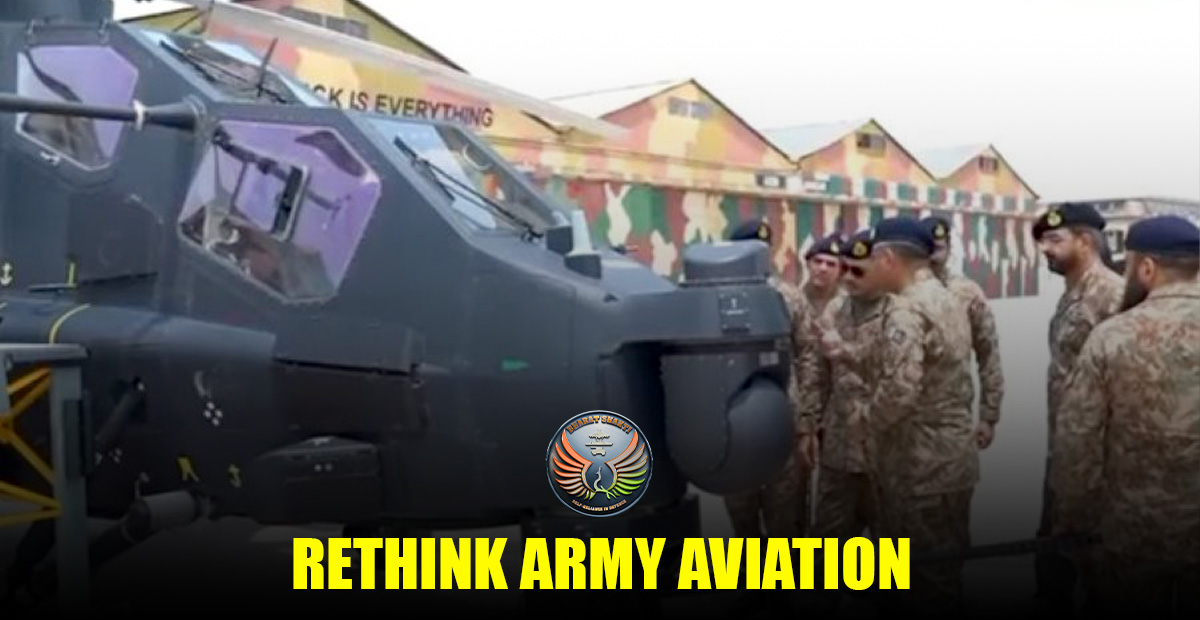
Pakistan’s battlefield received a significant upgrade this month with the induction of Chinese-built Z-10ME attack helicopters into the Pakistan Army. The move, closely following recent military conflict with India, is being seen as a deliberate signal of Beijing’s deepening military partnership with Islamabad – one that increasingly seeks to test New Delhi’s military posture on both its western and northern borders.
The visual confirmations are striking: a helicopter marked “Pakistan Army” and serial number 786-301 undergoing maintenance; another airborne from what appeared to be a forward base, armed with next-generation air-to-ground missiles. Pakistani social media accounts – including one reportedly linked to an active-duty officer – celebrated the arrival of a capability long coveted but until now limited by ageing AH-1F Cobras and Russian Mi-35 Hinds. Reports suggest that up to 40 Z-10MEs may already have been delivered or are in the pipeline, marking a step-change in Pakistan’s rotary-wing strike power.
Strategic Timing: A Triangular Shadow Over South Asia
The timing is deliberate. Just months ago, during Operation Sindoor in May 2025, Pakistani J-10C fighters – also of Chinese origin – were alleged to have shot down an Indian Air Force Rafale. The incident underscored the risks of a coordinated China–Pakistan military alignment.
That alignment has only tightened. In late July, Zhang Youxia, Vice-Chairman of China’s Central Military Commission and second only to Xi Jinping in the PLA hierarchy, hosted Pakistan’s Army Chief Gen. Asim Munir in Beijing. The meeting signalled a shared goal: to blunt India’s regional influence, not just diplomatically but through cutting-edge battlefield systems.
The Z-10ME is a case in point. Unlike legacy helicopters, this variant has been refined for high-altitude warfare, echoing the PLA’s own deployments across Tibet. In many ways, Pakistan is not just a buyer but a proving ground for Chinese technology in South Asia.
What Makes the Z-10ME Different
The Z-10ME is more than a replacement for ageing Cobras. Its features place it in a different class altogether:
- High-altitude capable WZ-9G engines, with performance reportedly comparable to US-made Apache AH-64E.
- Composite titanium and ceramic armour for survivability.
- Advanced electronic warfare suites, including AESA-based missile warning and countermeasures.
- Infrared-suppressed exhausts to reduce thermal signature.
- Six weapon stations, capable of carrying CM-502KG precision missiles with 25 km range, plus a 23 mm chain gun.
- Extended endurance, with a combat radius of over 1,100 km.
For Pakistan, this represents not just modernisation, but battlefield parity in the air–land domain against India’s ground forces.
India’s Challenge: Bridging the Army Aviation Gap
For India, the Z-10ME’s induction raises an uncomfortable question: Is the Army prepared to fight on its own terms?
Currently, India’s most potent attack helicopters – the Apache AH-64Es – remain under the Indian Air Force. The Army Aviation Corps operates ALH Dhruv, its armed Rudra variant, and the newly inducted Light Combat Helicopter (LCH) Prachand. While valuable, these platforms fall short of the heavy firepower, protection, and advanced sensors of purpose-built attack helicopters.
Numbers are also a problem. The Army has projected a requirement of 95 LCHs and at least 36 Apaches. Yet only six Apaches have been sanctioned for Army Aviation, while the IAF’s limited fleet risks being stretched across a potential two-front war scenario.
Doctrine and the “First Hour” Problem
In July, Army Chief General Upendra Dwivedi announced the rollout of the long-awaited Integrated Battle Groups (IBGs), formally naming the new formations Rudra. Designed as lean, self-contained fighting units, IBGs will bring together infantry, mechanised and armoured elements, artillery, special forces, and unmanned aerial systems under a single, flexible command. Each infantry battalion is now being equipped with dedicated drone platoons, while artillery has added Loiter Munition Batteries, and Army Air Defence is inducting indigenous systems to protect forward elements.
The concept represents the most significant force restructuring in decades, aimed at ensuring that formations can respond in hours rather than days. Crucially, IBGs tailored for the western front against Pakistan will differ in composition and tactics from those deployed along the high-altitude Himalayan frontier against China. But while the structural shift is bold, one gap remains: without organic attack helicopter support, IBGs risk being tactically constrained. The very speed and agility that make them effective could be blunted if they remain dependent on the Air Force for close air support.
It is not about inter-service rivalry. It is about tempo. Global precedents prove the point: the US Army, PLA, and Russian Ground Forces all retain direct control of attack helicopters to ensure instant responsiveness to battlefield dynamics. Without this, India risks ceding initiative in the crucial “first hour” of battle, when outcomes are often decided.
Apache vs. Prachand: A Complementary Mix
The debate should not be about choosing between heavy and light platforms. Instead, India needs both:
- Apaches for deep-strike and tank-hunting roles in plains and deserts.
- LCH Prachand for high-altitude warfare in Ladakh, Siachen, and Arunachal, where its narrow frame and Shakti engines provide unmatched agility.
Together, they can deliver the flexible firepower needed to counter threats across varied terrain.
Lessons from Recent Wars
From Nagorno-Karabakh to Ukraine, attack helicopters have shaped outcomes through precision strikes, convoy protection, and rapid troop support. In India’s own experience, during the 2020 Galwan standoff, helicopters proved critical for logistics and deterrence at high altitude. The lesson is clear: without organic, integrated attack aviation, land forces operate at a disadvantage.
The Way Forward: Integration, Not Tokenism
For India to meet the Z-10ME challenge, it must go beyond token acquisitions. What is needed is:
- Embedding Army Aviation squadrons within IBGs.
- Expanding the LCH fleet and fast-tracking Apache induction.
- Enhancing night-fighting and high-altitude training.
- Building seamless data links with UAVs and ground radars.
- Ensuring forward-based maintenance for sustained combat operations.
Without these reforms, even the most advanced helicopters risk being under-utilised.
Conclusion: Fighting on India’s Terms
China’s delivery of Z-10MEs to Pakistan is more than an arms transfer. It is a strategic signal – one that binds India’s two main adversaries into a tighter military embrace. For India, the answer lies not in symbolic deterrence but in doctrinal change: giving the Army control of sufficient numbers of attack helicopters, fully integrated into its operations.
Only then can India ensure that, when conflict breaks out, its ground forces fight fast, hard, and on their own terms.
Ravi Shankar/Huma Siddiqui

Dr Ravi Shankar has over two decades of experience in communications, print journalism, electronic media, documentary film making and new media.
He makes regular appearances on national television news channels as a commentator and analyst on current and political affairs. Apart from being an acknowledged Journalist, he has been a passionate newsroom manager bringing a wide range of journalistic experience from past associations with India’s leading media conglomerates (Times of India group and India Today group) and had led global news-gathering operations at world’s biggest multimedia news agency- ANI-Reuters. He has covered Parliament extensively over the past several years. Widely traveled, he has covered several summits as part of media delegation accompanying the Indian President, Vice President, Prime Minister, External Affairs Minister and Finance Minister across Asia, Africa and Europe.