


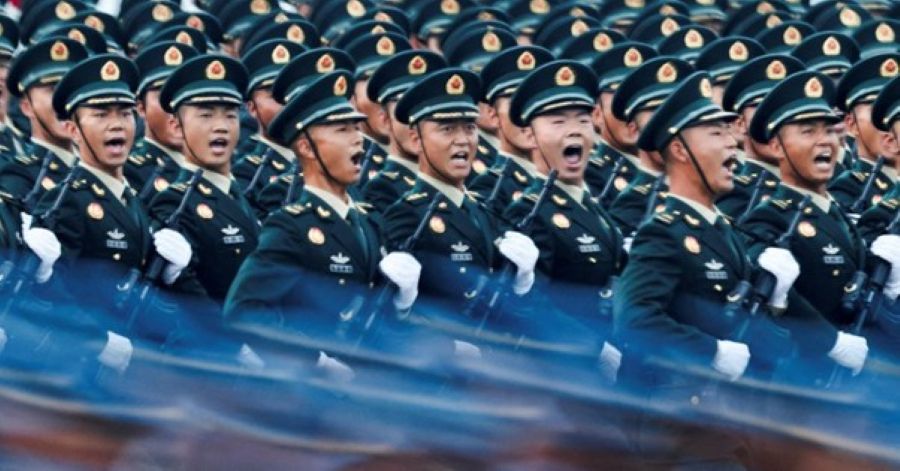
China rolled out its most advanced arsenal in a massive military parade through central Beijing on Wednesday, marking the 80th anniversary of its victory over Japan in World War II. The display underscored Beijing’s growing military confidence, with President Xi Jinping hailing the People’s Liberation Army (PLA) as the “steel backbone” of national rejuvenation.
The spectacle along Changan Avenue saw Xi deliver a speech from Tiananmen before inspecting troops in a parade car – his third such event since taking office. Seated alongside him were foreign leaders, including Russian President Vladimir Putin, North Korea’s Kim Jong-un, Belarus’s Alexander Lukashenko, and Malaysian Prime Minister Anwar Ibrahim, Pakistani delegates, as well as top serving and retired PLA generals.
Nuclear “Ace Cards” on Display
At the heart of the parade were new nuclear-capable systems showcasing China’s land, sea, and air triad. For the first time, the PLA unveiled its JL-1 air-launched nuclear missile, alongside the JL-3 submarine-launched ICBM. They were flanked by upgraded DF-31 and DF-61 intercontinental missiles, which state broadcaster CCTV described as the “strategic ace for safeguarding sovereignty.”
Equally notable was the DF-5C – an upgraded silo-based missile with a range exceeding 13,000 km and capable of carrying up to 10 independently targetable warheads, effectively placing targets worldwide within reach.
Anti-Ship and Hypersonic Weapons
The Rocket Force paraded the DF-26D, an intermediate-range ballistic missile known as the “Guam Killer,” highlighting China’s ability to threaten U.S. bases in the Pacific. Also on show were the DF-17 hypersonic missile with its manoeuvrable glide vehicle, and the YJ-21 anti-ship ballistic missile, deployable from destroyers and bombers, with speeds up to Mach 10.
Adding to Beijing’s hypersonic arsenal was the debut of the CJ-1000 long-range cruise missile, designed for strategic strikes over several thousand kilometres.
Naval and Aerial Advances
China also highlighted its expanding naval aviation with four carrier-based fighters, including the stealthy J-35 and the electronic warfare-capable J-15DT. State media said these aircraft mark a transition from “near-sea defence to far-sea defence.”
Supporting platforms included the KJ-500A airborne early warning aircraft and the carrier-based KJ-600, designed for the PLA Navy’s new Type 003 Fujian carrier. The twin-seat J-20S stealth fighter also appeared, touted for its potential role in controlling combat drones.
Meanwhile, the H-6J long-range bomber, fitted with YJ-12 anti-ship missiles, reinforced China’s emphasis on maritime strike capability.
Rise of Drones and Unmanned Systems
For the first time, the PLA gave centre stage to drones and unmanned vehicles. Four new AI-powered stealth drones were unveiled, alongside reconnaissance-strike UAVs, electronic warfare drones, unmanned wingmen, and naval submersibles. State media described them as capable of autonomous swarming, millimetre-level precision targeting, and rapid decision-making.
The GJ-11 stealth combat drone and FH-97 variant were described as “loyal wingmen,” designed to operate alongside crewed fighters like the J-20.
Strategic Airlift and Transport
Transport aircraft featured prominently with the Y-20A and its upgraded Y-20B variant, now powered by China’s domestically made WS-20 engines. Together, they signal Beijing’s expanding ability to project power across long distances.
Strengthened Air Defence
The parade also showcased new layers of China’s missile shield. The HQ-20, HQ-22A, and HQ-9C variants joined the HQ-19, an anti-ballistic and anti-satellite system comparable to America’s THAAD. Capable of intercepting missiles at altitudes of 200 km, the HQ-19 reflects Beijing’s ambitions in space and missile defence.
Regional Implications
The show of force comes amid heightened tensions in the Taiwan Strait and South China Sea. Analysts note that many of the systems displayed are tailored to counter U.S. naval assets and reinforce China’s deterrence posture.
Indian observers will also be watching closely. In the recent Operation Sindoor, India successfully targeted Pakistan’s Chinese-supplied HQ-9 systems, raising questions about their effectiveness. Beijing has since accelerated resupply of advanced air defence platforms to Pakistan, including the HQ-16 and potentially the HQ-19, to offset those losses.
Team BharatShakti