



Editor’s Note
Bangladesh’s reported $2.2 billion deal to procure 20 Chinese J-10CE multirole fighters is a new test for India’s regional strategy. With Chinese-origin aircraft now potentially operating across all of India’s borders, the development highlights Beijing’s expanding defence footprint in South Asia. It also underscores the urgency for New Delhi to sustain both technological superiority and strategic outreach in its eastern periphery.
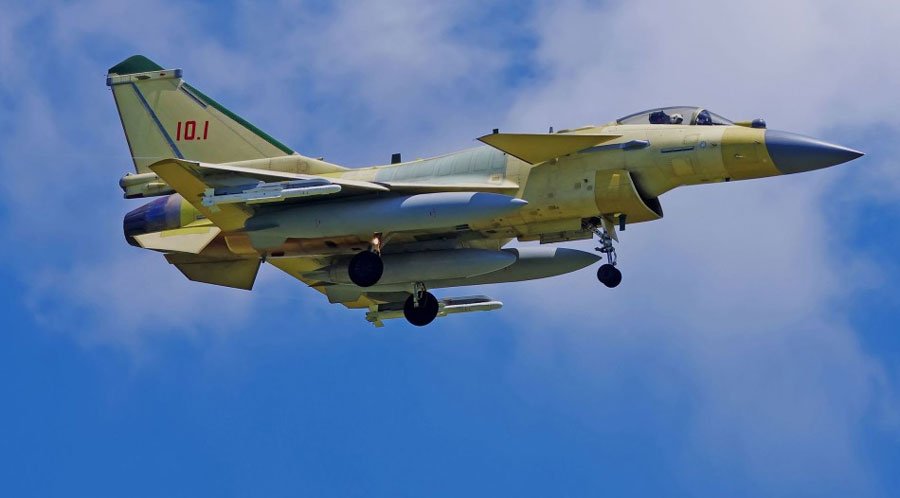
Bangladesh’s reported plan to acquire 20 Chinese J-10CE multirole fighter jets in a deal worth around $2.2 billion could mark a significant shift in South Asia’s airpower balance. If confirmed, the procurement would substantially upgrade the Bangladesh Air Force’s (BAF) combat capabilities and underscore Dhaka’s growing defence dependence on Beijing, a development with clear strategic implications for India.
Beijing–Dhaka Defence Axis Deepens
The proposed deal, reportedly under government-to-government (G2G) terms, includes training, maintenance and logistical support, with deliveries expected between FY 2025–26 and 2026–27. Payments would be spread over a decade, signalling a long-term institutional defence relationship with China.
The Chengdu J-10CE, export variant of the People’s Liberation Army Air Force’s J-10C, represents a major leap in capability for the BAF. Equipped with an AESA radar, advanced datalink systems, and PL-15E long-range air-to-air missiles, the J-10CE offers modern network-centric combat performance. With a combat radius of nearly 1,850 km and a top speed of Mach 2.2, it will give Bangladesh the ability to conduct beyond-visual-range interception and maritime strike missions over the Bay of Bengal, missions previously beyond its reach.
The new fleet will replace the BAF’s ageing Chinese F-7s, part of Dhaka’s Forces Goal 2030 modernisation plan, aimed at strengthening national air defence and developing limited deterrent capabilities.
China’s Expanding Perimeter Around India
For China, the J-10C deal is part of a broader strategic pattern. Beijing’s military footprint now extends across India’s periphery, Pakistan operates the same J-10CE variant, while Myanmar fields Chinese-origin JF-17s and other systems. The inclusion of Bangladesh in this network effectively means that Chinese fighter aircraft, along with Chinese technicians, trainers, and data linkages, will be present on all sides of India’s continental borders.
China has already supplied submarines to Bangladesh and invested heavily in infrastructure projects, such as the Payra Port and riverine facilities, which have potential dual-use applications. The fighter jet deal thus reinforces an emerging reality: Dhaka’s security and defence ecosystem is increasingly tied to Chinese supply chains and training pipelines.
Strategic Implications for India
While Bangladesh’s acquisition is not inherently adversarial, it adds a layer of complexity to India’s eastern security calculus. The Indian Air Force’s Eastern Air Command, responsible for guarding the Siliguri Corridor and India’s Northeast, will need to factor in advanced fourth-generation fighters operating from bases not far from its own airfields in Hasimara, Tezpur, and Chabua.
Operationally, the development reinforces India’s need to maintain qualitative and technological superiority through rapid induction of indigenous platforms such as the Tejas Mk-1A, Tejas Mk-2, and the upcoming AMCA, along with continued modernisation of its Su-30MKI and Rafale fleets. Strategically, it calls for a sharper regional engagement policy, one that leverages India’s defence diplomacy, training programs, and industrial partnerships to counterbalance China’s penetration in the Bay of Bengal littoral.
Risk for Dhaka
For Dhaka, however, the acquisition also comes with risks. Historically, Bangladesh has faced maintenance and reliability challenges with Chinese-origin hardware. Moreover, the deal could draw scrutiny from Western partners, especially the United States, which has sought to counterbalance Chinese influence in South Asia through its Indo-Pacific strategy.
The Bay of Bengal as a New Strategic Arena
The Bay of Bengal is rapidly emerging as a focal point of strategic competition. As India expands its maritime surveillance and joint command structures in the Andaman and Nicobar theatre, the introduction of advanced Chinese fighters in Bangladesh could lead to greater militarisation of the region’s air and sea space.
With India, Myanmar, and Bangladesh all modernising their air and naval assets, a quiet arms race may be taking shape across the eastern littoral-one that could influence not just regional deterrence dynamics but also the future of India’s “Neighbourhood First” and “Act East” strategies.
Conclusion
Bangladesh’s J-10CE acquisition, if finalised, will represent more than a mere equipment purchase—it will symbolise the steady diffusion of Chinese strategic influence into South Asia’s airpower landscape. For India, the challenge lies not only in sustaining military superiority but in shaping the regional environment through calibrated diplomacy, industrial partnerships, and credible deterrence.
The “Vigorous Dragon” taking flight in Dhaka’s skies will be closely watched in New Delhi, Beijing, and across the Bay of Bengal.
Ravi Shankar

Dr Ravi Shankar has over two decades of experience in communications, print journalism, electronic media, documentary film making and new media.
He makes regular appearances on national television news channels as a commentator and analyst on current and political affairs. Apart from being an acknowledged Journalist, he has been a passionate newsroom manager bringing a wide range of journalistic experience from past associations with India’s leading media conglomerates (Times of India group and India Today group) and had led global news-gathering operations at world’s biggest multimedia news agency- ANI-Reuters. He has covered Parliament extensively over the past several years. Widely traveled, he has covered several summits as part of media delegation accompanying the Indian President, Vice President, Prime Minister, External Affairs Minister and Finance Minister across Asia, Africa and Europe.


