



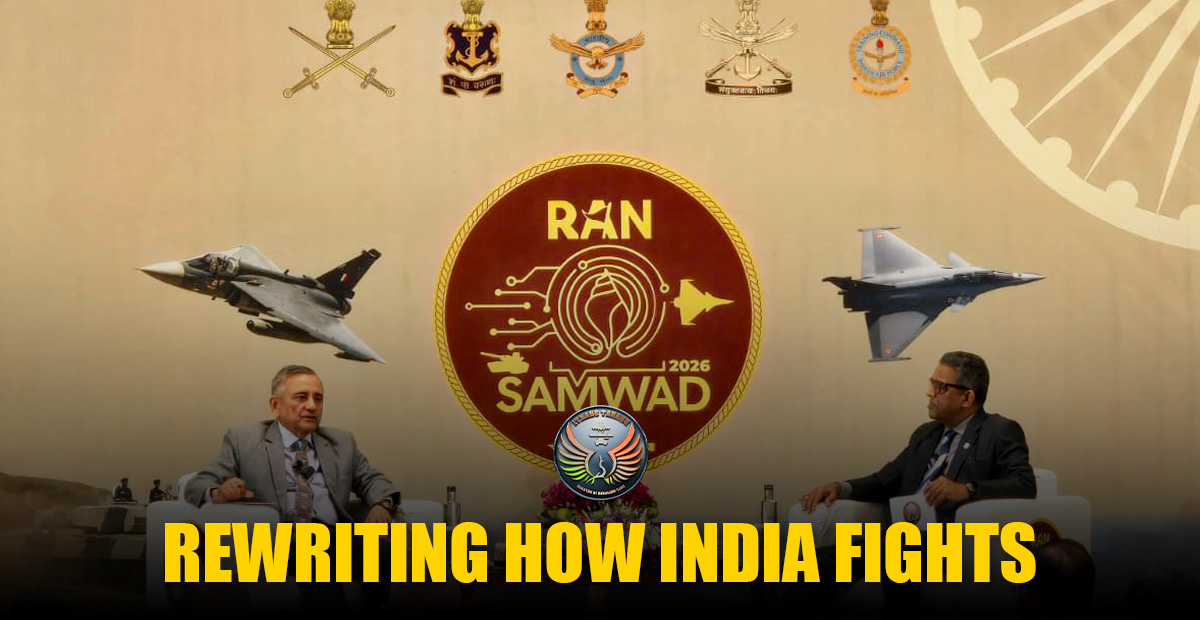
At Ran Samwad 2026, an important yet quiet admission – and a strategic signal – came from the Chief of Defence Staff General Anil Chauhan.
India’s biggest military challenge is no longer just capability.
It is coherence.
From Silos to Systems
In his conversation with BharatShakti’s Founder and Editor-in-Chief Nitin Gokhale, General Chauhan outlined what may well be the defining transition underway inside India’s armed forces: the shift from three services thinking separately to one military thinking together.
That may sound obvious, but it isn’t.
For decades, the Army, Navy and Air Force were built to dominate their respective domains. Structures, doctrines, even institutional pride were designed around that separation. What the CDS is attempting now – through jointness, integration and eventually theatre commands – is to undo that deeply embedded DNA.
And that is proving to be harder than buying new weapons.
Gen Chauhan was candid: when the process began, there wasn’t even a shared understanding of what “jointness” meant. Today, it has entered the lexicon. That may sound incremental, but in military reform, shared vocabulary is the first sign of shared intent.
Operation Sindoor: Proof, Not Theory
If there was a moment that validated this shift, it was the much-referenced Operation Sindoor.
For the CDS, it was more than a successful operation; it was evidence that years of pushing integration were beginning to pay off. Definitely not perfectly yet, and definitely not completely, but measurably.
That matters because militaries often debate reform endlessly without ever testing it in real conditions. Sindoor, General Chauhan says, was where concept met execution.
Watch: Nitin Gokhale’s Fireside Chat With CDS Gen Anil Chauhan
The Real Battlefield: Decision Speed
Gen Chauhan’s core argument is stark: Wars are decided by timely and correct decisions.
Everything else – AI, networks, sensors, drones – is in service of that.
This is where the Indian military’s transformation is now focused. Not just on acquiring technology, but on compressing decision cycles.
This is no longer about wiring systems together. It’s about extracting meaning from data – and ultimately, predicting the fight before it begins.
And this, is a fundamental change in how wars are fought and won.
And it explains why artificial intelligence, in Gen Chauhan’s words, becomes the “mother of all technologies” – not because it replaces humans, but because it enhances decision superiority.
Technology Isn’t the Bottleneck
Another crucial point he made was a detour from the usual narrative:
He candidly said that India does not lack access to technology. What it risks lacking is:
- Structures to absorb it
- Doctrines to employ it
- People trained to exploit it
He reiterated that technology alone does not deliver outcomes. It must be matched by organisational change running in parallel. And that this is where many militaries stumble. They buy advanced systems but retain outdated thinking. The result is capability without effectiveness.
The Theatre Command Moment
But perhaps the most consequential part of Chauhan’s remarks lay in his update on the Integrated Theatre Commands (ITCs).
- The concept is no longer contested – all three services have accepted it
- The differences now lie in execution – design, structure, architecture
- The system has moved to a stage where the military is ready to seek political approval for rollout
For years, theatre commands were discussed as a distant reform. Today, they are administratively and conceptually ready – awaiting final clearance.
This is where the CDS’s dual role becomes critical. As both military integrator and head of the Department of Military Affairs, General Chauhan has the rare ability to translate ideas into government-sanctioned structures.
That bridge between concept and implementation is often where reform dies. In this case, it appears to be holding.
A More Dangerous Neighbourhood
All of this is unfolding against a backdrop Chauhan does not sugarcoat:
- Two nuclear-armed adversaries
- Persistent border tensions
- Rapid technological disruption
- And a global environment where conflict is no longer exceptional – but routine
In such a landscape, India’s shift from a reactive to a proactive posture is not optional. It is inevitable.
The “new normal,” as he frames it, is clear:
- Cross-border terror will invite response
- Nuclear coercion will not deter action
- The distinction between perpetrators and enablers will collapse
This is strategic signalling, not rhetoric.
The Cognitive Battlefield
One of the more underappreciated shifts Chauhan highlights is the rise of cognitive warfare – real-time contestation of perception, narrative and truth, not just propaganda.
India’s experience shows that managing disinformation is now central. And crucially, it must be:
- Automated
- Integrated with operations
- Executed without distracting commanders
This is warfare where the first narrative often becomes the dominant one.
The Hard Truth
There is a tendency to assume that modernisation is about hardware – more missiles, better drones, faster jets.
What comes through from the CDS is something more uncomfortable: India’s military transformation is fundamentally about changing how it thinks, decides and fights.
Because in the wars that are coming, the side with the best equipment will not necessarily win. The side that integrates faster, decides quicker and adapts better will.
And that is the race India has now fully entered.


