


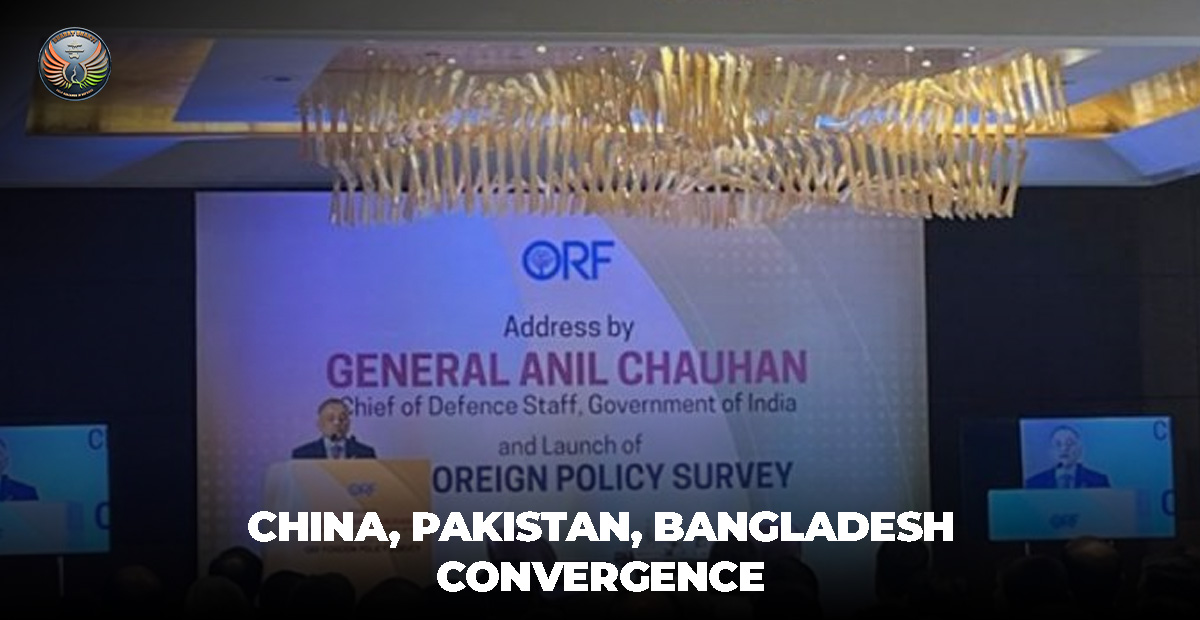
Chief of Defence Staff (CDS) General Anil Chauhan on Tuesday warned that a potential convergence of strategic interests among China, Pakistan, and Bangladesh could have serious implications for India’s stability and security landscape.
Speaking at an event organised by the Observer Research Foundation, Gen Chauhan noted that economic vulnerabilities in the Indian Ocean region were providing opportunities for “external powers” to deepen their influence — a development that could increase India’s strategic risks.
“There is a possible convergence of interests between China, Pakistan, and Bangladesh that may impact India’s stability and security dynamics,” he said.
His remarks come amid a downturn in India-Bangladesh relations, following the ousting of Prime Minister Sheikh Hasina and her reported flight to India in August last year.
China-Pakistan Collusion and Role of Defence Trade
Gen Chauhan highlighted growing China-Pakistan collusivity, pointing out that nearly 70 to 80 per cent of Pakistan’s military hardware over the past five years has been sourced from China. He noted that Chinese defence firms have commercial liabilities in Pakistan, suggesting an entrenched presence of Chinese original equipment manufacturers (OEMs) in the country.
“In the past five years, Pakistan has acquired the majority of its weapons and equipment from China. It’s reasonable to assume that Chinese OEMs have ongoing commercial obligations and a physical footprint within Pakistan,” he said.
Operation Sindoor: Lessons from a Nuclear Conflict
Delving into the May 7–10 military confrontation between India and Pakistan, Gen Chauhan noted that we are in a pause with regard to Operation Sindoor which was totally non-contact warfare and described it as perhaps the first direct conflict between two nuclear-armed states. “India has demonstrated that it will not be deterred by nuclear blackmail. Operation Sindoor is a unique example of conventional conflict between two nuclear weapon states,” he stated.
He emphasised that India’s nuclear doctrine — particularly the policy of ‘No First Use’ — creates space for conventional operations even in a nuclear environment. “Our doctrine gives us the strength to act, and Pakistan’s escalatory response pushed the conflict into a conventional domain, limiting its own nuclear options,” he observed.
He added that China remained inactive during the short-lived conflict. “There was no unusual activity along the northern border. Perhaps the short duration of the conflict played a role, but that’s a fact worth noting,” he said.
Gen Chauhan also stressed the importance of leveraging new domains such as cyber and electromagnetic warfare to expand operational capabilities.
Evolving Threats
The CDS identified emerging military challenges, particularly India’s increasing vulnerability to long-range vectors and precision strikes. “There is currently no foolproof defence against ballistic missiles, hypersonic weapons, cruise missiles, or large-scale drone attacks,” he cautioned.
He underlined the need for continuous high-level operational readiness, saying, “The second evolving challenge is the ability to maintain 24/7, year-round operational preparedness.”
Global Order in Flux: Ready for Full-Spectrum Conflict
Gen Chauhan said India must prepare for a full spectrum of conflict amid a global order in flux. “The international security environment is transitioning between two competing world orders. India must be ready to respond across the entire conflict spectrum,” he said, adding that shifts in U.S. strategic posture were adding further complexity.
He argued that national security should extend beyond military strength to include economic resilience and internal cohesion. “A resilient and dynamic economy is the bedrock of national power. It ensures sustainable development and strategic autonomy,” he said.
On internal stability, he remarked: “For a multilingual, multiethnic, and multireligious country like India, internal security is paramount. It must be embedded into our broader social security architecture.”
Gen Chauhan concluded by highlighting the complete synergy demonstrated by the Army, Navy, and Air Force during Operation Sindoor — an indication, he said, of India’s growing capacity to conduct integrated military operations across domains.
Team BharatShakti