



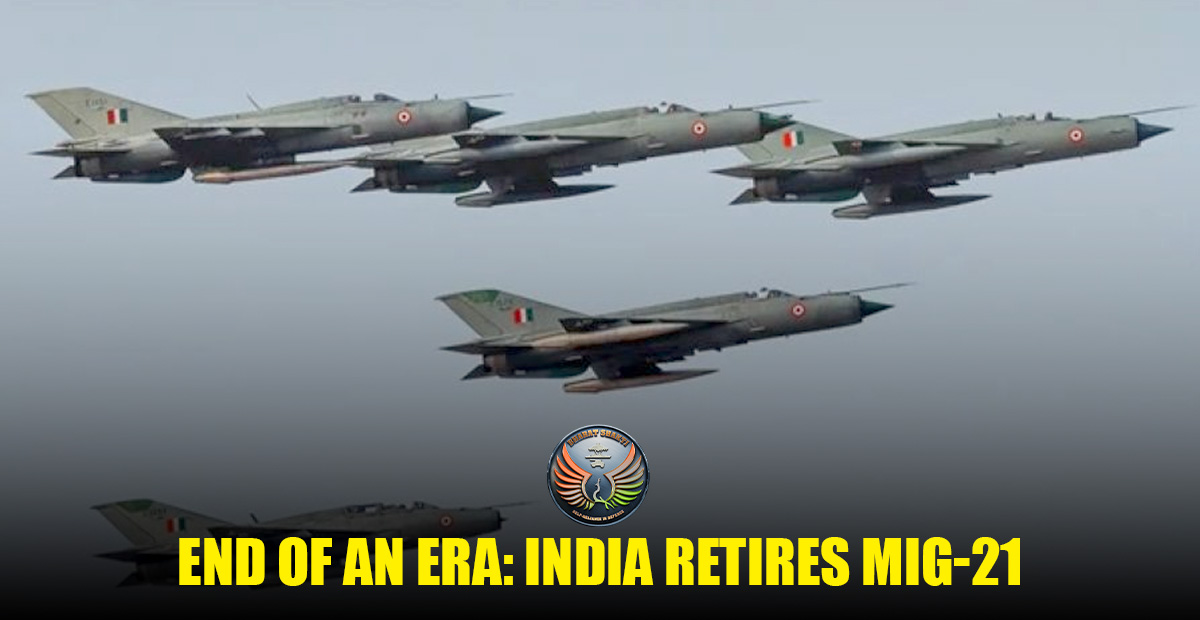
The roar of the MiG-21, once synonymous with India’s air power, will echo for the final time on September 26, 2025, when the Indian Air Force (IAF) stages a ceremonial farewell over Chandigarh. With that flight, the world’s longest-serving MiG-21 fleet will retire, closing a 60-year chapter in Indian aviation history.
The aircraft that earned nicknames ranging from “Sabre Slayer” in 1971 to “Flying Coffin” in its later years leaves behind a mixed legacy of glory, grit, and loss. As India bids farewell to its last two MiG-21 Bison squadrons -No 3 “Cobra” Squadron and No. 23 “Panthers” Squadron – the inevitable questions remain: What happens to the aircraft, their squadrons, and the pilots who flew them?
What Happens to the MiG-21 Jets After Retirement?
The remaining MiG-21 Bisons will make their final landing at Nal Air Base, Rajasthan, where they will undergo systematic decommissioning. The process is meticulous:
- Parts salvaged: Usable spares are stripped for training purposes or repurposed across systems.
- Airframes disposed or displayed: Aircraft deemed unfit for flying will either be scrapped or handed over to museums, institutions, and public memorials.
- Application-based allocation: Colleges, academies, and municipalities must apply to Air HQ to receive an aircraft, with only those proving their ability to preserve it granted approval.
Today, decommissioned MiG-21s stand guard outside universities, air bases, and museums across India – from the IAF Museum in Palam to the HAL Heritage Centre in Bengaluru – serving both as monuments and teaching tools. The final Bisons will soon join these static sentinels.
What Happens to the Squadrons?
The disbanding of the two Bison squadrons doesn’t erase their identity. In IAF parlance, they will be “number-plated” – archived for possible resurrection. Their crest, motto, and legacy remain intact, awaiting revival when new aircraft are inducted.
Fittingly, No. 3 “Cobra” Squadron is slated to be the first to re-equip with the indigenous LCA Tejas Mk-1A, symbolising the IAF’s transition from imported Cold War jets to homegrown fighters of the future.
What Happens to the Pilots?
For MiG-21 pilots, the farewell isn’t a retirement – it’s a transition. Depending on their age, rank, and specialisation, they will move across different streams:
- Conversion to modern fighters: Many will retrain on Su-30MKIs, Rafales, or Tejas Mk-1A, a process requiring 3–6 months of intensive conversion training.
- New flying streams: Some may shift to transport or rotary wings as operational needs dictate.
- Leadership and staff roles: Senior aviators often become instructors, test pilots, or staff officers shaping doctrine, training, and strategy.
In essence, the IAF ensures that decades of frontline experience do not vanish with the MiG-21’s retirement – they are recycled into the force’s next generation of air warriors.
Why Was the MiG-21 Iconic?
Inducted in the early 1960s, the MiG-21 was India’s first supersonic jet and, at its peak, formed nearly half of the IAF’s fighter strength. Cheap, fast, and lethal, it:
- Dominated skies in the 1971 war, downing Pakistani F-104 Starfighters.
- Played a frontline role in the Kargil conflict.
- Patrolled borders through decades of Cold War and post-Cold War uncertainty.
Yet, its later years were marred by safety concerns, earning it notoriety after a spate of crashes. The IAF’s decision to phase it out reflects both the aircraft’s obsolescence and India’s strategic shift towards modern and indigenous platforms.
End of an Era, Start of a New Chapter
The MiG-21’s last flight over Chandigarh will be more than a farewell – it will be a salute to six decades of service, sacrifice, and legacy. For veterans, it will stir memories of dogfights and daring missions; for young cadets, it will mark the passing of the torch.
The jet that once symbolized India’s leap into the supersonic age will live on – in museums, memorials, and memories – even as its pilots strap into newer machines to write the IAF’s next chapter.
On September 26, when the MiG-21 bows out, India will not just retire an aircraft – it will close a historic era of airpower and open the skies to the future.
Huma Siddiqui


