


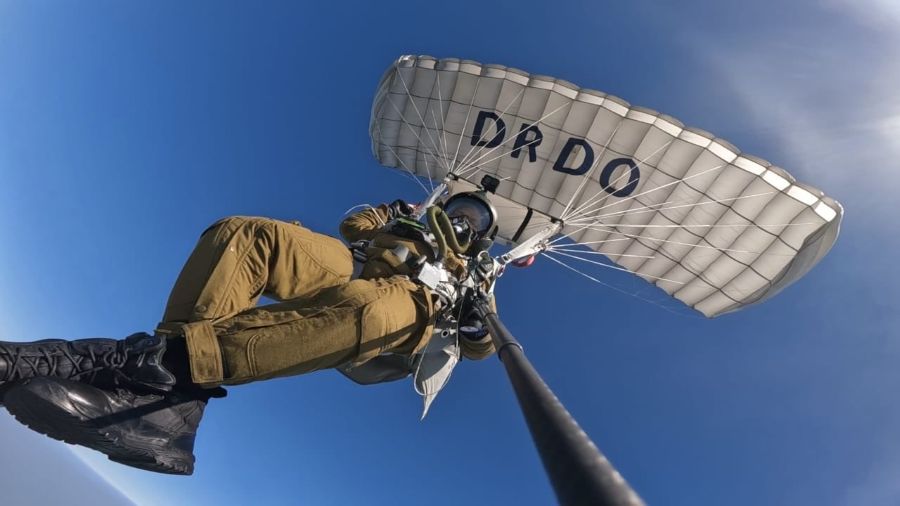
The Indian Air Force on Wednesday successfully conducted a combat free-fall jump from an altitude of 32,000 feet to test the Military Combat Parachute System (MCPS) – an indigenously developed system by the Defence Research and Development Organisation (DRDO).
According to the Ministry of Defence, the MCPS is the only parachute system currently in operational use by the Indian Armed Forces capable of deployment above 25,000 feet. The test marks a major milestone in India’s efforts to achieve self-reliance in advanced aerial delivery systems.
Jointly developed by DRDO’s Aerial Delivery Research and Development Establishment (ADRDE), Agra, and Defence Bio-Engineering and Electromedical Laboratory (DEBEL), Bengaluru, the MCPS was successfully deployed at 30,000 feet during the trial.
“The successful jump demonstrated the system’s advanced design, reliability, and tactical superiority,” an ADRDE spokesperson said. “Key features include a lower rate of descent, enhanced steering control, and compatibility with NAVIC, India’s satellite navigation system, ensuring secure and interference-free operations even in contested environments.”
The spokesperson added that the MCPS allows paratroopers to exit aircraft at extreme altitudes, deploy parachutes at preset heights, and navigate to designated landing zones with precision. The indigenous design promises faster maintenance turnaround and reduced dependence on foreign suppliers, a crucial advantage during wartime operations.
The Ministry further noted that compatibility with the NAVIC satellite system gives the MCPS a unique operational edge, ensuring freedom from external interference or denial-of-service threats from adversaries. The system’s design also enables maximum lifecycle utility with minimal maintenance downtime, outperforming comparable imported equipment.
Defence Minister Rajnath Singh congratulated DRDO, the armed forces, and industry partners for the successful demonstration, calling it “a significant milestone for India’s indigenous defence capability.”
Samir V. Kamat, Secretary, Department of Defence R&D and Chairman, DRDO, also lauded the development team, describing the achievement as “a major step towards self-reliance in the field of aerial delivery systems.”
Team BharatShakti