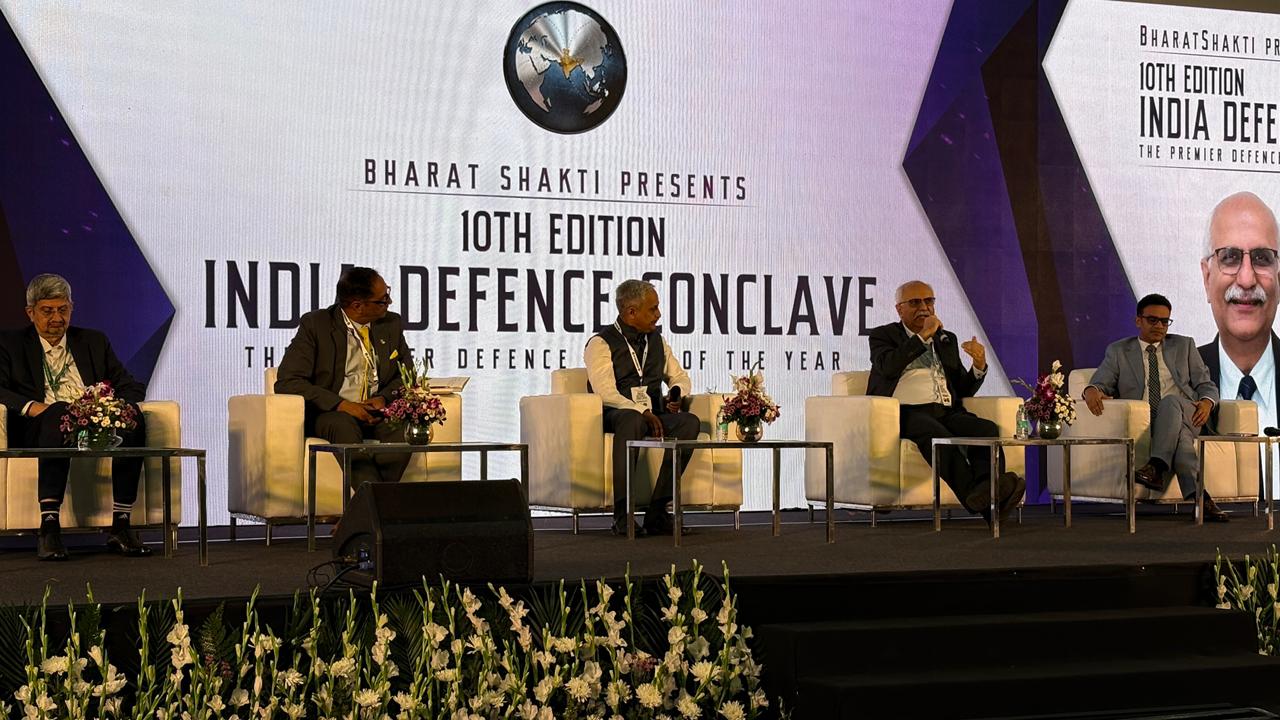
At the India Defence Conclave, Artificial intelligence, cyber warfare, and technological self-reliance emerged as dominant themes, reflecting India’s shift from conventional deterrence to intelligent defence capability.
AI, Data and the New Domains of War
In his keynote address, Dr Samir V. Kamat, Secretary, Department of Defence R&D and Chairman of DRDO, set the tone for the discussion.
“Economic growth is not possible unless the nation is kept secure,” he said. “Our armed forces must be capable of absorbing technological change, because the wars of tomorrow will be hybrid and multi-domain.”
He warned that future conflicts may begin with cyber attacks before a single missile is fired, and that data, artificial intelligence, and quantum technologies will increasingly shape battle outcomes. “The battlefield now includes the cyber and space domains,” he noted. “To secure India’s future, we must master emerging technologies, from AI and autonomy to advanced materials and intelligent systems.”
Kamat called for the entire ecosystem, DRDO, academia, startups, and industry, to collaborate in building critical technologies indigenously.
“It is time to leapfrog to a new normal. We must move from an import-driven defence economy to a fully indigenous ecosystem that can design, build, and export,” he said.
Safran: Building India’s Aerospace Ecosystem
Representing Safran India, J.S. Gavankar, CEO & Country Head, detailed how the French aerospace giant is deepening its presence in the country.
“Safran is now present in seven Indian cities, engaged in manufacturing and engineering activities,” he said. “We are setting up repair and maintenance facilities and expanding our support to the armed forces.”
Gavankar stressed that the company’s philosophy aligns with India’s vision of “Make in India, Sustain in India.”
“Innovation must happen in India,” he said. “The goal is to create a sustainable aerospace ecosystem that not only manufactures but also designs and develops advanced technologies here.”
L&T: Engineering the Future Force
Arun Ramchandani, EVP & Head, L&T Defence, said India now has the industrial and R&D base to build complex defence systems indigenously.
“Our focus is on developing platforms and systems that are entirely indigenous,” he explained. “The Indian ecosystem, from large industry to MSMEs, can now integrate to deliver advanced platforms of the future.”
Ramchandani highlighted the need to combine traditional engineering with digital technologies such as AI, simulation, and real-time systems integration. “It’s no longer enough to build physical systems; we must embed intelligence into every platform,” he added.
10th India Defence Conclave | Knowledge Session I | Building the Future Armed Forces
Adani Defence: Building Self-Reliance and Scale
Adding the perspective from India’s fast-rising private defence player, Ashish Rajvanshi, CEO of Adani Defence & Aerospace, underlined how the group is investing in future-ready capabilities that align with the hybrid warfare vision articulated by Dr Kamat.
“At Adani Defence, our mission is to build an ecosystem that delivers both scale and self-reliance,” Rajvanshi said. “The wars of the future will be fought with data, AI, and autonomous systems — and our focus is to integrate these technologies into our manufacturing and R&D.”
Adani has set up one of South Asia’s largest ammunition and missile manufacturing complexes in Kanpur, alongside partnerships with global technology leaders to indigenise missile systems, unmanned platforms, counter-drone systems, and electronic warfare technologies.
“We are investing in AI- and ML-driven systems, indigenous ammunition, and advanced aerospace capabilities,” Rajvanshi noted. “Our goal is to make India not just self-reliant, but a net exporter of advanced defence technology.”
He stated that building India’s defence capacity requires collaboration across MSMEs, startups, and academia, echoing DRDO’s call for a cohesive national effort.
“Hybrid warfare demands hybrid innovation,” he said. “We must combine industrial strength with digital intelligence.”
Human and Machine: The Next Battlefield
Cmde Arun Golaya (Retd), former head of TDAC, NIIO, reminded the audience that while machines are transforming warfare, the human behind the machine remains decisive.
“For thousands of years, war was fought by men. Now it’s increasingly fought by machines,” he said. “But unless we prepare our people to understand and control these technologies, the machine will control us.”
He said that the next phase of military readiness will depend on training, simulation, and cognitive adaptation, enabling soldiers to operate confidently in a world of AI, automation, and information warfare.
A Unified National Tech Defence Vision
From DRDO’s vision of mastering emerging technologies to Safran’s localized innovation, L&T’s integrated engineering, and Adani’s push for scalable manufacturing and AI-driven systems, a unified message echoed: India’s defence future lies in technological sovereignty.
As Dr Kamat summed up: “We must be ready for a new kind of war, intelligent, hybrid, and fought across domains. To secure our future, we must innovate, integrate, and master the technologies that will define it.”