


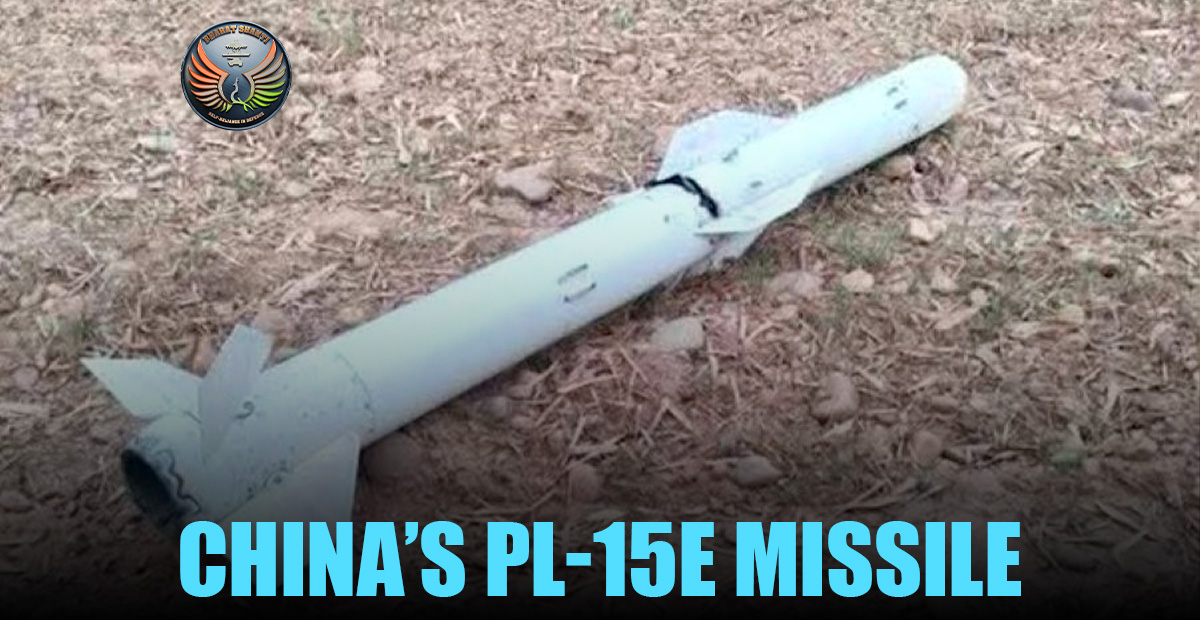
The recent interception of a Chinese PL-15E air-to-air missile during India’s Operation Sindoor has triggered intense global interest. Fired by Pakistan and downed over Punjab by Indian air defences, the missile’s debris is now a hotbed of military and intelligence curiosity.
Several major powers—including the Five Eyes alliance (United States, United Kingdom, Australia, Canada, and New Zealand), as well as France and Japan—have formally expressed interest in examining the remnants of the advanced Chinese weapon.
India Displays Debris After Operation Sindoor
At a press conference on May 12, Indian defence officials confirmed that Pakistan used the PL-15E in a failed aerial offensive. Air Marshal A.K. Bharti revealed that the missile, along with a Turkish drone, was successfully intercepted. Debris from the PL-15E was recovered in Punjab’s Hoshiarpur district, with fragments scattered over a wide area.
Why the Missile Debris Matters
The recent incident presents a unique opportunity for Western and allied militaries to closely examine one of China’s most sophisticated missile systems: the PL-15E. This export variant of the PL-15 boasts impressive features, including an Active Electronically Scanned Array (AESA) radar, a two-way data link for enhanced communication, and a dual-pulse solid rocket motor, all of which contribute to its long-range capabilities in air-to-air combat scenarios. Understanding these advanced technologies can provide valuable insights into China’s military prowess and inform future defence strategies.
Until recently, our understanding of these capabilities has primarily stemmed from speculation, open-source intelligence, and airshow demonstrations. The recovery of actual hardware now provides an unprecedented glimpse into China’s advanced missile design—a rarely permitted insight by Beijing. Key intelligence focuses include analyzing radar signatures and stealth materials, exploring propulsion and motor construction, assessing target acquisition and guidance systems, and evaluating resistance to electronic warfare.
Insights from this analysis could help countries develop better countermeasures, upgrade detection systems, and refine air combat doctrines.
France’s Stakes: Meteor vs PL-15E
France is particularly invested in the outcome. The PL-15E is widely seen as a potential rival—or even superior in some aspects—to the European Meteor missile developed by MBDA. During Operation Sindoor, Pakistani forces reportedly attempted to use the PL-15E to target Indian Rafale jets—aircraft manufactured by France.
For France, gaining access to the missile’s remains could inform future Rafale upgrades, enhance missile defence integration, and guide broader air superiority strategy in contested airspaces.
A New Front in the Geopolitical Tech Race
While China has showcased the PL-15E at events like the Zhuhai Air Show, real-world combat usage—and now the availability of wreckage—offers an unprecedented look at its true capabilities.
As China accelerates its military modernization and expands its reach, particularly in the Indo-Pacific, understanding systems like the PL-15E is becoming vital for nations seeking to maintain strategic and technological parity.
Huma Siddiqui