


Editor’s Note
As China expands its military footprint from Djibouti to the South China Sea, India has quietly built a counter-network of overseas military access, stretching from Oman to Vietnam, reshaping the balance of power in the Indian Ocean without announcing a single foreign base.
As China steadily expands its military footprint across the Indo-Pacific through a chain of ports and bases stretching from Djibouti to the South China Sea, India has responded, but in a markedly different way.
Instead of announcing large, permanent overseas bases, New Delhi has built a discreet but expanding web of access agreements, surveillance facilities and logistics partnerships that now extend from the western Indian Ocean to Southeast Asia and Central Asia. Together, they allow Indian forces to operate farther from home, stay deployed longer, and counter
China’s growing presence without the political baggage of foreign garrisons.
This low-visibility network, spanning Oman, Mauritius, Seychelles, Singapore, Vietnam and beyond, is increasingly central to India’s ambition to act as a net security provider in the Indian Ocean Region (IOR).
A Web of Strategic Access
India today enjoys varying degrees of military access at several key locations astride major sea lanes and choke points.
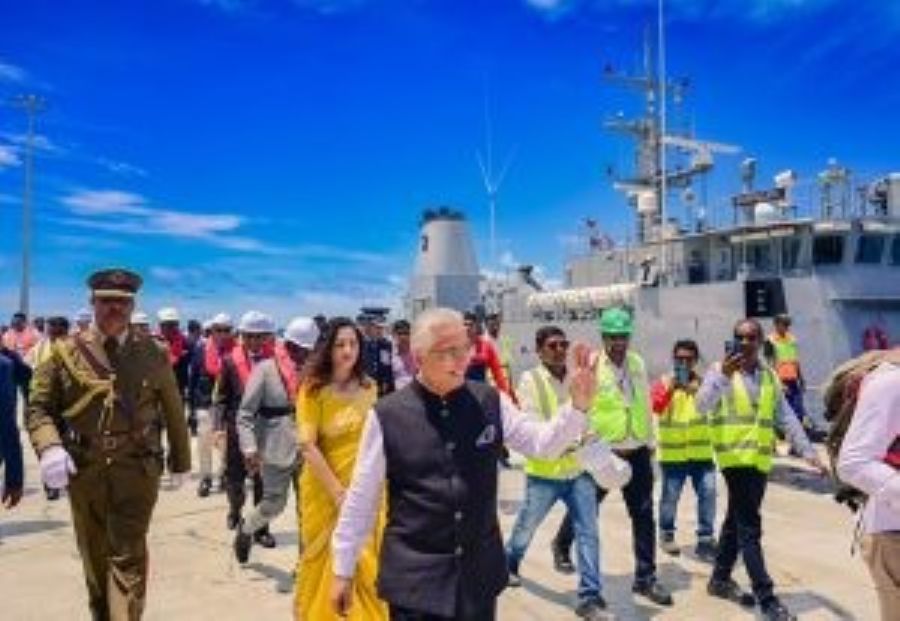
Oman provides berthing and logistics support at Muscat and Duqm, giving Indian naval and air assets reach close to the Gulf of Aden. Mauritius has leased North Agaléga Island, where India has developed airstrips, jetties and radar facilities. Seychelles hosts Indian-supported infrastructure on Assumption Island, while Singapore allows Indian Navy ships access to refuelling and logistics at Changi Naval Base.
Further east, Vietnam grants berthing rights at Nha Trang, enhancing India’s presence in the South China Sea. Madagascar hosts Indian-operated radar posts, while the Maldives, Sri Lanka and Nepal are integrated into India’s coastal surveillance and air security grid through radar chains and airstrip access.
In parallel, logistics-sharing agreements with the United States, Japan and other partners give Indian warships and aircraft access to a vast global network of bases, without permanent stationing.
“India has moved from having almost no overseas presence to a loose network of foreign bases, listening posts and access arrangements, mainly across the Indian Ocean and into Central Asia,” said Lt Col Manoj Channan (retd). “These footholds extend India’s surveillance and strike reach far beyond the subcontinent, and help offset China’s ‘string of pearls’ strategy without triggering backlash.”
Two Models, One Strategy
India’s overseas posture rests on two distinct models. The first involves facilities developed directly by India. The now-closed Farkhor Air Base in Tajikistan, India’s first military outpost abroad, set the template. Similar investments have followed in Bhutan, Mauritius, Seychelles and Oman, typically focused on airfields, jetties and surveillance infrastructure.
The second model relies on logistics partnerships, which analysts often describe as “virtual bases”. These agreements allow Indian forces to refuel, replenish and repair at friendly facilities across the Indo-Pacific, dramatically expanding operational endurance.
Together, the two approaches offer flexibility while avoiding the optics of overt militarisation.
Why It Matters Now
The urgency behind this strategy has grown as China’s People’s Liberation Army Navy (PLAN) pushes deeper into the Indian Ocean, supported by ports and facilities from Gwadar to Djibouti.
For the Indian Navy, overseas access is inseparable from maritime dominance. The Strait of Hormuz, Bab-el-Mandeb, Malacca Strait, and the Mozambique Channel are critical chokepoints that carry the bulk of India’s energy imports and trade.
“For global and regional powers, overseas military bases provide the logistics and maintenance support necessary for sustained operations far from home,” said Vice Admiral A.K. Chawla (retd). “Britain controlled choke points to build its empire, the US operates hundreds of overseas bases today, and China has now joined that category with Djibouti.”
“In that context,” he added, “selective overseas access is no longer optional for India if it is to counter an assertive China amid an uncertain global balance of power.”
Recent moves underline this logic. The commissioning of INS Jatayu at Minicoy Island in 2024, India’s westernmost naval base, has strengthened surveillance near the Maldives at a time when Male is drawing closer to Beijing. Combined with the induction of MH-60R Seahawk helicopters, India’s reach across the Arabian Sea has expanded significantly.
Air Power and Strategic Depth
For the Indian Air Force, overseas facilities are less about expeditionary warfare and more about deterrence and strategic depth.
“To maintain our presence in our area of influence, we need outposts,” said Air Commodore T.K. Chatterjee (retd). “Being non-aligned and non-expeditionary, India does not need permanent bases like the US, but we do need military and logistics facilities where we anticipate threats.”
He pointed to the Andaman and Nicobar Islands and Bhutan as critical for countering pressure from Pakistan, protecting the Siliguri Corridor and influencing traffic through the Malacca Strait.
A Low-Visibility, High-Impact Approach
What ultimately distinguishes India’s approach is political design. Facilities are small, often dual-use, and embedded within host-nation frameworks, reducing accusations of militarisation while delivering strategic leverage.
As India’s trade routes, diaspora and security interests expand, this network is likely to deepen further, particularly in Africa, Southeast Asia and the western Pacific.
In an era defined by naval competition and contested sea lanes, India’s overseas military access is no longer peripheral. It has become a central, if understated, pillar of New Delhi’s strategy to balance China, quietly but decisively.
Huma Siddiqui