



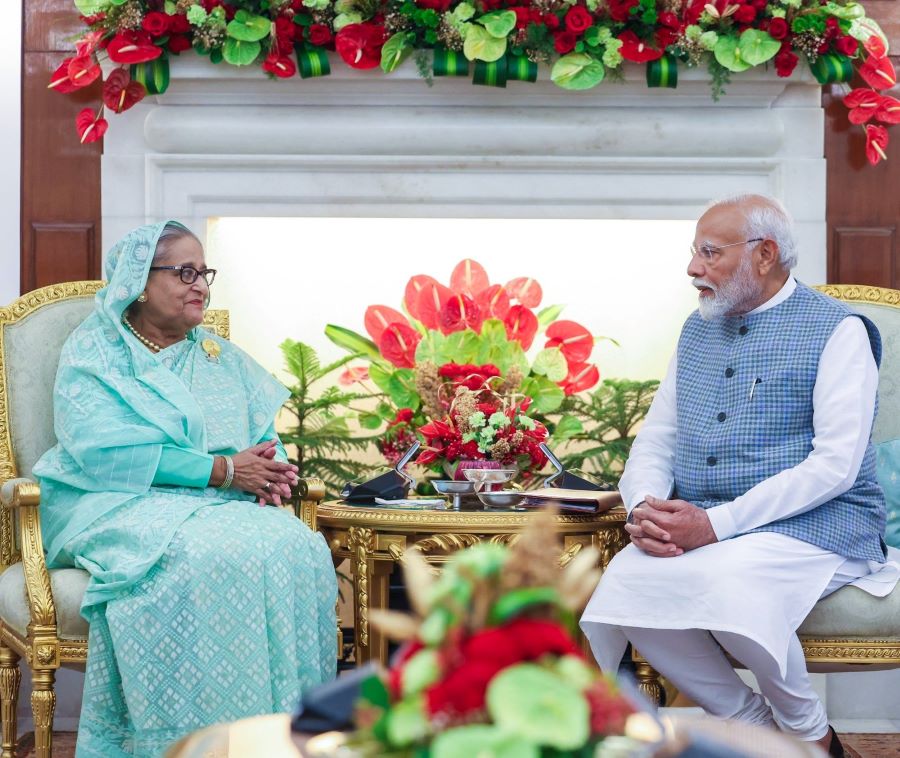
India and Bangladesh have taken significant steps to strengthen their defence ties, signing agreements that will expand cooperation in crucial sectors such as maritime security, ocean economy, space, and telecommunication. These agreements, signed during Bangladesh Prime Minister Sheikh Hasina’s visit to India on Saturday, mark a significant move by New Delhi to position itself as a regional power and a counterweight to China. Notably, Prime Minister Hasina is the first foreign leader to visit New Delhi since Narendra Modi began his third term as Prime Minister two weeks ago.
Prime Minister Modi expressed his satisfaction with the discussions, stating, “We have had detailed discussions from defence production to modernisation of armed forces.” He warmly welcomed Bangladesh’s decision to join his Indo-Pacific Oceans Initiative, a move that will significantly expand and facilitate regional cooperation among India’s maritime neighbours. These agreements, he emphasized, are a testament to India’s commitment to a neighborhood-first approach, a strategy that promises mutual benefits for both nations.
The PM observed, “We have decided to strengthen our cooperation over counterterrorism, fundamentalism, and peaceful border management. Our vision for the Indian Ocean Region is the same. We welcome Bangladesh’s decision to join the Indo-Pacific Oceans Initiative. We will continue our cooperation at BIMSTEC and other regional and international forums.”
Bangladesh also enjoys good ties with China, its major trade partner mostly for raw materials. However, maintaining a close relationship with Beijing is challenging for Bangladesh, as it also needs to balance its diplomatic and trade relationships with India and the United States, which are China’s main rivals. The garment industry in Bangladesh, which earns more than 80% of its foreign currency from exports, heavily relies on China for raw materials.
Hasina’s announcement of increased cooperation in river water sharing and the power and energy sectors is a clear indication of the potential for economic growth between the two countries. Her meeting with Indian industry leaders and invitation for them to invest in Bangladesh’s infrastructure, including the development of bigger ports, waterways, rail, and road connectivity, further underscores this potential. India’s loan of $8 billion to Bangladesh over the past eight years is a testament to their belief in this shared vision of economic prosperity.
India, Bangladesh’s largest export destination in Asia, has established a trade relationship of significant scale. In the financial year 2022-23, the trade volume between the two countries reached a staggering $ 15.9 billion. New Delhi exports a variety of products, including cotton, motor vehicles, sugar, iron, steel, aluminum, electrical and electronic equipment. It also imports cereal, pulp paper and board, cement, and raw hides from Bangladesh, underscoring the magnitude of this trade relationship.
Team BharatShakti


