



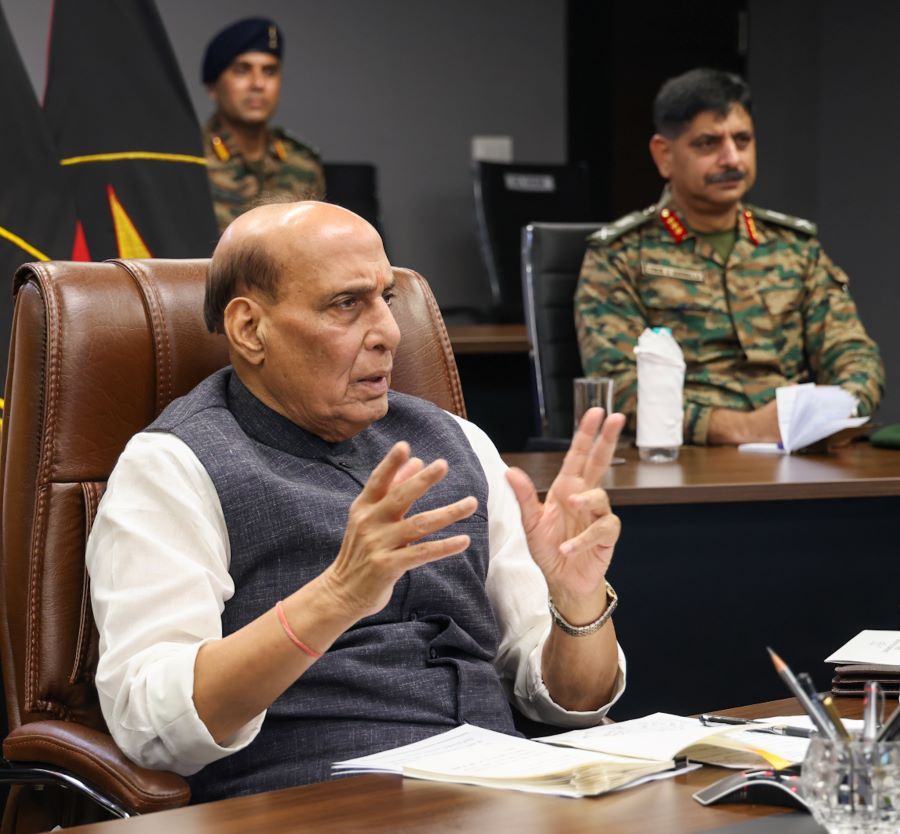
In a major push towards defence modernisation following Operation Sindoor, the Defence Acquisition Council (DAC), chaired by Defence Minister Rajnath Singh, has cleared procurement proposals valued at approximately Rs 79,000 crore. The approvals, finalised at a high-level meeting in South Block, mark an important step in boosting the operational capabilities of the Indian Army, Navy, and Air Force through a mix of indigenous platforms and advanced technologies.
Indian Army: Enhanced Firepower and Mobility
The DAC has granted Acceptance of Necessity (AoN) for several critical systems for the Indian Army, including the Nag Missile System (Tracked) Mk-II (NAMIS), the Ground-Based Mobile ELINT System (GBMES), and High Mobility Vehicles (HMVs) equipped with material handling cranes.
The upgraded NAMIS Mk-II, mounted on the newly developed NAMICA-2 tracked vehicle, will bolster the Army’s ability to neutralise enemy armour, bunkers, and fortified positions. Meanwhile, the GBMES will provide continuous electronic intelligence coverage of enemy emitters, strengthening battlefield situational awareness. The inclusion of high-mobility logistics vehicles will further enhance troop support across varied terrain, a key takeaway from operational experiences during Operation Sindoor.
Indian Navy: Expanding Amphibious and Maritime Reach
For the Indian Navy, the DAC has cleared proposals for the acquisition of Landing Platform Docks (LPDs), 30mm Naval Surface Guns, Advanced Lightweight Torpedoes (ALWTs), Electro-Optical Infra-Red Search and Track Systems, and Smart Ammunition for the 76mm Super Rapid Gun Mount.
The LPDs, large amphibious ships capable of transporting troops, armoured vehicles, and aircraft, will significantly boost India’s capacity for expeditionary and humanitarian operations. While the overall cost of the LPD programme is expected to be substantial, exact financial details are yet to be finalised. The ships are to be built indigenously, a move expected to inject momentum into the domestic shipbuilding sector.
The ALWT, developed by the DRDO’s Naval Science and Technological Laboratory, is designed to engage conventional, nuclear, and midget submarines, enhancing the Navy’s undersea warfare capabilities. The new 30mm guns will also improve the Navy and Coast Guard’s capability to conduct low-intensity maritime operations and counter-piracy missions.
Indian Air Force: Embracing Autonomous Warfare
For the Indian Air Force, the DAC approved the Collaborative Long Range Target Saturation/Destruction System (CLRTS/DS), among other projects. The system is an autonomous platform capable of independent take-off, navigation, target identification, and precision engagement — reflecting the IAF’s growing focus on unmanned and AI-enabled systems.
A Shift Towards Self-Reliance
A strong emphasis on indigenous development and production runs through the entire approval list. With DRDO and domestic defence manufacturers playing leading roles, these projects align closely with the government’s Aatmanirbhar Bharat (self-reliant India) initiative.
Experts believe the procurement plan will not only improve combat readiness but also drive technological innovation and job creation across India’s defence industrial base.
Post-Operation Sindoor Modernisation
The latest decisions reflect a strategic recalibration after Operation Sindoor, which underscored the importance of mobility, rapid response, and multi-domain integration. By equipping the services with modern systems designed and built in India, the Ministry of Defence aims to prepare the armed forces for the complex operational environment of the future.
Across all three services, the clearances highlight a decisive tilt towards indigenous manufacturing and technology development. More participation from public-sector giants such as BEL and AVNL, and private heavyweights such as L&T, Ashok Leyland, and Kalyani Group, is expected to stimulate India’s defence industrial base and generate significant employment in high-technology sectors.
Post-Operation Sindoor, the focus has shifted firmly toward multi-domain readiness and self-reliance.
Team BharatShakti