



After years of delays and shifting requirements, the Indian Navy’s long-pending acquisition of four Landing Platform Docks (LPDs) is expected to gain fresh momentum with the government poised to issue a new Acceptance of Necessity (AoN) under Article 12 of the Defence Procurement Manual (DPM) for shipbuilding in India following the clearance from the Defence Procurement Board. With the growing presence of the Chinese Navy in the waters surrounding India, this long-anticipated move is likely to be expedited, as New Delhi seeks to bolster its amphibious warfare and maritime expeditionary capabilities. The LPDs will be constructed domestically, and the selected bidder will be free to choose local or global partners—public or private—for execution, marking a strategic shift in how large-scale naval platforms are acquired and built.
Why LPDs Are Crucial
LPDs are the backbone of modern expeditionary forces, designed to transport troops, armour, and aircraft directly to hostile shores. Their versatility allows them to launch amphibious assaults, sustain out-of-area contingency operations, and spearhead disaster relief and humanitarian missions.
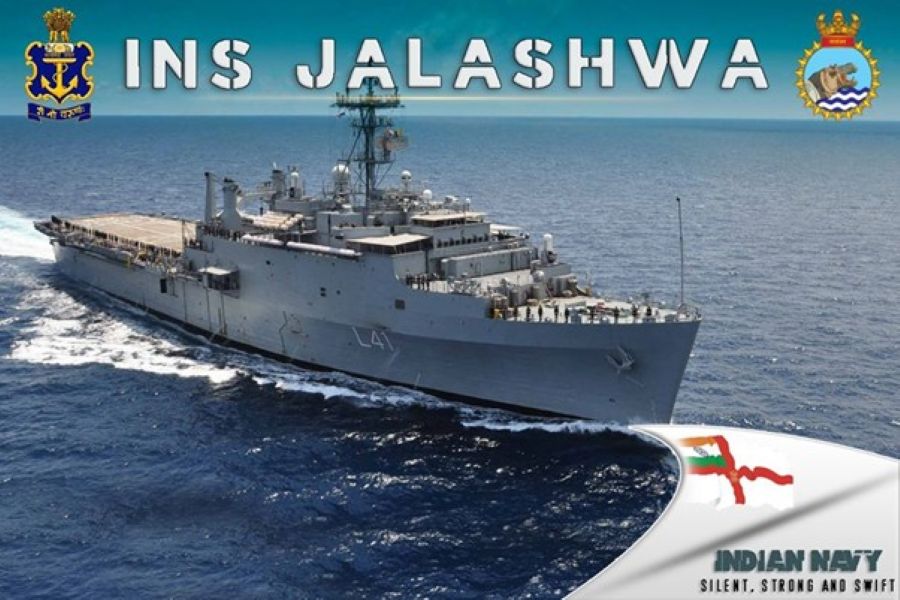
India currently relies on a single such platform, INS Jalashwa, acquired from the U.S. in 2007. But with rising maritime threats and the Navy’s expanding responsibilities across the Indo-Pacific, planners have long argued that more LPDs are critical to project power, secure island territories, and operate in contested chokepoints.
What the Navy Wants
According to the Navy’s 2021 Request for Information (RFI), the future LPDs are envisioned as multi-role, technology-heavy platforms with both combat punch and humanitarian reach. Planned features include:
Weapons Systems
The weapons systems are designed to enhance operational readiness and ensure comprehensive defence capabilities. It includes 32 Vertical Launch Short Range Surface-to-Air Missiles (VLSRSAMs) for robust aerial defence, complemented by 16 long-range anti-ship missiles to engage maritime threats effectively. Additionally, four AK-630 Close-In Weapon Systems (CIWS) equipped with electro-optical fire control provide a reliable shield against incoming projectiles. The integration of Heavy and Medium Machine Guns (HMGs and MMGs) further fortifies layered deck defence, ensuring a multi-faceted approach to maritime safety and threat engagement.
Aviation & Amphibious Support
The aviation and amphibious support capabilities are enhanced by a dedicated flight deck and spacious hangar designed to accommodate multiple helicopters. Additionally, the platform is equipped to operate fixed-wing naval drones, further extending its operational reach. To facilitate rapid troop and armour deployment, it features embarked Landing Craft Mechanised (LCMs), ensuring swift and efficient mobilisation in various mission scenarios.
Command & Control
– A fully integrated Command and Information Centre for theatre operations.
– Serves as the command hub for task force, landing force, and air operations commanders.
Other Features
– Electric or hybrid propulsion systems.
– A high degree of indigenisation.
– Facilities for medical treatment, disaster relief, and search-and-rescue operations.
– Supports unmanned systems as a mothership.
These ships will also carry Landing Craft Mechanised (LCMs) to transport troops and armoured vehicles ashore, enhancing flexibility in amphibious operations.
The Long Road to Approval
The LPD project dates back to 2010, when the Cabinet Committee on Security (CCS) first sanctioned it under the Buy and Make (Indian) category. A global tender floated in 2013 was scrapped amid procedural hurdles. Momentum returned in 2021 with a revised RFI, but bureaucratic delays stalled progress again. Now, with the Defence Ministry poised to revisit the plan, optimism within naval circles is high that the acquisition will finally move forward.
Who’s Competing
The upcoming tender is anticipated to attract bids from India’s leading shipbuilders, including Larsen & Toubro (L&T), Cochin Shipyard Limited (CSL), Mazagon Dock Shipbuilders (MDL), and Hindustan Shipyard Limited (HSL). These companies are likely to collaborate with international OEMs such as Navantia from Spain, Naval Group from France, and Fincantieri from Italy. Notably, the program emphasises local construction with a high degree of indigenous content, supporting the Atmanirbhar Bharat and Make in India initiatives.
Delivery Timeline
Per the RFI, the first ship is to be delivered within 60 months of contract signing, followed by subsequent vessels at yearly intervals. If the tender is floated this fiscal and contracts signed by 2026, the first LPD could enter service by 2031 – giving India the expeditionary muscle it has long lacked.
Strategic Payoff
As China expands its naval footprint in the Indo-Pacific, India’s ability to project and sustain forces across the IOR will be decisive. Beyond strengthening warfighting capacity, the LPD program will deepen India’s indigenous warship-building ecosystem, while signalling a doctrinal shift toward expeditionary, theatre-level operations.
Team BharatShakti


