


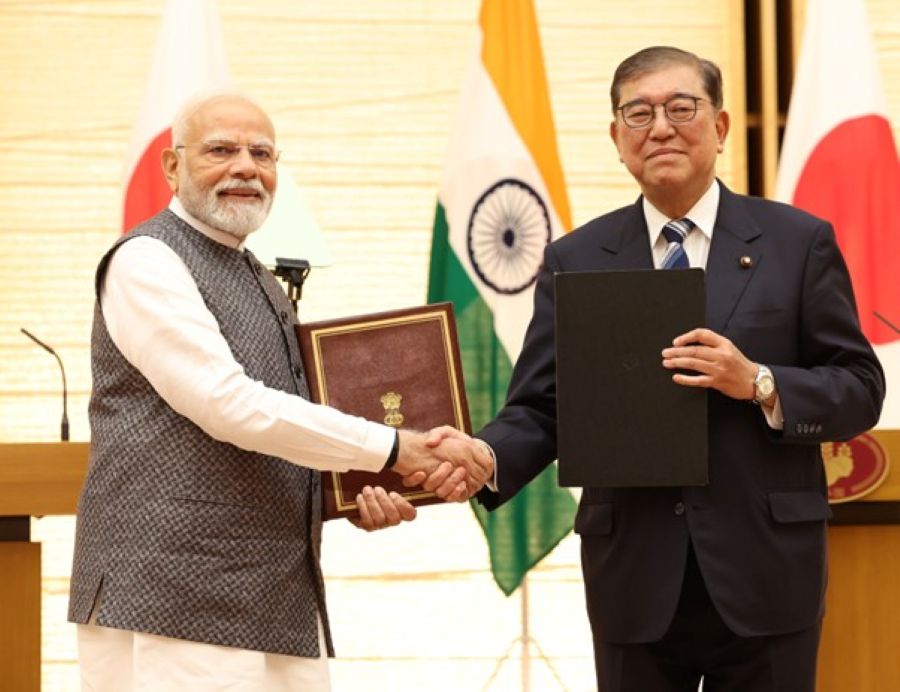
India and Japan have elevated their strategic partnership with the adoption of a Joint Declaration on Security Cooperation, setting the stage for deeper collaboration in defence, maritime security, cyber, and space domains. The declaration was unveiled on Friday during Prime Minister Narendra Modi’s visit to Japan for the 15th Annual India–Japan Summit.
Framing their partnership as vital to a free, open, and rules-based Indo-Pacific, both governments reaffirmed their Special Strategic and Global Partnership as the cornerstone of regional peace and prosperity.
Strengthening Defence and Military Synergy
The declaration calls for greater interoperability between the two armed forces, including more complex bilateral exercises, reciprocal participation in multilateral drills, and the launch of tri-service exercises with a focus on humanitarian assistance and disaster relief. Cooperation will also extend to counter-terrorism, peacekeeping, special forces collaboration, and advanced CBR (chemical, biological, radiological) defence measures.
Plans were also outlined for enhanced logistics support under existing agreements and shared maintenance facilities to bolster operational readiness.
Maritime Security and Indo-Pacific Outlook
Recognising the centrality of maritime stability, the two nations pledged to expand naval and coast guard port calls, improve maritime domain awareness through shared platforms such as the IFC–IOR and IPMDA, and coordinate against piracy and transnational crimes via regional mechanisms like ReCAAP. Disaster risk reduction at sea will be a key area of future collaboration.
Defence Technology and Industrial Cooperation
Industrial engagement is set to deepen under the Defence Equipment and Technology Cooperation framework, covering co-development and co-production of advanced systems, joint R&D between India’s DRDO and Japan’s ATLA, and collaboration in defence medicine and health security. The declaration also opens pathways for cooperation on critical minerals supply chains, including exploration and processing.
A landmark example of this recent collaboration is the UNICORN stealth radar system, co-developed by Japan’s NEC Corporation and India’s Bharat Electronics Limited. Already in use on Japan’s Mogami-class frigates, this marks Japan’s first defence co-production project with India – and only its second technology transfer of such scale in Asia after the Philippines.
Also Read: India, Japan Agree To Widen Defence Tech Collaboration, Transfer of Stealth Warship Antennas
Addressing Emerging Security Challenges: Cyber, AI, Robotics
The two sides pledged to jointly counter terrorism, cyber threats, unmanned systems, and transnational crime, while expanding intelligence sharing and R&D in frontier technologies such as AI, robotics, semiconductors, quantum sciences, and biotechnology. Space cooperation, including navigation, earth observation, debris tracking, and situational awareness, will be strengthened as part of the broader Indo-Pacific security framework.
Regional and Global Security Commitments: Quad
Both sides underscored their support for ASEAN centrality, the Quad, and the Indo-Pacific Oceans Initiative. They committed to upholding maritime freedoms, resisting coercive actions, and promoting sustainable infrastructure. Japan reaffirmed support for India’s entry into the Nuclear Suppliers Group (NSG), while both nations backed each other’s case for UN Security Council reforms.
Institutionalising Strategic Dialogue
The declaration also strengthens institutional mechanisms, including annual National Security Adviser consultations, defence industry forums, high-level military staff talks, and coast guard commandant meetings, alongside new economic security and Track 1.5 dialogues.
A Defining Moment in Bilateral Ties
In May 2025, the Japan-India Defence Cooperation framework was established within the Indo-Pacific regional context. It provides a structured mechanism for managing bilateral defence initiatives from a “comprehensive and integrated perspective.”
Analysts describe the declaration as a watershed moment in India–Japan relations, reflecting a maturing partnership that now goes beyond diplomatic goodwill to concrete security collaboration. By institutionalising defence cooperation, sharing sensitive technologies, and aligning their strategic outlooks, the two nations have signalled their intent to shape the future security architecture of the Indo-Pacific.
Ravi Shankar

Dr Ravi Shankar has over two decades of experience in communications, print journalism, electronic media, documentary film making and new media.
He makes regular appearances on national television news channels as a commentator and analyst on current and political affairs. Apart from being an acknowledged Journalist, he has been a passionate newsroom manager bringing a wide range of journalistic experience from past associations with India’s leading media conglomerates (Times of India group and India Today group) and had led global news-gathering operations at world’s biggest multimedia news agency- ANI-Reuters. He has covered Parliament extensively over the past several years. Widely traveled, he has covered several summits as part of media delegation accompanying the Indian President, Vice President, Prime Minister, External Affairs Minister and Finance Minister across Asia, Africa and Europe.