


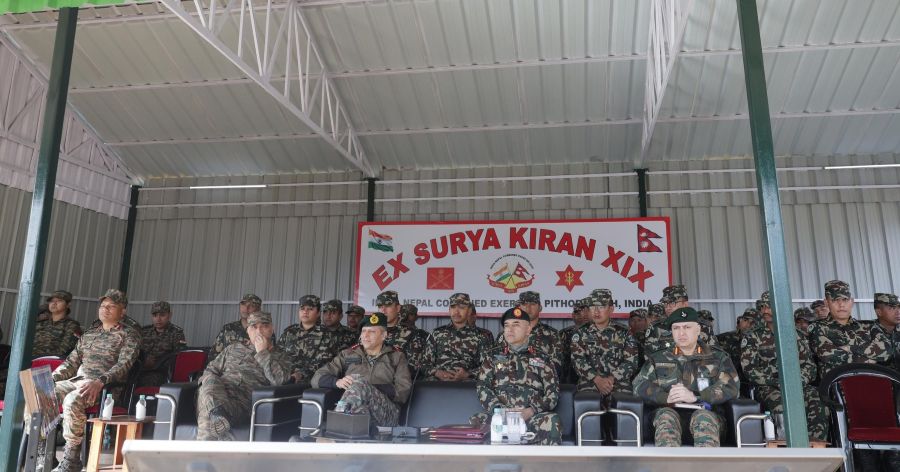
Exercise Suryakiran–XIX reached its concluding stage on Monday with the Directors General of Military Operations of India and Nepal arriving in Pithoragarh to watch the final evaluation of the joint counter-terrorism (CT) drills. Their visit marked the end of nearly two weeks of combined training involving battalion-sized contingents from both countries.
A Training Cycle Built Around Realistic CT Scenarios
This year’s edition placed troops in a range of situations simulating the missions undertaken during UN Chapter VII operations. Over the course of the training period, Indian and Nepali soldiers carried out coordinated actions in forested ridges, steep valleys and dispersed settlements, settings that reflect operational realities in the Himalayan belt.
Both armies contributed equal numbers of personnel, with the Indian contingent largely from the Assam Regiment and the Nepalese contingent mainly from the Devi Datta Regiment. Mixed teams were formed early in the exercise to help participants adjust to each other’s standard operating procedures.
Technology-Enabled Drills
A notable part of the training involved familiarisation with emerging technologies now widely used in field operations. Surveillance drones, precision-strike quadcopters, data-linked sights, automated logistics platforms, and AI-assisted imagery feeds were introduced into several scenarios. These systems were used to improve situational awareness, speed up decision-making, and support rapid actions in terrain where movement is often restricted.
Interaction Between Commanders and Troops
During the evaluation, the DGMOs were briefed on how joint teams planned their tasks, shared information and executed manoeuvres. They observed the coordination between ground troops, aerial assets, and small reconnaissance elements. Officers described how the exercise helped refine procedures for short-duration missions requiring close cooperation.
A Simple Gesture to Mark Continued Cooperation
To mark the completion of the training period, the two senior officers planted a sapling inside the training area. The act was presented as a reminder of the long-running defence relationship between the two neighbours and the routine nature of their military exchanges.
Why the Exercise Continues to Hold Relevance
The Surkiran series remains a regular feature in the calendar of both armies, and this year’s training addressed several current requirements:
maintaining CT preparedness in rugged terrain familiar to both sides, updating methods in line with modern surveillance and communication technologies, strengthening interoperability that may be needed during peacekeeping or humanitarian missions, and sharing approaches to disaster relief and evacuation in difficult geography.
Beyond Counter-Terrorism
Alongside CT scenarios, the two contingents practised environmental protection measures, casualty management, and cooperation between ground troops and aviation elements. These modules help both sides maintain familiarity with a broad set of tasks that often accompany security operations in mountainous regions.
Team BharatShakti