



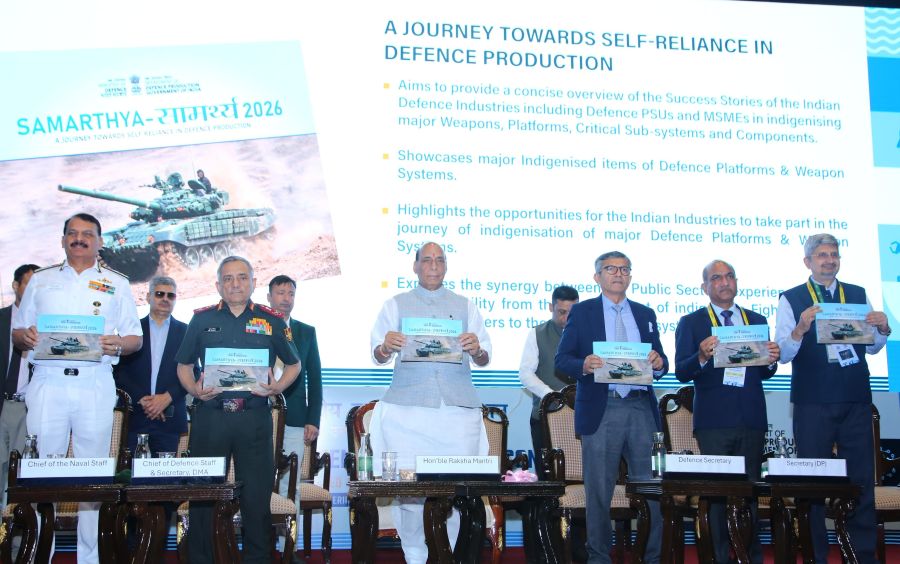
India has thrown open more than Rs 625 crore worth of frontline military technology problems to the country’s innovation ecosystem, signalling a shift in how the armed forces intend to source critical capabilities for future warfare.
At the two-day National Defence Industries Conclave 2026 on March 19-20, senior officials and industry speakers emphasised that the newly launched Innovations for Defence Excellence (iDEX) initiatives, the Defence India Start‑up Challenge (DISC-14), and ADITI Challenges 4.0 are not traditional procurement exercises.
Instead, they represent India’s attempt to identify long-term technology partners capable of co-developing complex defence systems with the armed forces.
“Many people are treating this like a procurement announcement. ADITI 4.0 is not a tender. It’s India selecting its future technology partners,” one of the speakers at the conclave said while outlining the significance of the latest ADITI challenges.
“A tender asks who can supply a product. ADITI asks who understands the operational problem well enough to build the solution alongside the military.”
The distinction, he said, is critical, particularly for foreign defence companies accustomed to competing through catalogue offerings.
“You cannot answer these problems through a product brochure,” he added.
25 High-End Technology Challenges
Under ADITI 4.0, the government has released 25 technology challenges drawn from the Indian Army, Indian Navy, Indian Air Force, and the Defence Space Agency.
Each challenge carries funding support of up to Rs 25 crore, with additional industry participation expected through matching investments.
The technology demands go far beyond incremental improvements. They include next-generation capabilities such as:
- Autonomous armoured systems equipped with AI-based decision layers
- Cognitive electronic warfare platforms
- Loitering munitions with guided course correction
- Quantum radar operating at practical military frequencies
- Space-based sensing architectures
- AI-driven open-source intelligence systems capable of real-time data fusion
Taken together, the problems sketch out a blueprint for how India expects warfare to evolve in the coming decade.
According to the speaker, the challenges reflect the operational realities of “Indian doctrine, Indian terrain and Indian budget constraints”, making close collaboration with domestic partners essential.
Early Movers Already Positioning
Industry players that have moved quickly are already aligning themselves with the challenges, the speaker noted.
Some companies have mapped specific military problems to their technology stacks rather than marketing pitches. Others have begun identifying MSME partners vetted by the Defence Research and Development Organisation (DRDO).
“There are firms already walking factory floors in Tamil Nadu and Telangana, identifying manufacturing partners,” he said. “They’re not attending webinars, they’re building relationships.”
He estimated that foreign original equipment manufacturers (OEMs) have roughly a 60-day window to position themselves within the programme before partnerships and technology alignments begin to solidify.
A Wider Innovation Push
The announcement formed part of a broader innovation push unveiled during the conclave at Manekshaw Centre.
Addressing the gathering, Defence Minister Rajnath Singh stressed that India must move quickly to build a robust defence manufacturing ecosystem, particularly in emerging domains such as drones.
“India must work in mission mode to emerge as a global hub of indigenous drone manufacturing in the coming years,” he said, pointing to the strategic importance of self-reliance amid a rapidly changing geopolitical landscape.
Alongside the 25 ADITI challenges, the government also launched 82 problem statements under DISC-14, while defence public sector undertakings unveiled 101 additional innovation challenges aimed at integrating start-ups and MSMEs into their supply chains.
Innovation Pipeline Expanding
Officials said the innovation pipeline built through iDEX has already begun producing tangible outcomes.
Since the programme was launched in 2018:
- 676 start-ups, MSMEs and innovators have joined the defence innovation ecosystem
- 548 contracts have been signed
- 566 challenges have been launched
- 58 prototypes, valued at about Rs 3,853 crore, have received procurement clearance
- 45 procurement contracts, worth nearly Rs 2,326 crore, have been concluded
Defence Production Secretary Sanjeev Kumar said the latest set of challenges is intended to deepen the participation of smaller companies in advanced defence manufacturing and design.
“The problem statements will allow MSMEs, start-ups and innovators to design state-of-the-art products and strengthen their technological capabilities,” he said.
For industry observers, however, the real significance lies in the shift from buying equipment to shaping technology partnerships. This change could define how India builds its next generation of military capabilities.
Ravi Shankar

Dr Ravi Shankar has over two decades of experience in communications, print journalism, electronic media, documentary film making and new media.
He makes regular appearances on national television news channels as a commentator and analyst on current and political affairs. Apart from being an acknowledged Journalist, he has been a passionate newsroom manager bringing a wide range of journalistic experience from past associations with India’s leading media conglomerates (Times of India group and India Today group) and had led global news-gathering operations at world’s biggest multimedia news agency- ANI-Reuters. He has covered Parliament extensively over the past several years. Widely traveled, he has covered several summits as part of media delegation accompanying the Indian President, Vice President, Prime Minister, External Affairs Minister and Finance Minister across Asia, Africa and Europe.


