


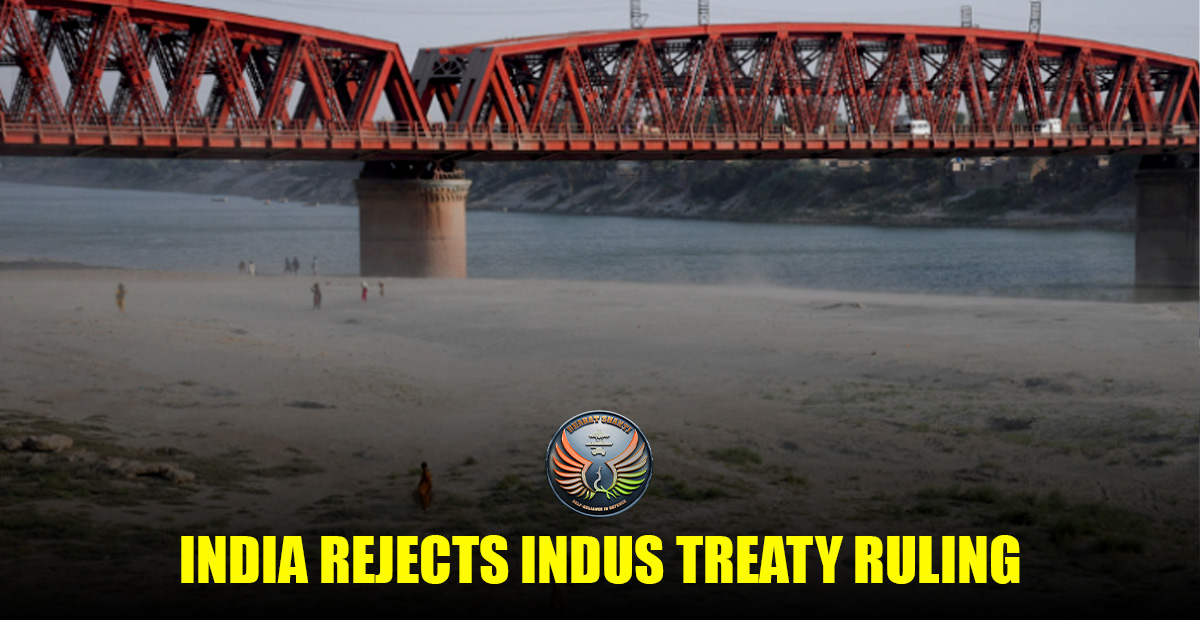
India has unequivocally rejected the recent decision of the so-called Court of Arbitration (CoA) on the Indus Waters Treaty (IWT), asserting that the tribunal lacks jurisdiction and its findings carry no legal weight. The Ministry of External Affairs (MEA) linked the rejection to Pakistan’s continued sponsorship of cross-border terrorism, warning Islamabad against “reckless provocations.”
At his weekly briefing on Thursday, MEA Spokesperson Randhir Jaiswal reaffirmed that India had placed the IWT in abeyance through a sovereign decision, taken after the April 22 Pahalgam terror attack that killed 26 Indian civilians.
“India has never accepted the legality, legitimacy, or competence of the so-called Court of Arbitration,” Jaiswal said. “Its pronouncements are without jurisdiction, devoid of legal standing, and have no bearing on India’s rights to utilise the waters.”
He also condemned what he described as Pakistan’s “selective and misleading” references to the CoA’s award.
Treaty Dispute and Court Ruling
The CoA recently upheld Pakistan’s objections to the design of Indian hydroelectric projects on the Indus system’s western rivers, urging India to remain within treaty limits. New Delhi maintains the treaty no longer applies, citing Pakistan’s persistent use of terror as an instrument of state policy.
“As reiterated in our press release of 27 June 2025, the Indus Waters Treaty stands in abeyance by a sovereign decision of the Government of India, in response to Pakistan’s continued sponsorship of cross-border terrorism,” Jaiswal said.
Escalating Rhetoric from Pakistan
The MEA’s rejection comes amid a wave of belligerent statements from Islamabad.
Earlier this week, Prime Minister Shehbaz Sharif declared that India would not be allowed to “snatch even one drop” of water, warning:
“If you threaten to hold our water, remember—you cannot take even one drop from Pakistan. You will be taught such a lesson that you will be left holding your ears.”
Former foreign minister Bilawal Bhutto-Zardari accused India of waging an “attack on the Indus Valley Civilisation” and vowed resistance “even if it leads to war.”
The most alarming remarks have been attributed to Pakistan’s Army Chief, Field Marshal Asim Munir, who allegedly made a veiled nuclear threat at an event in Florida:
“We are a nuclear nation. If we think we are going down, we’ll take half the world down with us.”
While no official transcript or video confirms the statement, its circulation has sparked concern. Munir is also reported to have threatened the destruction of any Indian dams on rivers flowing into Pakistan.
India’s Stern Warning
Jaiswal cautioned Pakistan against any form of adventurism, indirectly referring to Operation Sindoor – India’s retaliatory precision strikes in May on terror infrastructure in Pakistan and Pakistan-occupied Kashmir (PoK) following Pahalgam massacre.
“We have seen a continuing pattern of reckless, war-mongering and hateful comments from Pakistan’s leadership,” Jaiswal said. “This is a familiar tactic to divert attention from domestic failures. Pakistan would be well-advised to temper its rhetoric, as any misadventure will have painful consequences, as was demonstrated recently.”
Strategic Outlook
As tensions remain high, India is pursuing a proactive posture on diplomatic, military, and strategic fronts. A recent Parliamentary panel report has urged heightened vigilance against coordinated threats from Pakistan and China, including in the maritime domain.
New Delhi maintains its commitment to regional peace, but officials stress that Pakistan’s dual policy, speaking peace abroad while enabling terror at home, is rapidly exhausting India’s patience.
Ravi Shankar

Dr Ravi Shankar has over two decades of experience in communications, print journalism, electronic media, documentary film making and new media.
He makes regular appearances on national television news channels as a commentator and analyst on current and political affairs. Apart from being an acknowledged Journalist, he has been a passionate newsroom manager bringing a wide range of journalistic experience from past associations with India’s leading media conglomerates (Times of India group and India Today group) and had led global news-gathering operations at world’s biggest multimedia news agency- ANI-Reuters. He has covered Parliament extensively over the past several years. Widely traveled, he has covered several summits as part of media delegation accompanying the Indian President, Vice President, Prime Minister, External Affairs Minister and Finance Minister across Asia, Africa and Europe.