


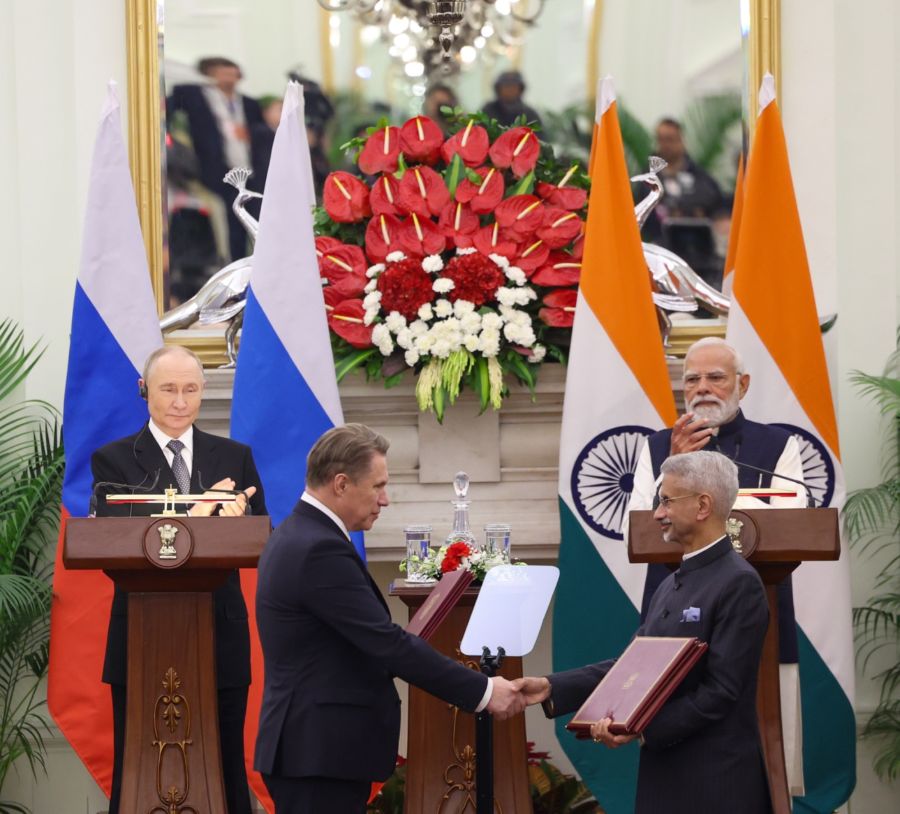
India and Russia have signalled a major strategic reset in their six-decade defence partnership, moving decisively beyond the traditional buyer-seller dynamic towards a deeper model of joint research, co-development and co-production of cutting-edge military technologies. The shift- formally articulated in the Joint Statement issued after summit talks between Prime Minister Narendra Modi and President Vladimir Putin – represents one of the most significant reorientations in bilateral defence engagement in recent years.
The joint statement underscores that, “responding to India’s quest for self-reliance, the partnership is reorienting to joint research and development, co-development and co-production of advanced defence technology and systems.”
It marks a transformative move for a relationship long defined by off-the-shelf purchases, licensed production, and dependence on imported Russian spares.
For the first time, both countries have explicitly committed to:
- Joint manufacturing in India of spares, components and aggregates for Russian-origin equipment
- Transfer of technology (ToT) to support Make in India
- Setting up of joint ventures not only to meet Indian military requirements, but also to export to friendly third countries
This recalibration places India and Russia in a collaborative framework similar to India’s growing partnerships with Western defence suppliers – but with the advantage of decades of operational familiarity with Russian platforms.
The Indian military has often flagged chronic delays in the supply of Russian spares, which directly affect the serviceability of frontline platforms such as Su-30MKIs, Mi-17 helicopters, T-90 tanks and Akula-class submarines.
Localised production of crucial components could dramatically increase readiness levels while reducing dependence on unpredictable supply chains.
The move towards co-development unlocks possibilities for a new generation of systems where India has long sought deeper technological participation:
- Next-generation fighter aircraft technologies
- Advanced aero-engines and marine propulsion systems
- Long-range and hypersonic missiles
- High-performance radars and electronic warfare systems
Russia holds critical know-how in several of these domains, with systems like the S-400, S-500, and Sukhoi-57 representing the technological edge that India hopes to access more collaboratively.
So far, BrahMos remains the flagship India–Russia joint venture – a highly successful enterprise but one based on a legacy Soviet Yakhont design. India’s earlier withdrawal from the Fifth-Generation Fighter Aircraft (FGFA) programme highlighted New Delhi’s insistence on genuine design participation rather than token co-development.
The new framework appears to reflect lessons learned: India seeks meaningful engineering access, long-term industrial rights and export flexibility – conditions the joint statement now seems prepared to accommodate.
Defence Minister Rajnath Singh’s meeting with Russian Defence Minister Andrey Belousov on Thursday further reinforced the renewed push. India conveyed interest in:
- Additional S-400 units
- Potential exploration of S-500 acquisition in the future
Three S-400 squadrons are already operational and played a decisive role during Operation Sindoor, strengthening India’s strategic air defence posture.
The joint statement also highlighted:
- Successful INDRA joint exercises
- Regular staff-level contacts
- Outcomes of the 22nd IRIGC–M&MTC meeting in New Delhi
- A commitment to “expand military delegation exchanges”
It signals that cooperation is not limited to technology but extends to operational synergy and doctrinal understanding.
The India–Russia defence relationship is entering a qualitatively new era. The reorientation from platform acquisition to joint innovation ecosystems aligns with India’s long-term push for defence self-reliance and global export competitiveness.
For Russia, facing Western sanctions and seeking resilient, long-term partners, India offers stable demand, industrial capacity, and geopolitical alignment in select domains.
If executed effectively, this paradigm shift could produce:
- Reduced lifecycle dependence on foreign suppliers
- Enhanced Indian capability in high-end defence manufacturing
- Shared intellectual property and joint export markets
- A modernised framework that keeps Russia relevant in India’s evolving defence matrix
Ravi Shankar

Dr Ravi Shankar has over two decades of experience in communications, print journalism, electronic media, documentary film making and new media.
He makes regular appearances on national television news channels as a commentator and analyst on current and political affairs. Apart from being an acknowledged Journalist, he has been a passionate newsroom manager bringing a wide range of journalistic experience from past associations with India’s leading media conglomerates (Times of India group and India Today group) and had led global news-gathering operations at world’s biggest multimedia news agency- ANI-Reuters. He has covered Parliament extensively over the past several years. Widely traveled, he has covered several summits as part of media delegation accompanying the Indian President, Vice President, Prime Minister, External Affairs Minister and Finance Minister across Asia, Africa and Europe.