


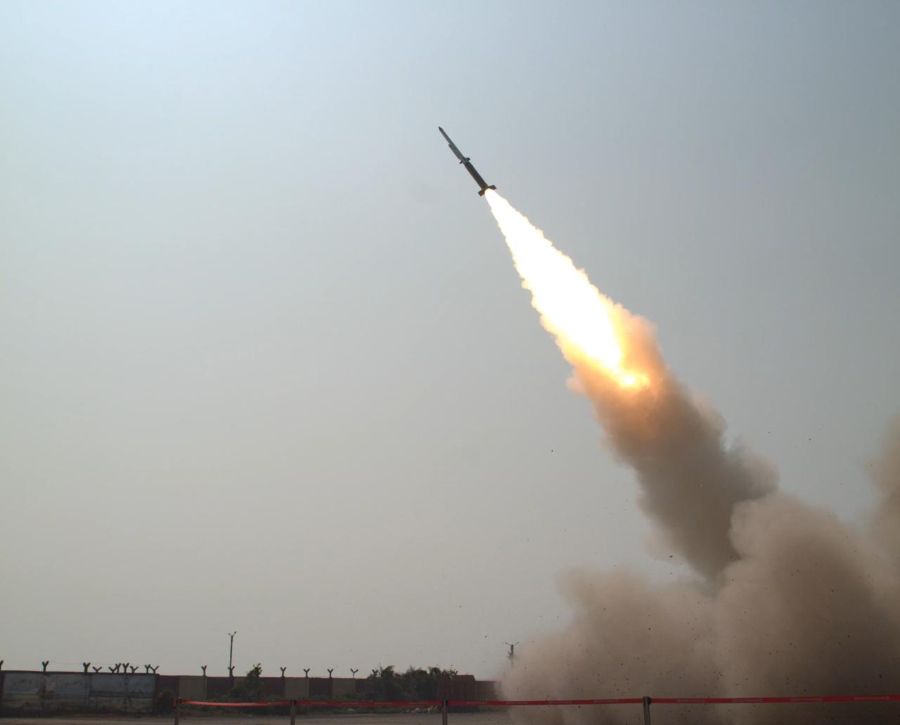
India on Monday successfully demonstrated Solid Fuel Ducted Ramjet (SFDR) technology, marking a key advance in indigenous missile development.
The test was conducted by the Defence Research and Development Organisation (DRDO) at the Integrated Test Range (ITR) in Chandipur, off the Odisha coast, at around 10.45 am on February 3.
With the successful flight trial, India joins a small group of countries that have mastered ramjet-powered missile technology. The capability is considered critical for the development of next-generation, long-range air-to-air missiles.
According to an official statement, the system was first accelerated to the required Mach number using a ground booster. The nozzle-less booster, Solid Fuel Ducted Ramjet motor and fuel flow controller then operated as designed during the flight.
DRDO said the system’s performance was validated using flight data collected by multiple tracking instruments deployed along the Bay of Bengal coastline. Senior scientists from several DRDO laboratories, including the Defence Research and Development Laboratory, High Energy Materials Research Laboratory, Research Centre Imarat and ITR, monitored the launch.
A ramjet is an air-breathing engine that compresses incoming air using the missile’s forward speed, eliminating the need for rotating compressor components. In an SFDR system, solid fuel is burned in a controlled manner as air flows through the engine, generating sustained thrust at high speeds.
Unlike conventional rocket motors, which burn out quickly, ramjet-powered missiles can maintain high velocity for longer periods, particularly in the terminal phase of flight. It allows the missile to remain fast and manoeuvrable, making it more difficult for targets to evade.
Solid Fuel Ducted Ramjet (SFDR) technology was successfully flight tested from the Integrated Test Range (ITR), Chandipur off the coast of Odisha today. SFDR is very crucial for development of long range Air to Air Missiles pic.twitter.com/66ZwE0micY
— DRDO (@DRDO_India) February 3, 2026
The successful demonstration has significant operational relevance. Ramjet-powered air-to-air missiles can engage targets at extended ranges while retaining high energy close to impact. It improves effectiveness in beyond-visual-range combat and enhances survivability for fighter aircraft.
Only a few countries possess this technology due to the complexity of sustaining stable combustion at supersonic speeds. For India, the achievement strengthens self-reliance in critical defence technologies and reduces dependence on external suppliers.
The SFDR technology is expected to be integrated into future missile programmes, boosting the combat capability of the Indian Air Force and supporting India’s long-term missile development plans.
Team BharatShakti