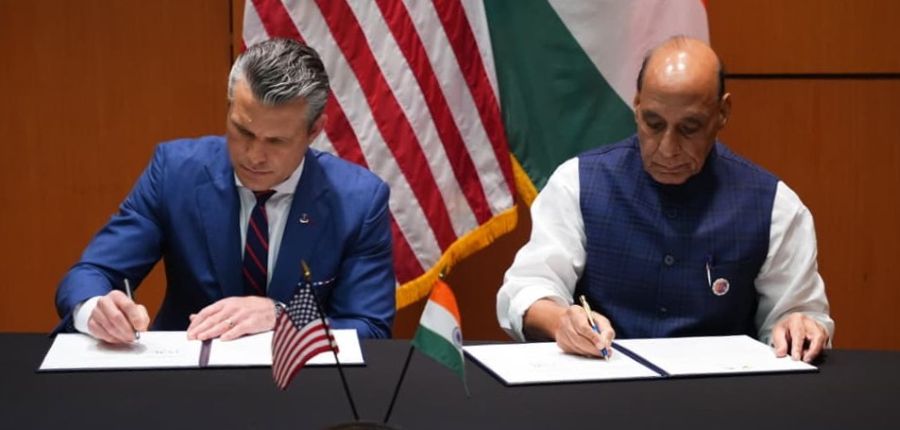
India and the United States signed a 10-year Defence Framework Agreement on Friday, setting a long-term roadmap for deeper military, technological, and strategic cooperation.
The agreement was finalised on the sidelines of the 12th ASEAN Defence Ministers’ Meeting Plus (ADMM-Plus) in Kuala Lumpur, during a bilateral meeting between India’s Defence Minister Rajnath Singh and his U.S. counterpart Pete Hegseth, the U.S. Secretary of War.
It was the first face-to-face meeting between the two since Operation Sindoor, and it comes at a time when bilateral ties have been under strain due to tariffs and energy trade disputes.
A Milestone in Defence Ties
Announcing the agreement on social media, Singh called the signing of the “Framework for the U.S.–India Major Defence Partnership” a “new era” in the two nations’ strategic relationship.
“This framework will provide policy direction to the entire spectrum of the India–U.S. defence relationship,” Singh said. “It is a signal of our growing strategic convergence and will herald a new decade of partnership.”
Hegseth, in a corresponding post, described the pact as “ambitious,” adding that it would advance the India–U.S. defence partnership, “a cornerstone for regional stability and deterrence.”
“We’re enhancing coordination, information sharing, and technology cooperation,” he said. “Our defence ties have never been stronger.”
The 10-year agreement replaces the earlier framework signed in 2015, expanding its scope to cover co-development, co-production, intelligence sharing, and joint training between the two militaries.
Cooperation Amid Friction
The deal comes at a delicate moment. Over the past few months, India–U.S. relations have been tested by Washington’s decision to impose higher tariffs on Indian exports in response to New Delhi’s continued purchases of Russian oil.
President Donald Trump’s decision to double import duties reignited trade tensions that had only recently eased, while U.S. statements urging India to reduce its energy ties with Moscow have met with quiet resistance in New Delhi.
Despite these frictions, both governments have made clear that strategic and defence cooperation remains non-negotiable, especially as instability in West Asia and the Indo-Pacific intensifies.
ASEAN Setting and Broader Regional Message
The signing took place on the margins of the ADMM-Plus summit, where defence ministers from ASEAN countries and dialogue partners, including India, the U.S., China, Russia, Japan, and Australia, gathered to discuss regional security.
India currently co-chairs the ADMM-Plus Expert Working Group on Counterterrorism with Malaysia for the 2024–2027 cycle, and the next ASEAN–India Maritime Exercise is planned for 2026.
Implications: What the 10-Year Pact Means
Strategic Predictability in the Indo-Pacific
The long-term framework gives both nations a stable foundation for defence cooperation, ensuring policy continuity across administrations. It enables structured military planning and greater interoperability, signalling to regional powers that the India–U.S. alignment is here to stay.
Push for Co-Development and Defence Manufacturing
The new agreement is expected to accelerate joint projects in advanced military technology, ranging from drones and jet engines to cybersecurity and AI-enabled warfare systems. It aligns with India’s ‘Atmanirbhar Bharat’ (self-reliant India) initiative, which fosters local production and reduces dependence on Russian imports.
Institutionalised Information and Intelligence Sharing
Building on existing agreements such as LEMOA, COMCASA, and BECA, the new framework strengthens mechanisms for secure communications, logistics access, and real-time data exchange, which are essential for joint maritime patrols, counterterrorism, and disaster relief operations.
Managing Disagreements Without Derailing Cooperation
By signing the framework amid tariff and energy disputes, both sides are signalling their intent to compartmentalise economic frictions and preserve strategic collaboration. Defence ties, in effect, become the ballast in a sometimes-turbulent bilateral relationship.
Expanding Multilateral Cooperation
The agreement paves the way for India and the U.S. to play a more proactive role in regional security initiatives, from Quad naval exercises to ASEAN-led capacity-building programs. It reinforces their shared commitment to a “free, open, and rules-based Indo-Pacific.”
Industry and Economic Upside
American defence majors are expected to expand cooperation with Indian public and private firms, while India gains leverage to negotiate technology access and domestic assembly rights.
What to Expect Next
In the months ahead, officials are expected to form joint working groups to operationalise the framework’s objectives. New announcements could include:
- Co-production of key military platforms in India.
- Tri-service exercises and integrated training modules.
- Expanded cooperation in space security, cyber defence, and AI warfare.
- Institutional mechanisms for supply chain resilience and defence logistics.
The agreement also lays the groundwork for broader coordination during humanitarian crises, regional instability, and counterterrorism operations, areas where both militaries have already collaborated.
Huma Siddiqui