


The Indian Armed Forces are expected to require more than 1,000 helicopters over the next 10 years, creating one of the world’s largest upcoming military rotorcraft markets and accelerating efforts to build domestic manufacturing capability.
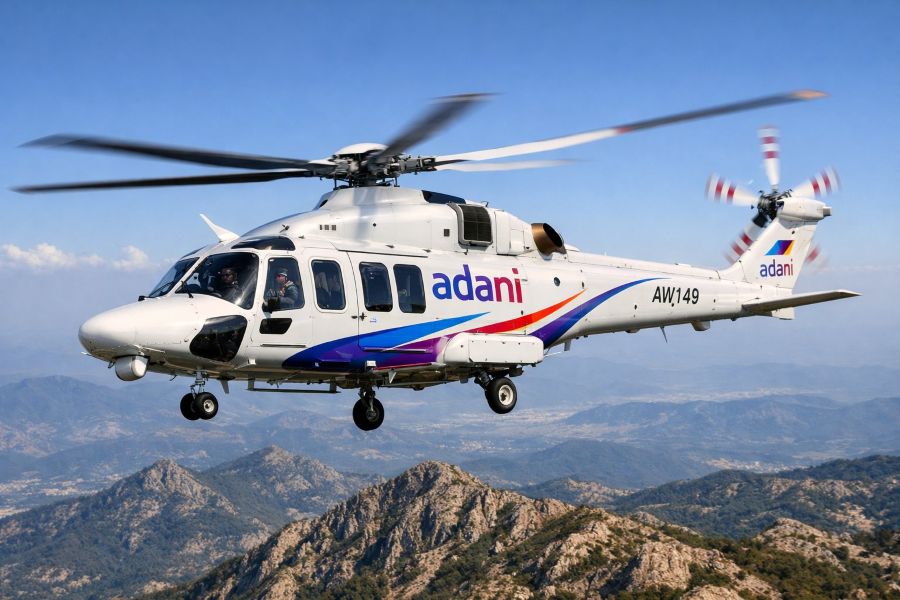
Against this backdrop, Adani Defence & Aerospace and Italian aerospace major Leonardo on Tuesday announced a strategic partnership to establish an integrated helicopter manufacturing ecosystem in India. The two companies signed a Memorandum of Understanding (MoU) at an event in the national capital.
The partnership will focus on meeting the operational requirements of the Indian Armed Forces, particularly through the local production of Leonardo’s AW169M and AW109 TrekkerM helicopters. The collaboration will include phased indigenisation, establishment of maintenance, repair and overhaul (MRO) facilities, and comprehensive pilot training capabilities, according to a company release.
India currently has a low helicopter penetration density, with fewer than 250 helicopters relative to its population, and is projected to need around 100 helicopters annually over the next decade. Much of the demand is expected to come from the replacement of ageing fleets and expanding operational requirements across the Army, Navy and Air Force.
Jeet Adani, Director, Adani Defence & Aerospace, said the alliance marks a critical step in building a long-term aviation ecosystem in the country.
“This alliance with Leonardo is a pivotal stride toward a resilient, future-ready helicopter ecosystem in India. Together, we will build an ecosystem on Indian soil that brings manufacturing, assembly, training, and world-class support into one cohesive whole,” he said.
He added that the partnership is rooted in a shared purpose of serving both defence and civil aviation needs while strengthening India’s industrial base.
Ashish Rajvanshi, CEO, Adani Defence & Aerospace, said the scale of the Armed Forces’ projected demand underscores the need for sovereign manufacturing capability. “With the Indian Armed Forces projecting demand for over 1,000 helicopters in the coming decade, this partnership realises our vision for sovereign manufacturing. It will accelerate indigenisation, strengthen supply chains, and establish India as a world-class production base,” he said.
Gian Piero Cutillo, Managing Director, Leonardo Helicopters, described India as a key growth market. “We are extremely pleased to join forces with Adani to contribute to India’s vision for a stronger rotorcraft industry and to enable access to modern technology and operational capability. India is a big market, and its armed forces have a growing requirement for helicopters,” he said.
Beyond defence applications, the manufacturing ecosystem is expected to have a significant economic impact, generating thousands of high-skilled jobs across engineering, manufacturing, logistics and sustainment services, while positioning India as a competitive global hub for helicopter production.
The Leonardo partnership comes just a week after Adani Defence & Aerospace signed a strategic collaboration with Brazilian aircraft manufacturer Embraer to develop a regional transport aircraft manufacturing ecosystem in India. Together, the twin agreements highlight Adani Defence’s broader strategy to build a full-spectrum aerospace and defence manufacturing base, spanning both fixed-wing aircraft and rotary-wing platforms.
What Adani–Leonardo Officials Said
On size of India’s helicopter market
Responding to media queries, Rajvanshi said that
India’s helicopter market currently accounts for less than 2 per cent of the global market, but is expected to expand sharply as military and civil penetration increases. According to him, the Indian Armed Forces alone are projected to require over 1,000 helicopters over the next 8–10 years, translating to a demand of around 100 helicopters annually, driven largely by the replacement of ageing Cheetah and Chetak fleets and new operational requirements across the Army and Navy.
On production timeline
Adani said work on building the ecosystem would begin immediately, even as regulatory and acquisition processes continue. While a definitive rollout schedule is still being finalised, he indicated that the first helicopters are expected to roll out before the end of the decade, with confidence that production would commence well before 2030.
On investment size and business model
Adani Defence said the partnership is being designed as a long-term industrial programme, not a one-off response to a single military order. Investment levels will be finalised once the business plan, location, scope of manufacturing and extent of technology transfer are frozen. The programme is expected to span 10–15 years, reflecting the scale and complexity of building a first-time helicopter manufacturing ecosystem in India.
On indigenisation and technology transfer
The collaboration will follow a phased indigenisation approach, aligned with India’s defence acquisition policies. Both partners said the extent of localisation and technology transfer would be calibrated to the operational requirements of the Armed Forces and evolving policy norms, with a clear commitment to complying with Buy (Indian) and Buy and Make categories.
On platform selection
According to Leonardo officials, initially, the ecosystem will focus on the AW169M—a key requirement for the Indian Navy—and the AW109 TrekkerM, which is among Leonardo’s most widely deployed light twin-engine helicopters globally. The portfolio may expand over time based on market demand, including potential civil applications.
On MRO and sustainment
Jeet Adani said MRO, servicing and lifecycle support will be a core pillar of the ecosystem, covering both military and civil rotary-wing platforms. The company plans to build domestic capability to support helicopters throughout their operational life, reducing dependence on overseas servicing.
On civil helicopter market
While defence requirements will anchor the initial phase, the both companies acknowledged that rising civil helicopter penetration, emergency medical services, offshore operations and regional connectivity, could significantly expand overall demand and manufacturing volumes in the future.
On global supply chain integration
Leonardo executives said India would not be viewed as an isolated market, with the potential for the Indian ecosystem to eventually support global supply chains, depending on capability development and cost competitiveness.
Huma Siddiqui