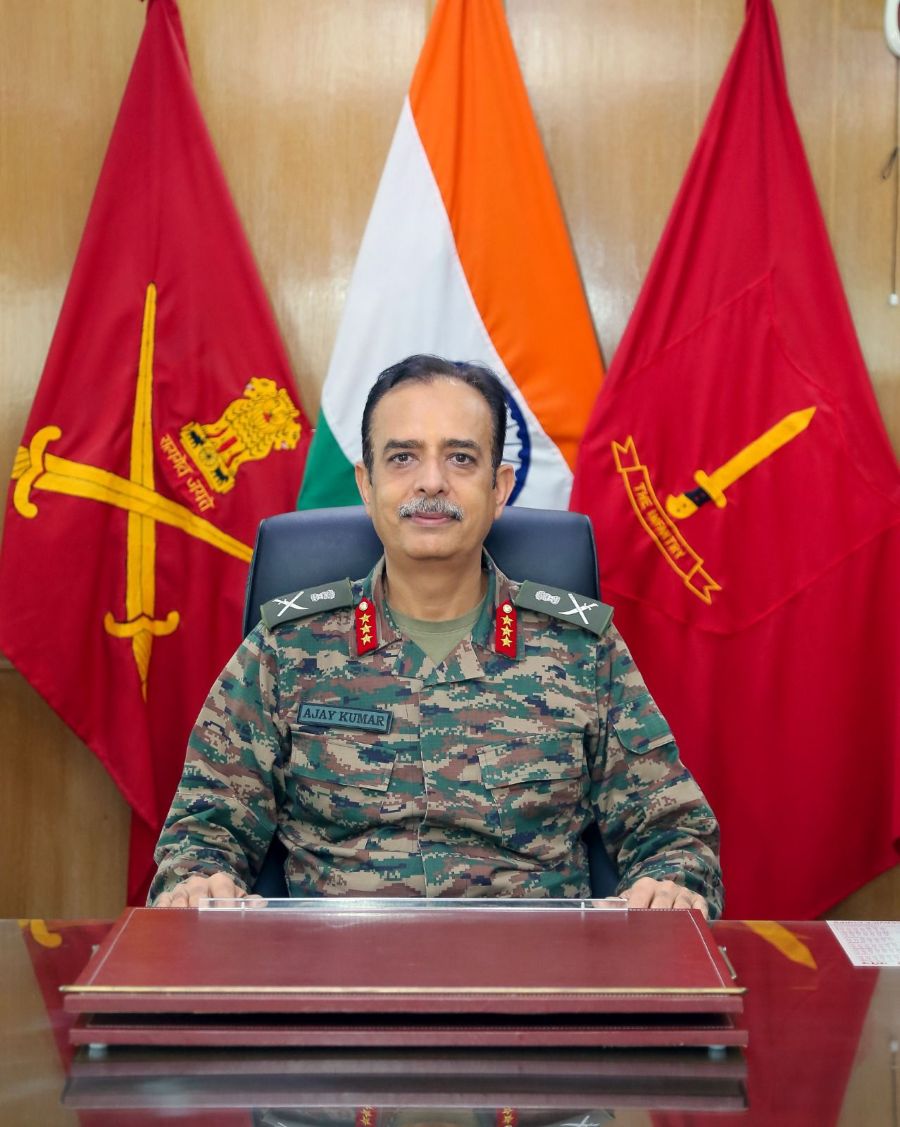
Building upon the lessons of Operation Sindoor, the Indian Army has completed a major phase in restructuring its Infantry, marking a decisive shift toward high-mobility, technology-enabled warfare. The progress report shared by Lieutenant General Ajay Kumar, Director General, Infantry, on Wednesday highlights the operational deployment of Bhairav commando battalions, the integration of Ashni drone platoons across Infantry units, and the ongoing induction of 4.25 lakh new carbines under an expansive modernisation drive.
“The Infantry is undergoing its most comprehensive transformation in decades from a manpower-heavy force to a capability-based, technology-enabled combat arm,” said Lt Gen Kumar during a media interaction ahead of Shaurya Diwas on October 27, celebrated as Infantry Day. “We are modernising around six pillars: lethality, mobility, communication, transparency, survivability, and training, and the results are already visible in the field.”
‘Bhairav’ Battalions: Light, Fast and Battle-Ready
According to the DG Infantry, the Army has raised and deployed five Bhairav battalions, which have already commenced field operations following intensive on-the-job training that began on October 1. These compact, multi-domain units – described as “lean, mean and lethal” – are designed for swift tactical strikes, high-mobility deployment and independent action in border and high-intensity contingencies.
“Five Bhairav battalions are already in their intended areas of operation and will be fully battle-ready by the end of this month,” Lt Gen Kumar said. “Training for four additional battalions is underway, and within six months we aim to operationalise another 25 units.”
Each Bhairav battalion comprises roughly 200–250 personnel, drawn from Infantry, Artillery, Signals and Army Air Defence. The units are taskable directly at the Corps Commander level, providing operational flexibility for rapid-response missions along the Line of Control, in counter-insurgency zones, or along high-altitude borders.
“The Bhairavs bridge the space between conventional Infantry battalions and Special Forces,” Lt Gen Kumar explained. “They are optimised for agility, precision and rapid deployment in joint operations.”
‘Ashni’ Drone Platoons: Expanding Digital Battlefield
The Infantry’s other transformative element, the Ashni drone platoons, has reached wide deployment. Nearly 385 Infantry battalions are now equipped with dedicated drone platoons, each operating a fleet of 10 systems – 4 for surveillance and 6 for loitering munitions, or ‘kamikaze’ drones capable of autonomous targeting and precision strikes.
“Our drone operators are no longer attached support elements – they are now part of the core Infantry structure,” Lt Gen Kumar said. “The Ashnis have greatly enhanced battlefield transparency and real-time decision-making, giving commanders eyes and reach far beyond the line of sight.”
These platoons operate a mix of surveillance, combat, and logistics drones, supported by emerging technologies such as anti-tank guided munitions, AI-enabled reconnaissance tools, and foliage-penetration radars. The DG revealed that one such radar–drone pairing, validated during recent operations, demonstrated “significant operational value” in detecting concealed threats and guiding precision engagements.
From Lessons of Operation Sindoor to a Future-Ready Force
Lt Gen Kumar said Operation Sindoor had been a turning point, shaping the Army’s understanding of joint, technology-driven warfare.
“Operation Sindoor underscored the need for synchronising tactical actions with strategic outcomes,” he noted. “It proved the decisive role of Intelligence, Surveillance and Reconnaissance (ISR) integration and demonstrated the kind of multi-domain synergy we must institutionalise across the Army, Air Force, Navy and other agencies.”
Following the operation, the Infantry has accelerated the induction of 7.62mm assault rifles, fourth- and fifth-generation anti-tank systems, and loitering munitions, while fielding Software-Defined Radios (SDR) for encrypted battlefield communication. Infantrymen are being equipped with NIJ Level IV ballistic gear, tactical shields and upgraded combat kits to improve survivability.
Reshaping the Modern Infantry
The DG said that by mid-2026, the Infantry’s frontline units would reflect a digitally networked, high-mobility structure, in which drones, precision weapons, and AI-assisted systems would define tactical decision-making. Training infrastructure is also being revamped with containerised ranges, simulators, and digitally-aided combat training systems.
“The modern Infantryman will be as much a sensor and communicator as a shooter,” Lt Gen Kumar said. “The Bhairavs and Ashnis are only the beginning – we are building an Infantry capable of dominating every domain of battle, from the physical to the digital.”
Ravi Shankar

Dr Ravi Shankar has over two decades of experience in communications, print journalism, electronic media, documentary film making and new media.
He makes regular appearances on national television news channels as a commentator and analyst on current and political affairs. Apart from being an acknowledged Journalist, he has been a passionate newsroom manager bringing a wide range of journalistic experience from past associations with India’s leading media conglomerates (Times of India group and India Today group) and had led global news-gathering operations at world’s biggest multimedia news agency- ANI-Reuters. He has covered Parliament extensively over the past several years. Widely traveled, he has covered several summits as part of media delegation accompanying the Indian President, Vice President, Prime Minister, External Affairs Minister and Finance Minister across Asia, Africa and Europe.